
Myths, Metals, and Meaning
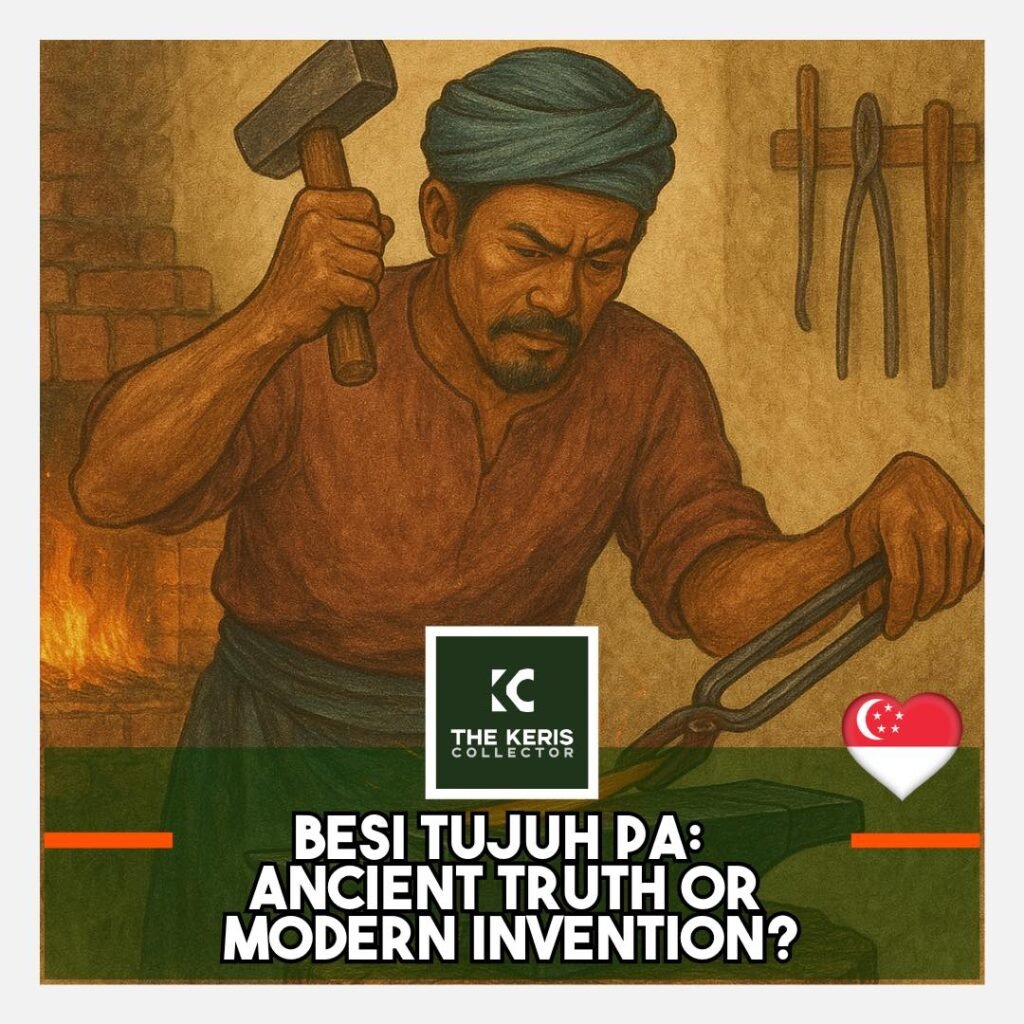
Across the Malay world, the keris is more than a weapon. It is an artifact of layered meaning, shaped by tradition, infused with symbolism, and wrapped in myth. Among the many beliefs surrounding its crafting, one peculiar claim has gained traction in recent years: Besi Tujuh Pa.
According to this narrative, a keris forged from seven tools; each beginning with the Jawi letter “Pa”; possesses exceptional spiritual strength and endows its owner with influence, protection, and power. At first glance, it appears like another mystical inheritance from the deep past. But closer scrutiny reveals something different; something far more human, and possibly far more useful.
This essay proposes a reframing of the Besi Tujuh Pa concept; not as an ancient esoteric formula, but as a modern-day moral philosophy, rooted in practical wisdom and communal values.
Unpacking the Concept: What Is Besi Tujuh Pa?
The literal interpretation of Besi Tujuh Pa involves forging a blade from seven iron implements, whose names begin with the Jawi letter “Pa” (ڤ). Commonly cited examples include:
• Parang (machete)
• Paku (nail)
• Pasak (peg)
• Pagar (fence)
• Pahat (chisel)
• Panah (bow)
• Payung (umbrella) or Pahar (tray)
Believers argue that this combination imbues the blade with mystical qualities, drawing upon the symbolic weight of the items and the spiritual resonance of the Jawi script.
Yet, the tradition lacks historical grounding. There is no mention of Besi Tujuh Pa in precolonial manuscripts, early keris manuals, or colonial records. It is absent from the writings of key observers of Malay culture such as R.J. Wilkinson (1901), R.O. Winstedt (1934), and G.C. Woolley (1928), all of whom documented keris rituals and metallurgy in detail.
This absence suggests one of two possibilities: either the tradition was so secret it escaped all documentation (unlikely), or it is a more recent invention inspired by fragments of real practice, dressed in the language of myth.
Reinterpreting the “Pa”: Practical Tools, Symbolic Lessons
Rather than dismissing the idea altogether, let us explore what these seven tools could represent when read symbolically. Each object, when removed from mysticism and placed in a real-world context, points to essential human skills and values:
• Parang: Clearing obstacles; the courage to shape one’s environment.
• Paku and Pasak: Building and securing; structural integrity in relationships and commitments.
• Pagar: Protection and boundary-setting; both literal and emotional.
• Pahat: Precision; the artisan’s discipline and craftsmanship.
• Panah: Focus and intent; long-range vision.
• Pahar or Payung: Service and shelter; responsibility to others.
Rather than arcane power, these tools reflect vocational mastery and community-building. They echo values prized in classical Malay society: berbudi (kindness), berbakti (service), berilmu (knowledge), and berani (courage).
Malay Metallurgy: The Real Story
Traditional Malay blacksmiths (pandai besi) often recycled metal; old tools, broken farm implements, and domestic scraps; into new blades. This wasn’t mystical; it was practical. As Gardner (1907) and Woolley (1928) observed, the process involved:
• Reforging available material, not mining raw ore
• Maximising utility from discarded objects
• Blending different metals for strength and flexibility
This practice aligns with Besi Tujuh Pa, but not in the way some might think. It was a form of early sustainable craftsmanship, long before environmentalism became fashionable. In this light, the seven tools are not ingredients of a magic recipe, but remnants of a community’s daily life, melted together to form a symbol of shared effort.
Cultural Myth as Social Philosophy
The Besi Tujuh Pa myth, whether invented or inherited, can be embraced not as a literal truth but as an allegory of self-development:
• Seven disciplines to master
• Seven lessons to internalise
• Seven communities to engage with
The belief that the items must be collected from different places, and preferably broken, furthers this interpretation. It suggests the seeker must:
• Travel and connect with others (expanding horizons)
• Recognise value in the discarded (wisdom in brokenness)
• Rebuild from fragments (transformation through craft)
This frames Besi Tujuh Pa as a rite of passage;a metaphor for the layered journey from apprentice to master, from outsider to leader.
Modern Implications: From Myth to Message
In a time of cultural amnesia, the Besi Tujuh Pa story offers a compelling framework for heritage education, vocational pride, and intergenerational values. It reminds us:
• That tools are symbols, not just instruments
• That mastery lies in effort, not inheritance
• That spiritual value can be found in the mundane
Just as the keris is forged in fire, folded over and over to gain strength; so too is character built from repeated trials, connections, and acts of service.
Conclusion: The True Edge of the Keris
Whether Besi Tujuh Pa is ancient, invented, or something in between, its real power lies not in its metal but in its message.
The belief should not be taken as a mystical blueprint, but as a philosophical metaphor for becoming whole, one forged through discipline, community, and humility.
So let us keep telling the story. But let us tell it truthfully, with reverence, yes, but also with clarity. The myths we inherit should not cloud our understanding, but sharpen it, like a good blade, folded with care, tempered with heat, and guided by purpose.
References:
• Wilkinson, R.J., 1901. A Malay-English Dictionary. Singapore: Kelly & Walsh.
• Gardner, D.J., 1907. The Kris: Mystic Weapon of the Malay World. Journal of the Straits Branch of the Royal Asiatic Society, (49), pp.1–25.
• Woolley, G.C., 1928. Malay Keris and Their Meanings. Sarawak Museum Journal, 3(5), pp.110–135.
• Winstedt, R.O., 1934. A History of Classical Malay Literature. Kuala Lumpur: Oxford University Press.
• Gallop, A., 1994. The Legacy of the Malay Letter. London: British Library.
• Ibrahim, H., 2015. The Keris: Its History and Development. Kuala Lumpur: Dewan Bahasa dan Pustaka.
• Rahim, R.A., 2020. Tradisi Pandai Besi dan Warisan Melayu. Shah Alam: Institut Warisan Alam Melayu.
• The Keris Collector, 2024. Merungkai Misteri Besi 7-Pa . YouTube, 16 September. Available at: https://youtu.be/ZKs3JrgBctQ?si=GtseClnzE0EV72LX [Accessed 22 July 2025].
TLDR
Besi Tujuh Pa, the idea of forging a keris from seven tools beginning with the Jawi letter “Pa”; is not historically substantiated, but its symbolic potential is rich. The tools represent essential skills and values. When read as metaphor, the belief becomes a meaningful philosophy of discipline, community, and transformation.