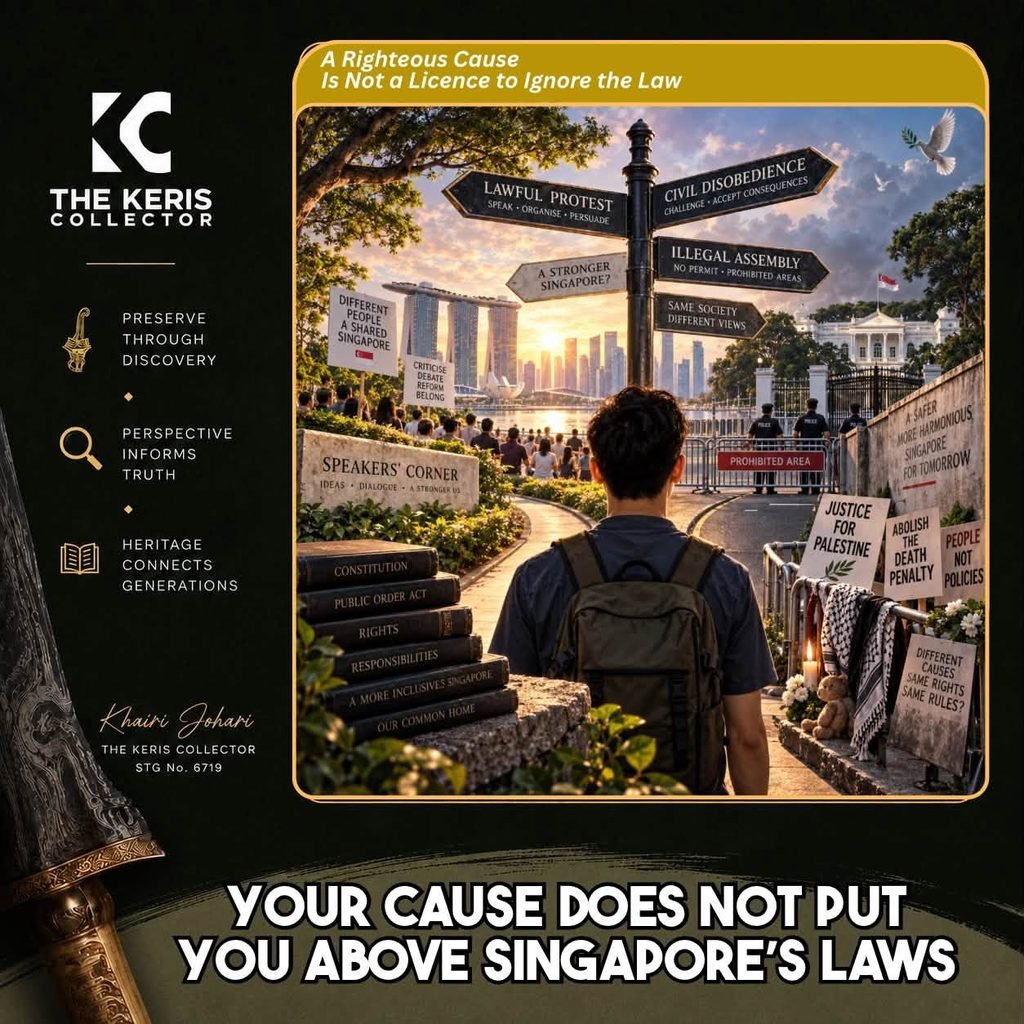
Singaporeans should be free to criticise the Government, support Palestine, oppose capital punishment and campaign for laws to change. But political conviction does not create a personal exemption from the laws that protect public order in a small, multiracial and multireligious country.
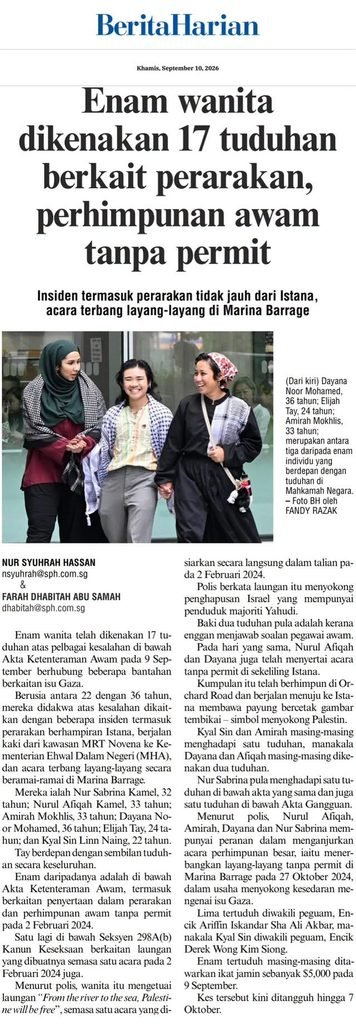
Six people were charged in Singapore on 9 September 2026 over several alleged incidents involving public assemblies, processions and related offences.
Almost immediately, parts of the argument online became something else.
Palestine. Israel. Zionism. Political repression.
The implication in some reactions is that because some of the causes involved are morally serious, particularly the suffering of Palestinians in Gaza, enforcement of Singapore’s public-order laws somehow reveals which side Singapore has chosen.
I do not accept that logic.
You can support Palestine and obey Singapore law.
You can criticise Israel and obey Singapore law.
You can oppose the death penalty and obey Singapore law.
You can disagree strongly with the Government and obey Singapore law.
And if you believe the law itself is wrong, you can campaign to change it.
The principle is straightforward:
The rightness of your cause and the lawfulness of your method are two different questions.
That distinction matters because Singapore’s system of public order is not an accidental inconvenience placed in the way of activists. It is a deliberate feature of how this country has chosen to manage political expression while preserving security, social stability and communal harmony.
We should be prepared to debate whether that balance is always drawn correctly.
But we should first understand what the balance actually is.
Six Accused Persons, Not One “Palestine Protest”
The six cases should not be lazily bundled together.
According to the Singapore Police Force, two women face charges concerning their alleged participation in the February 2024 “Letters for Palestine” procession around the perimeter of the Istana.
Another accused person faces charges arising from several different incidents, including alleged participation in candlelight vigils near Changi Prison, an anti-death-penalty protest outside the State Courts, a procession to the Ministry of Home Affairs, a staged memorial at NUS concerning ties between Singapore educational institutions and Israel, and other alleged offences.
Four women face charges over their alleged roles in organising a mass kite-flying event at Marina Barrage in October 2024 to publicise a cause relating to the Gaza conflict.
There are also allegations under legislation other than the Public Order Act.
These are allegations. The six accused persons are entitled to defend themselves, and nothing here should be read as determining their guilt.
But the charges themselves reveal something important.
People are not being charged with the offence of “supporting Palestine”.
There is no such offence.
The legal questions concern alleged conduct: organising or participating in public assemblies or processions without the required permit, doing so in prohibited areas in some instances, and other separately alleged offences.
That is an important difference.
Why Does Singapore Regulate Public Assemblies?
Singapore is not a large, homogeneous country with an unlimited tolerance for political experiments that go wrong.
We are a small, densely populated, multiracial and multireligious city-state.
Our history matters.
The Maria Hertogh riots demonstrated how a legal dispute could become entangled with religion and race and descend into deadly communal violence.
The political and labour unrest of the 1950s included the Hock Lee bus riots.
Then came the racial riots of 1964.
None of this means every demonstration becomes a riot.
Of course not.
Nor should history become a convenient excuse for Government never to reconsider restrictions.
But Singapore’s caution did not emerge because somebody in Government simply dislikes demonstrations.
The underlying proposition is that organised public mobilisation can have consequences extending beyond the intentions of its organisers, particularly when political causes intersect with race, religion or conflicts elsewhere.
The Ministry of Home Affairs describes the Public Order Act as part of a framework balancing speech, assembly and political expression against public order and stability in a multiracial, multireligious and densely populated society.
That philosophy is recognisably Singaporean.
And I broadly support it.
We have spent decades building something extraordinarily difficult: a society in which people of different races and religions live beside one another with a very high degree of everyday peace and security.
We should not treat that achievement as though it maintains itself.
A Permit Is Not Political Approval
Under Singapore’s Public Order Act, a Police permit is required for public assemblies or processions whose purposes include demonstrating support for or opposition to a person, group or government, publicising a cause or campaign, or marking or commemorating an event, subject to statutory exemptions and conditions.
That means the law regulates the manner of political expression, not simply whether the Government likes the opinion being expressed.
This distinction is essential.
A person who opposes capital punishment is entitled to hold that opinion.
A person who supports Palestine is entitled to hold that opinion.
A person who thinks Singapore’s foreign policy towards Israel is wrong is entitled to say so.
The existence of those opinions is not what automatically triggers the Public Order Act.
How political mobilisation is organised in public space is a different matter.
And the permit regime is not, as sometimes implied, a system under which virtually every public gathering is automatically rejected.
In a parliamentary answer covering the period from the introduction of the Public Order Act in 2009 to 2020, MHA reported 11,269 applications for public assemblies outside Speakers’ Corner, of which 8,545 had been approved.
Those figures do not tell us how politically controversial applications fare specifically, and many approved events were plainly not contentious political demonstrations.
But they establish something important:
Public assemblies outside Speakers’ Corner are not prohibited per se.
Singapore regulates public assembly.
That is different from abolishing it.
But There Are Causes Singapore Deliberately Restricts
This is where I would revise my original instinct that people should simply “get the permit”.
For some activities, that answer is too simplistic.
Police have stated that permits will not be granted for assemblies advocating political causes of other countries or foreign entities, or where the activity may stir emotions and lead to public-order incidents.
That policy can be criticised.
Indeed, there is a legitimate question here.
If someone wants to organise a public demonstration concerning Gaza, but the authorities have already made clear that such overseas political causes face particular restrictions, how meaningful is it to tell that person simply to apply?
That is where critics of Singapore’s framework have a serious argument.
Perhaps Singapore draws the line too tightly.
Perhaps the law should provide greater latitude.
Perhaps Singaporeans should be allowed greater space to demonstrate publicly about overseas conflicts.
Those arguments deserve consideration.
But notice what follows.
If you believe the restriction is wrong, the argument is that Singapore should change the restriction.
It is not that the restriction magically ceases to exist because you disagree with it.
That is the difference between political disagreement and personal exemption.
What About Speakers’ Corner?
Singapore does provide a designated space for political expression.
Speakers’ Corner at Hong Lim Park was established specifically as a place where Singaporeans can express their views. Singapore citizens and entities can organise qualifying assemblies there without obtaining a Police permit, provided the conditions of the exemption are satisfied.
Again, the system is regulated.
There are restrictions on participation, as well as restrictions concerning religion and activities that could generate hostility between racial or religious groups.
One can argue that these conditions are too restrictive.
But the existence of Speakers’ Corner matters because it demonstrates the underlying philosophy of the Singapore system.
Political expression is permitted. Public mobilisation is regulated.
That is not the libertarian model adopted by some societies.
Singapore has never pretended otherwise.
And Singaporeans are entitled to decide that our country’s particular vulnerabilities justify a different balance.
The Istana Is Not an Ordinary Pavement
The February 2024 “Letters for Palestine” procession illustrates why location matters.
The Istana is a security-sensitive prohibited area.
An earlier prosecution of three organisers of that procession is particularly instructive because the District Judge initially acquitted them.
Among the matters considered below were that members of the public ordinarily used the pavement, there was no signage informing pedestrians that the route formed part of a prohibited area, and similar letter-delivery walks had previously occurred.
The prosecution appealed.
The High Court overturned the acquittals.
The court held that the route’s ordinary use by pedestrians did not prevent it from legally forming part of a prohibited area. The organisers were ultimately convicted.
That history is important because it shows the issue was sufficiently substantive to be litigated.
But it also establishes the present legal position.
Publicly accessible does not mean legally unrestricted.
And a security-sensitive location does not lose that status because the cause motivating a procession is peaceful or sympathetic.
Again, the current accused persons must be judged on their own pending cases. Previous convictions of other people do not determine their guilt.
But the underlying principle should not be controversial.
Singapore has every right to maintain heightened security restrictions around locations such as the Istana.
I would expect those restrictions to apply whether the demonstrators carried Palestinian symbols, Israeli flags, anti-government placards or banners supporting a cause I personally agreed with.
The law cannot depend on whether I like the protest.
The Principle Must Survive Reversal
This is the test I keep returning to.
Imagine that tomorrow a group marched around the Istana carrying Israeli flags without the required authorisation.
Would people currently defending unauthorised Palestine-related activism insist just as passionately that those demonstrators’ moral convictions entitled them to disregard Singapore law?
What if racial nationalists decided that immigration posed an existential threat to Singapore and marched wherever they pleased?
What if religious extremists believed their cause came from an authority higher than the Singapore state?
What if a foreign political movement attempted to mobilise its supporters here?
Would sincerity create immunity?
It cannot.
A rule-of-law argument means very little if the rule changes according to whose placard we happen to agree with.
This is precisely why Singapore is entitled to regulate public mobilisation consistently.
The alternative is not necessarily immediate chaos.
But the alternative principle is dangerous: each political faction gradually claims the right to decide for itself when its cause is important enough that ordinary rules no longer apply.
That is not a sustainable basis for governing a diverse society.
Civil Disobedience Is Different
There is, however, a more serious argument available to an activist.
Civil disobedience.
Sometimes people knowingly violate laws because they believe the laws themselves are unjust.
History makes it impossible to maintain that breaking a law automatically makes the political cause immoral.
Law and morality are not identical.
So if someone says:
I understand what Singapore law requires. I believe the restriction itself is unjust. I am deliberately defying it as an act of conscience.
That is an intellectually coherent position.
I may disagree with it.
The Government may prosecute it.
The courts may convict.
But the argument itself deserves to be taken seriously.
There is also nothing inconsistent about accepting that prosecution may follow while continuing to argue that the law or punishment is unjust.
What civil disobedience does not do is erase the legal consequence of deliberate disobedience.
That distinction gives us three very different propositions.
Lawful political expression says:
I will argue for change within the existing rules.
Civil disobedience says:
I believe this rule is unjust, and I am deliberately challenging it despite the possible consequences.
Moral exemption says:
My cause is righteous, therefore the rule should not apply to me.
The first is an ordinary feature of democratic politics.
The second has a long and serious political tradition.
The third is where I part company.
Singapore Is Not Simply “Zionist”
The suggestion that enforcement against Palestine-related assemblies proves Singapore is “Zionist” is particularly weak once Singapore’s actual foreign policy is examined.
Singapore maintains diplomatic relations with Israel.
Singapore also supports Palestinian statehood.
In February 2026, Foreign Minister Vivian Balakrishnan reiterated Singapore’s condemnation of Hamas’s 7 October 2023 attacks and Israel’s right of self-defence, subject to international law.
But he also stated explicitly that Israel’s military response had breached international humanitarian law.
Singapore maintains that Israeli settlements in the West Bank are illegal under international law and continues to support a negotiated two-state solution.
By February 2026, Singapore had sent 11 tranches of humanitarian assistance worth more than S$25 million to help civilians in Gaza.
That is not the foreign policy of a country treating the conflict like football and blindly cheering for one team.
It is the foreign policy of a small state attempting to maintain relationships, defend international law, protect its national interests and contribute where it can.
You are entitled to think Singapore should do more for Palestine.
You can demand stronger criticism of Israel.
You can oppose Singapore’s relationship with Israel altogether.
But those are arguments about foreign policy.
Enforcement of domestic public-order legislation is not, by itself, evidence that Singapore has chosen Israel over Palestine.
We should be sophisticated enough to distinguish the two.
Opposition to the Death Penalty Is Legitimate Too
The same principle applies to the anti-death-penalty activities involved in some of the allegations.
I support Singapore retaining capital punishment for the gravest offences.
Others strongly disagree.
They are entitled to.
The evidence surrounding the marginal deterrent effect of capital punishment compared with other severe punishments is more complicated than either side sometimes admits. Singapore’s Government has produced evidence supporting its deterrence position, while broader criminological literature continues to debate how confidently such effects can be measured.
But I do not need to prove the death-penalty debate here.
That is precisely the point.
Someone may campaign for abolition.
Write against capital punishment.
Challenge Government evidence.
Petition Parliament.
Persuade voters.
I can disagree with every conclusion while defending the legitimacy of the argument.
But the law governing where and how a public assembly may take place remains a different question.
Freedom to hold an opinion is not the same thing as freedom to conduct any political activity anywhere one chooses.
Being Pro-Singapore Does Not Mean the Government Is Always Right
There is one trap I do not want this argument to fall into.
Supporting Singapore’s public-order framework does not require believing that every Government decision is correct.
That would be intellectually lazy and, frankly, not particularly patriotic.
Government is an institution entrusted with governing Singapore.
It should be scrutinised.
Parliament should be challenged.
Laws should be questioned.
Policies should change when better evidence or changing circumstances justify change.
Singapore’s public-order framework should therefore continue to face a legitimate question:
Have we drawn the balance between public order and political expression correctly for Singapore in 2026?
That question should never become taboo.
But there is a difference between arguing that Singapore should change a law and deciding individually that the law no longer deserves obedience.
The first is democratic argument.
The second, when deliberately chosen, is civil disobedience and should be recognised as such.
Neither requires pretending the law does not exist.
Singapore’s Stability Is Worth Defending
Perhaps we have become so accustomed to Singapore’s stability that we sometimes treat it as the natural condition of society.
It is not.
Social trust is constructed.
Communal peace is maintained.
Institutions matter.
Rules matter.
Restraint matters.
Singapore is not perfect, and its laws should never be placed beyond criticism.
But neither should we become embarrassed about defending a system that has produced an exceptionally safe and stable multiracial society.
The Ministry of Home Affairs states openly that maintaining public order and stability is important to Singapore’s economic survival and international standing, and that the legal framework seeks to balance individual expression against the needs of a densely populated, multiracial and multireligious state.
I think that balance is worth defending.
Not blindly.
Not permanently in every detail.
But deliberately.
Because the principle becomes meaningful precisely when the cause before us is one we sympathise with.
I can look at the suffering of Palestinian civilians and feel compassion.
I can believe Singapore should provide humanitarian assistance.
I can accept criticism of Israel.
I can defend another Singaporean’s right to demand that our foreign policy change.
I can defend someone’s right to argue that capital punishment should be abolished even though I support retaining it.
And I can still say:
Singapore’s laws apply.
If those laws are wrong, challenge them.
If the restrictions are excessive, campaign to change them.
If conscience genuinely demands civil disobedience, have the courage to call it civil disobedience and make the moral case for it.
But a cause does not acquire legal immunity simply because the people advancing it are convinced that history is on their side.
Every political faction believes its urgent cause is different.
Every activist believes this time matters more.
Every ideologue believes his exception is justified.
A multiracial, multireligious republic cannot govern itself on that basis.
Singapore should continue to make room for disagreement.
It should continue to allow its laws to be criticised.
And where restrictions no longer serve Singapore well, we should have the confidence to reconsider them.
But we should be equally confident about something else.
Public order is not the enemy of political expression. It is part of the framework that allows people with profoundly different convictions to share the same country peacefully.
The rule of law is easiest to defend when it restrains people whose causes we dislike.
Its real test comes when it restrains a cause we believe is right.
That is when principle matters.
And that is precisely when Singapore should have the confidence to defend it.
Sources and References
This essay reflects publicly available information as of 10 September 2026. The six persons charged on 9 September are treated throughout as accused persons. Nothing here determines guilt, attributes unproven motives or predicts the outcome of pending proceedings.
The account of the allegations relies principally on the Singapore Police Force’s statement concerning the six persons charged and the related proceedings.
The discussion of Singapore’s public-order framework draws on the Public Order Act and Ministry of Home Affairs material explaining the regulation of public assemblies and processions, including the permit system and Speakers’ Corner framework.
Historical permit figures come from MHA’s parliamentary reply reporting 11,269 applications for public assemblies outside Speakers’ Corner from the introduction of the Public Order Act in 2009 to 2020, of which 8,545 were approved. These aggregate figures should not be interpreted as the approval rate for controversial political demonstrations specifically.
The discussion of the February 2024 “Letters for Palestine” procession relies principally on the High Court’s grounds of decision in Public Prosecutor v Annamalai Kokila Parvathi and other appeals [2026] SGHC 121. The High Court overturned the District Judge’s acquittals and convicted the three organisers.
The historical discussion draws on Singapore institutional and historical records concerning the Maria Hertogh riots, political and labour unrest during the 1950s, the Hock Lee bus riots and the 1964 racial riots. These events are used to explain the historical development of Singapore’s cautious approach towards public mobilisation, not to suggest that contemporary peaceful demonstrations inevitably lead to disorder.
Singapore’s position on Israel and Palestine was checked against Ministry of Foreign Affairs statements, including the February 2026 Committee of Supply debate. Singapore has condemned Hamas’s 7 October 2023 attacks, recognised Israel’s right of self-defence subject to international law, stated that Israel’s military response breached international humanitarian law, opposed Israeli settlements in the West Bank, supported a negotiated two-state solution and provided substantial humanitarian assistance for civilians in Gaza.
The capital-punishment discussion draws on Singapore Ministry of Home Affairs material concerning deterrence and public attitudes, together with independent criminological literature recognising the methodological difficulty of conclusively establishing the marginal deterrent effect of capital punishment over alternative severe punishments.