
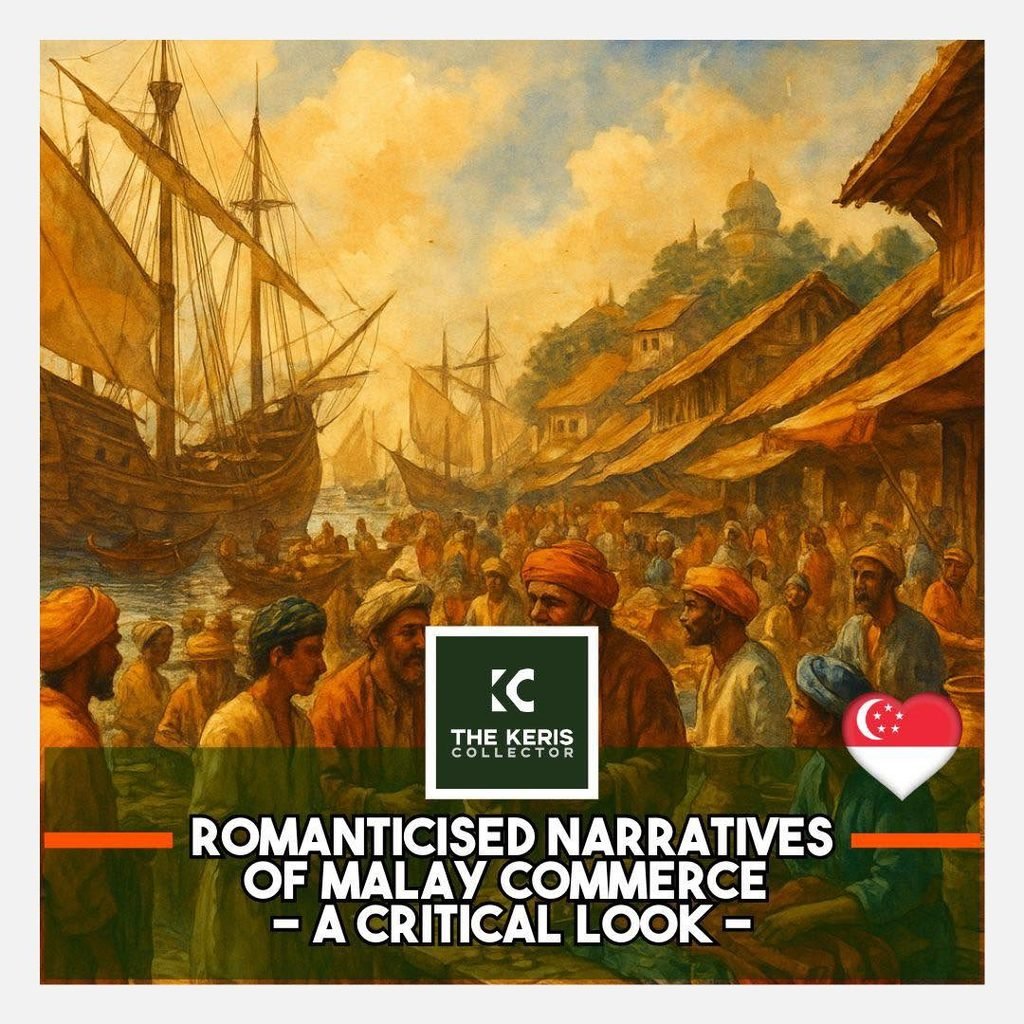
Revisiting a Romanticised Narrative of Malay Commerce
Author’s Note | September 2026
I first published this essay on my Facebook page on 4 July 2025.
At the time, I was responding to a social media post declaring:
“Melayu Itu Bangsa Perdagangan – Bukan Hanya Petani atau Nelayan.”
My concern was not with acknowledging Malay participation in trade. That is well established. What bothered me was the transformation of a complicated maritime history into something resembling a motivational slogan: that the Malays were once a great “trading race”, that this greatness had somehow been forgotten or suppressed, and that recovering this historical identity could somehow restore something supposedly lost in the present.
More than a year later, I returned to my own essay.
I still agree with its central concern.
But reading it again, I also found myself questioning some of my own arguments.
There is a certain irony here. In trying to challenge an oversimplification, I had occasionally created another.
Some of my statements about indigenous Southeast Asian participation in maritime commerce were too sweeping. My discussion of the jong was inadequate. I made assumptions about the occupations of ordinary Malays without providing sufficient evidence. Most importantly, I treated the word “Malay” more straightforwardly than I would today, despite the considerable historical complexity surrounding Melayu as a geographical, political, cultural and ethnic category.
I could simply edit the old essay and quietly replace it.
I would rather not.
So I have preserved the original essay below, substantially as it appeared on 4 July 2025, followed by my revised assessment in September 2026.
I think there is value in allowing our older arguments to remain visible.
Historical inquiry should not be about defending something simply because we once wrote it. If further reading, better evidence or better questions require us to modify an argument, then we should modify it.
Sometimes the conclusion changes.
Sometimes the conclusion survives, but for better reasons.
This is one of those occasions.
Part I | The Original Essay
Originally published on Facebook, 4 July 2025
Was the Malay World Truly a Trading Powerhouse?
A Critical Look at Romanticised Narratives of Malay Commerce
We’ve all seen posts like this making the rounds on social media: catchy headlines, numbered facts, emotional nostalgia, a rallying cry to “LIKE & SHARE.”
One such post recently declared that:
“Melayu Itu Bangsa Perdagangan — Bukan Hanya Petani atau Nelayan.”
It argues that Malays have historically been master traders, and that this legacy has been forgotten or silenced.
While the intent to celebrate heritage is understandable, even admirable, it’s worth taking a pause and asking: how accurate is this picture?
Does the post reflect history, or a stylised revision of it?
Let’s examine it more carefully.
The Main Claim
That Malays were not just farmers or fishermen, but international traders who dominated global commerce in the premodern era, and that this trading spirit has since been erased from memory.
This is a romantic narrative. But beneath its glossy appeal are several fallacies and oversimplifications.
1. False Dichotomy / Either-Or Fallacy
“Kita sering digambarkan hanya sebagai penoreh, nelayan dan petani… Tapi fakta sejarah membuktikan — bangsa Melayu dulu menguasai perdagangan antarabangsa.”
This implies that Malays were either humble labourers or powerful traders. But real history doesn’t work like that.
A society can, and often does, contain multiple roles at once. Most Malays were indeed farmers and fishermen. That doesn’t negate the fact that a small elite engaged in trade.
The problem is the binary framing: it tries to elevate one narrative by erasing another.
2. Hasty Generalisation
The post lists seven “proofs” to argue that Malays were predominantly a trading race. But those examples are selective, cherry-picked, and mostly refer to elites rather than the rakyat.
For instance:
Trade links with India, China and the Middle East existed, but were mostly facilitated by Arab, Indian and Chinese traders using Malay ports as stopovers, not necessarily led by Malays themselves.
Melaka’s structured port and taxation system? It’s true. But it was largely managed under cosmopolitan rule, with heavy reliance on Gujaratis, Tamils and Chinese merchant networks. Malays were players, but not always the dominant ones.
Malay ships, such as the jong, did exist, but we lack strong archaeological evidence that they rivalled Chinese treasure fleets or Arab dhows in terms of reach or frequency.
This all amounts to cherry-picking outliers and presenting them as the norm.
3. Appeal to Emotion / Romantic Nationalism
“Bangsa kita bangsa niaga, bukan bangsa suruhan.”
This is emotionally charged.
It suggests that reclaiming a mythical mercantile past is somehow key to present-day dignity or economic revival. It’s loaded language that oversimplifies very complex socio-economic challenges faced by Malays today, which are structural, educational and policy-related, not rooted in forgetting history.
4. Post Hoc Fallacy
The post subtly implies: because we were traders before, we should naturally reclaim our place as dominant traders again.
That’s not how economic development works.
History isn’t destiny.
Just because your ancestors did something centuries ago doesn’t mean it applies today. The global trade landscape has shifted dramatically. Institutions, skills, digital tools and networks determine success now, not nostalgic memory.
5. Strawman Fallacy
The post sets up an imaginary enemy: that society today denies Malay trading history or sees Malays as only manual labourers.
But who actually says this?
It’s an exaggeration, meant to provoke a rallying response rather than a rational discussion.
A More Balanced View
Yes, Malays were involved in trade, especially as facilitators within Southeast Asian port networks. Melaka, Aceh, Pattani and Brunei were important entrepôts.
That’s a legitimate point.
But that role was part of a broader multi-ethnic trading ecosystem that included Javanese, Bugis, Chinese, Arabs, Tamils and others. Trade flourished not because of one race’s dominance, but because of interconnected collaboration, often under rulers who were strategic and cosmopolitan.
The average Malay back then was more likely to be tilling land or harvesting fish than sailing to Zanzibar or Baghdad.
And there’s nothing shameful about that.
Subsistence work was, and still is, the backbone of any civilisation.
Conclusion: Heritage with Honesty
It’s important to be proud of one’s heritage.
But pride without clarity, context or critical thought can easily become mythmaking.
The real question is not “Were Malays traders?” but “How do we understand the many roles that Malays played, realistically, not romantically?”
If we want to inspire economic revival among Malays today, the answer lies not in glorifying a selective past, but in empowering the present: better education, digital entrepreneurship, financial literacy and strategic policy.
Celebrate your roots, but let those roots nourish growth, not nostalgia.
JoFe
Part II | Revisiting the Argument
September 2026
More than a year later, I would frame the argument differently.
My original essay was right, I think, to question the transformation of complex maritime history into racial mythology.
But I was too dismissive of something important.
Indigenous Southeast Asians were not merely standing on the docks while Arabs, Indians and Chinese conducted international commerce around them.
Research into Southeast Asian maritime history and shipbuilding gives indigenous societies considerably more agency than my original wording allowed. Maritime powers in Southeast Asia built, owned and operated substantial ocean-going vessels centuries before Europeans entered the region in force.
So the correction has to work both ways.
We should not replace romantic nationalism with an equally distorted picture of Southeast Asians as passive participants in somebody else’s trading world.
The evidence deserves better than either extreme.
So, let me ask the question again.
Was the Malay World Truly a Trading Powerhouse?
The short answer?
Yes, the Malay world was deeply embedded in major maritime trading networks.
But that is not quite the same thing as saying:
“The Malays were a great trading race.”
That distinction is where things become interesting.
The Maritime World Was Real
Maritime Southeast Asia was not simply a passive stretch of coastline waiting for foreign merchants to arrive.
Its peoples possessed sophisticated maritime traditions of their own.
Research by maritime historian Pierre-Yves Manguin has been particularly important here. His work demonstrates that Southeast Asian maritime powers built, owned and operated sizeable ocean-going vessels from the early centuries of the first millennium CE.
This matters because older treatments could leave the impression that large-scale maritime commerce in Southeast Asian waters was essentially conducted aboard foreign ships.
The evidence presents a more complicated picture.
Indigenous Southeast Asians built ships.
They sailed them.
They traded.
They fought at sea.
And they participated actively in regional and long-distance maritime networks.
The Strait of Melaka occupied an extraordinarily important position within those networks, linking commercial worlds extending towards the Indian Ocean in one direction and the South China Sea and East Asia in the other.
By the fifteenth century, Melaka had become one of the great commercial centres within this system.
This was not simply an accident of geography.
Its rulers understood the value of commerce.
Melaka developed administrative mechanisms for dealing with merchants and regulating a remarkably cosmopolitan port. Tomé Pires, writing in the early sixteenth century, left one of our most important contemporary descriptions of Melaka and its commercial world.
Modern scholarship continues to demonstrate the extent to which fifteenth-century Melaka sat at the centre of overlapping maritime networks.
So yes, describing the Malay world as commercially significant is entirely reasonable.
Describing indigenous Southeast Asians as passive spectators would be wrong.
But another problem remains.
Who exactly are we describing when we say “the Malays”?
What Does “Malay” Mean?
This is the question I should have spent considerably more time on in my original essay.
We need to be careful about taking modern racial or ethnic categories and projecting them backwards through history.
Melayu has not carried one simple, fixed meaning across a thousand years.
Leonard Andaya’s work on the origins of Melayu, for example, stresses that Melayu ethnicity was not something predetermined and unchanging. Its meaning was historically contested, including among communities on both sides of the Strait of Melaka.
Other scholarship on Malayness reaches much the same warning from different directions: “Malay” may be readily understood today, but historically it can be remarkably difficult to define without encountering contradictions, changing boundaries and different local meanings.
That doesn’t mean Malay identity is imaginary.
It means identities have histories too.
They develop.
They expand.
They contract.
Their meanings change.
That becomes important when modern historical narratives begin gathering achievements from across maritime Southeast Asia and assigning them retrospectively to one timeless racial category.
Srivijaya becomes evidence of Malay greatness.
Melaka becomes evidence of Malay greatness.
Austronesian maritime technology becomes Malay technology.
The jong becomes simply a Malay ship.
Commercial networks spanning numerous islands, ports, polities and communities become evidence that “the Malays controlled international trade.”
One claim reinforces the next until an enormous and diverse maritime world has been compressed into a modern ethnic biography.
That should make us cautious.
Melaka Was Great Precisely Because It Was Connected
Melaka provides perhaps the best example.
There is no need to diminish its importance.
Fifteenth-century Melaka was an extraordinary commercial centre.
Modern scholarship describes it as a strategic port-of-trade positioned within networks connecting the Indian Ocean, the China Seas, the Java Sea and other parts of maritime Asia.
But its success cannot be understood by imagining one ethnic community conducting trade while everybody else merely participated around them.
Melaka’s commercial world involved merchants and maritime communities from different parts of Asia and Southeast Asia. Commodities, people, languages and ideas moved through overlapping networks.
That cosmopolitanism was not a footnote to Melaka’s greatness.
It was part of its greatness.
Melaka succeeded because it connected worlds.
To recognise that does not diminish Malay history.
Quite the opposite.
A polity capable of attracting international commerce and positioning itself as an important intermediary within vast Asian networks demonstrates considerable political and economic sophistication.
Why would we need to transform that achievement into racial domination before we can be proud of it?
And What About the Jong?
This is another point where I need to correct my original essay directly.
In 2025, I wrote:
“Malay ships (like the jong) did exist, but we lack strong archaeological evidence that they rivalled Chinese treasure fleets or Arab dhows in terms of reach or frequency.”
I would not make that argument today.
For one thing, it asks the wrong question.
Whether a Southeast Asian jong could “rival” Zheng He’s famous treasure fleet tells us very little about whether indigenous Southeast Asians possessed sophisticated maritime technology.
They clearly did.
Manguin’s research describes large indigenous vessels associated with the commercial and military networks of insular Southeast Asia. His earlier work concluded that Southeast Asian maritime powers were building, owning and operating substantial ocean-going vessels long before European expansion into the region.
His later study of the “vanishing jong” examined these vessels specifically in the context of Southeast Asian trade and warfare between the fifteenth and seventeenth centuries.
There is still plenty we do not know.
Terminology can be difficult. Historical descriptions of ship size require caution. Reconstructions remain open to debate. We should also resist casually assigning every regional vessel tradition to one modern ethnic identity.
But my old comparison was unnecessary.
A vessel does not need to be the largest ship in the world to demonstrate sophisticated maritime technology.
That was an error in my earlier reasoning.
Were Malays Traders?
Yes.
But I now think this is almost the wrong question.
There were Malay merchants.
There were rulers whose power and prosperity depended heavily upon maritime commerce.
There were shipowners, sailors, navigators, harbour officials and intermediaries.
There were also Javanese, Chinese, Indian and numerous other merchants and maritime communities operating within the same interconnected world.
And away from the great ports were farmers, fishermen, craftspeople, religious scholars, soldiers, labourers and countless others.
Civilisations are complicated things.
Why reduce them to a single occupation?
If Venice was a great commercial republic, we would not therefore conclude that every Venetian was an international merchant.
Likewise, demonstrating that Melaka was one of Asia’s great commercial centres does not demonstrate that an entire ethnic population constituted a hereditary “race of traders”.
These are different propositions.
“Bangsa Kita Bangsa Niaga”
This brings me back to the phrase that originally caught my attention:
“Bangsa kita bangsa niaga, bukan bangsa suruhan.”
It is rhetorically powerful.
But think about what it implies.
Why should being descended from merchants provide greater dignity than being descended from fishermen?
Why should the farmer be something we need to escape from?
Agriculture fed civilisations.
Fishing sustained coastal societies.
Craftspeople produced the material world.
Sailors transported commodities.
Merchants connected markets.
Rulers created institutions.
Labourers made those systems function.
There is no need to diminish one ancestor to make another ancestor glorious.
More importantly, historical achievement is not hereditary capital.
Suppose tomorrow we discovered incontrovertible evidence that our ancestors commanded enormous fleets and dominated half the Indian Ocean.
What exactly would that prove about us?
Very little.
We inherit their history.
We do not automatically inherit their achievements.
History Is Not a Motivational Poster
Perhaps this is the part of my original argument that has changed the least.
I don’t think our history needs exaggeration to make it valuable.
The maritime history of Southeast Asia is already extraordinary.
People built sophisticated vessels.
They crossed seas.
Ports rose and fell.
Merchant communities migrated.
Languages became instruments of commerce.
Religions travelled alongside commodities.
Foreign merchants settled among local communities.
People intermarried.
Ideas moved.
Technologies moved.
Political power intersected with commercial networks.
Anthony Reid famously described the period from roughly 1450 to 1680 as Southeast Asia’s “Age of Commerce”, a period during which the region became deeply integrated into expanding global trading systems and trade-based cities acquired enormous importance.
Melaka emerged within this world and became one of its great intersections.
That story does not become more impressive simply because we assign all its achievements to ourselves.
Nor does it require an assumption that somebody deliberately erased our greatness.
If someone claims that history has been suppressed, my response remains straightforward:
Show the evidence.
Not suspicion.
Not memes.
Not motivational graphics.
Evidence.
Perhaps We Have Been Asking the Wrong Question
Instead of asking:
“Were the Malays once a great trading race?”
I think the more productive historical question is:
How did the peoples and polities of the Malay world participate in, organise and benefit from the great maritime trading networks connecting Southeast Asia with the wider world?
That question is much harder to fit onto a motivational poster.
Good.
It is also far more interesting.
It allows us to investigate Melaka without pretending everybody in Melaka was Malay.
It allows us to appreciate indigenous maritime technology without automatically assigning every Austronesian achievement to a modern ethnic category.
It allows us to recognise Malay, Javanese, Chinese, Indian, Arab, Bugis and numerous other participants without turning history into an ancestral medal table.
And, perhaps most importantly, it leaves room for the evidence to surprise us.
Heritage With Honesty
I understand why people search the past for confidence.
Every community does it.
There is something deeply human about discovering that people whom we regard as our ancestors accomplished remarkable things.
There is nothing wrong with taking pride in that inheritance.
But there is a difference between appreciating our inheritance and borrowing the achievements of dead people to compensate for anxieties in the present.
Our ancestors do not need us to make them taller.
And we should not need them to make ourselves taller either.
If the Malay world produced great merchants, study them.
If its peoples built remarkable ships, reconstruct them.
If its ports connected continents, understand how those networks actually worked.
And if evidence contradicts something we once believed, follow the evidence anyway.
Including when the thing being corrected is something we ourselves wrote.
That is not disrespecting heritage.
That is taking heritage seriously.
So, was the Malay world truly a trading powerhouse?
In meaningful respects, yes.
Its ports, polities, merchants, sailors and maritime communities participated actively in trading systems connecting the Indian Ocean, Southeast Asia and East Asia. Melaka in particular became one of the great commercial intersections of fifteenth-century Asia.
But that is a richer and more defensible claim than saying that a timeless “Malay race” once dominated international commerce.
We don’t need that mythology.
The history itself is already remarkable.
And perhaps the lesson for us today isn’t that we should become traders because our ancestors supposedly were.
Perhaps it is something much simpler:
Past glories are not future conquests.
What our ancestors achieved belongs to history.
What we achieve with the opportunities available to us now is up to us.
Preserve Through Discovery.
JoFe
The Keris Collector
References & Further Reading
The following is not intended to be an exhaustive bibliography of Southeast Asian maritime history. These are starting points for readers who wish to examine some of the evidence and scholarship informing the revised essay.
Primary and Near-Contemporary Source
Pires, Tomé. The Suma Oriental of Tomé Pires: An Account of the East, from the Red Sea to Japan, Written in Malacca and India in 1512–1515, and The Book of Francisco Rodrigues. Translated and edited by Armando Cortesão. 2 vols. London: Hakluyt Society, 1944.
Pires provides one of the most important early-sixteenth-century descriptions of Melaka, its administration, commerce and wider Asian trading environment. As with any primary source, his account should be read critically and within the circumstances in which it was produced.
Indigenous Southeast Asian Shipping and the Jong
Manguin, Pierre-Yves. “The Southeast Asian Ship: An Historical Approach.” Journal of Southeast Asian Studies 11, no. 2 (1980): 266–276. DOI: 10.1017/S002246340000446X.
A foundational study of indigenous Southeast Asian shipping. Manguin argues that Southeast Asian maritime powers built, owned and operated sizeable ocean-going ships from the early centuries of the first millennium CE.
Manguin, Pierre-Yves. “The Vanishing Jong: Insular Southeast Asian Fleets in Trade and War (Fifteenth to Seventeenth Centuries).” In Southeast Asia in the Early Modern Era: Trade, Power, and Belief, edited by Anthony Reid, 197–213. Ithaca: Cornell University Press, 1993.
Especially relevant to the discussion of large indigenous vessels and their roles in the commercial and military history of insular Southeast Asia.
Melaka and Maritime Commerce
Hall, Kenneth R. “Introduction: Asian Maritime Networking Centered in Fifteenth Century Melaka.” Journal of the Economic and Social History of the Orient 65, no. 3 (2022): 325–343. DOI: 10.1163/15685209-12341569.
A useful introduction to recent scholarship treating Melaka as a strategic centre within extensive Asian maritime networks.
Hall, Kenneth R. “Fifteenth-Century Melaka’s Networked Ports-of-Trade and Maritime Diasporas in the Bay of Bengal and Western Indian Ocean.” Journal of the Economic and Social History of the Orient 65, no. 3 (2022): 446–470.
Useful for understanding Melaka within wider networks of ports, merchants and maritime diasporas rather than as an isolated trading centre.
Reid, Anthony. Southeast Asia in the Age of Commerce, 1450–1680. Volume One: The Lands Below the Winds. New Haven: Yale University Press, 1988.
Reid, Anthony. Southeast Asia in the Age of Commerce, 1450–1680. Volume Two: Expansion and Crisis. New Haven: Yale University Press, 1993.
Reid’s two-volume study remains an important starting point for understanding the extraordinary commercial, social, political and religious transformations experienced across Southeast Asia during the early modern period.
Melayu and Malay Identity
Andaya, Leonard Y. “The Search for the ‘Origins’ of Melayu.” Journal of Southeast Asian Studies 32, no. 3 (2001): 315–330. DOI: 10.1017/S0022463401000169.
Particularly relevant to this essay. Andaya uses linguistic, archaeological and historical evidence to examine the development of Melayu and argues against treating Melayu ethnicity as predetermined or historically static.
Barnard, Timothy P., ed. Contesting Malayness: Malay Identity Across Boundaries. Singapore: Singapore University Press, 2004.
A collection examining how Malay identities have been understood and negotiated across different places and historical periods. It is useful precisely because it demonstrates how difficult it can be to impose one timeless definition of Melayu upon a complicated historical landscape.
A Final Note on the Sources
These references should not be treated as a list of authorities who all agree with one another.
They don’t.
That is partly the point.
Historical scholarship develops through evidence, interpretation, disagreement and revision. New archaeological discoveries can alter what we know. Old texts can be reconsidered. Categories we once took for granted can become questions in themselves.
Readers should therefore examine the sources, compare arguments and follow the evidence wherever it leads.
Including when it leads somewhere we did not expect.
That is, after all, what happened to this essay.