
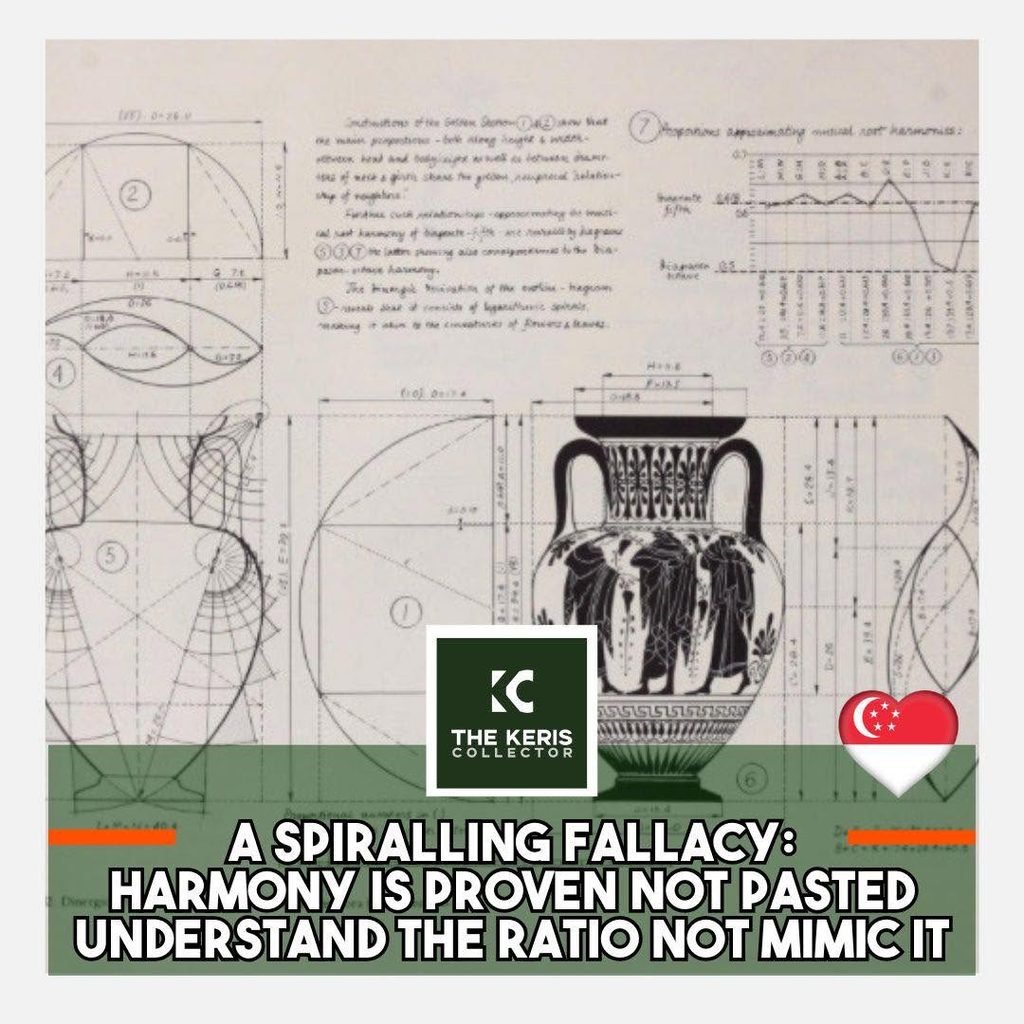
Author’s Note | Revisited, September 2026
I originally published this essay on Facebook on 6 July 2025.
Its target was a claim I had increasingly encountered within discussions about the keris: that the traditional keris was deliberately designed according to the Golden Ratio, usually demonstrated by placing a Golden Spiral over a photograph of a blade.
My response was sceptical.
I remain sceptical.
But after returning to the subject and examining both the historical literature on keris measurement and modern mathematical research on keris design, I would revise parts of my original argument.
Traditional keris cultures certainly had systems of measurement.
Modern researchers have also identified mathematical relationships, including Fibonacci-related patterns, when analysing keris forms.
Those facts deserve acknowledgement.
What they do not automatically establish is the much stronger historical claim that traditional keris makers deliberately designed their blades according to the mathematical constant φ.
That distinction is important.
There are really three different claims:
A keris can be mathematically analysed.
Clearly true.
Some measurements or forms found on kerises may correspond approximately with mathematical ratios or Fibonacci-related patterns.
Testable, and modern researchers have attempted precisely this.
Traditional keris makers intentionally designed kerises according to the Golden Ratio.
That is a historical claim.
And historical claims require historical evidence.
That remains the central argument of this essay.
Part I | The Original Essay
Originally published on Facebook, 6 July 2025
The Golden Ratio & The Keris: A Spiralling Fallacy
Some myths are beautiful because they stir the imagination. Others are dangerous because they masquerade as truth.
The recent fascination with the idea that the Malay keris was intentionally designed using the Golden Ratio (φ ≈ 1.6180339887) sits somewhere in between, a seductive story that wilts under scrutiny.
Let’s unpack the foundations, then dismantle the fantasy.
What Is the Golden Ratio, Really?
The Golden Ratio, denoted by the Greek letter φ (phi), is a specific irrational number found when a line is divided into two parts such that:
(a + b) / a = a / b = φ ≈ 1.6180339887…
This proportion recurs in nature (think nautilus shells, sunflower seed patterns), architecture (the Parthenon), and Renaissance art (Leonardo da Vinci’s Vitruvian Man), but always as an observation, not a universal design mandate.
The golden spiral, often associated with this ratio, is created by drawing circular arcs connecting the opposite corners of squares in a Fibonacci-based rectangle, where the side lengths follow the Fibonacci sequence:
1, 1, 2, 3, 5, 8, 13…
The Flawed Leap: Golden Ratio and the Keris
Here’s the claim:
“The curve of the keris blade matches the golden spiral, therefore it was intentionally designed by the Malays using φ.”
Let’s dissect why this is both misleading and intellectually irresponsible.
1. Post-hoc Matching ≠ Proof of Intent
Just because a shape can be overlaid onto another does not mean it was designed that way. A crescent moon can fit into the spiral, so can a banana. That doesn’t mean bananas were cultivated by phi-conscious horticulturists.
This is the Texas sharpshooter fallacy: drawing the target after the bullet holes are already in the wall. It’s a classic example of confirmation bias, seeing a pattern and then projecting meaning onto it.
Keris blades come in all forms: straight (lurus) and wavy (lok), with varying lok counts, asymmetrical designs, and regional stylisations. Trying to universalise them under a strict mathematical spiral is absurd. The variance is cultural, not mathematical.
2. Historical Disconnect: Golden Ratio Was Not Known in Malay Metallurgy
Let’s be blunt: there is no historical record of Malay pandai besi or empu using phi or any concept resembling it in their design philosophy. While these craftsmen were highly skilled and developed intricate aesthetic canons, there is no evidence that phi or Euclidean geometry was part of their toolkit.
The Golden Ratio only entered popular European consciousness during the Renaissance (15th–16th century), and the term “Golden Ratio” itself was coined much later in the 1800s. Even in classical Greek texts like Euclid’s Elements, it was treated more as an abstract geometric curiosity than a design principle.
To retroactively suggest that pre-modern Malay keris artisans intuitively embedded a European geometric constant into their blades, without documentation, cultural transmission, or tooling, is a fantasy.
3. Mathematical Incompatibility with Keris Design
Let’s test this.
Suppose a keris blade is 36 cm long. If the base of the blade to the midpoint is a, and the remainder is b, for the blade to follow the Golden Ratio:
(a + b) / a = a / b = φ
Let’s solve this using algebra.
Let:
a = bφ
Then:
(a + b) / a = (bφ + b) / bφ
which simplifies to:
(φ + 1) / φ = φ
The mathematics works perfectly as mathematics.
But when this is applied onto hand-forged objects with organic variances, tapering widths, curvature and asymmetry, the results may differ from object to object.
Measuring ten different keris specimens and attempting to draw golden spirals across them may therefore give different results.
That is not necessarily evidence of a common design rule.
4. Could Some Keris Be Doctored to Fit the Spiral?
This is not a baseless suspicion. In the age of social media virality, there’s motivation to modify or selectively photograph keris to “fit” the golden spiral, not for scholarship, but for spectacle.
With today’s design tools, you can easily rotate, stretch or skew images to fake alignment. A keris that doesn’t fit the spiral? Just Photoshop it until it does.
That is not research. That’s fabrication.
It’s akin to cutting a jigsaw piece so it fits where it shouldn’t. The fit may look pleasing, but it destroys the original design’s intent.
Conclusion: Seek Meaning, But Seek Truth First
There’s nothing wrong with seeing beauty in patterns. But imposing the Golden Ratio onto keris design, without evidence, consistency, or cultural context, is a modern myth draped in mathematical prestige.
Let us honour the ingenuity of Malay bladesmiths on their own terms, not by retrofitting them into a European equation.
A keris is rich with symbolism, spirituality, cosmology, and craft. That alone should be enough.
Don’t claim the sun rises because you happened to wake up today.
Part II | Revisiting the Argument
The First Correction Is Mine
There is an irony in returning to this essay.
I criticised people for seeing the Golden Ratio where the evidence did not justify it.
Yet in explaining the Golden Ratio, I repeated several popular claims that suffer from almost exactly the same problem.
I wrote that φ occurs in:
nautilus shells, the Parthenon and Leonardo da Vinci’s Vitruvian Man.
Those examples are much less secure than I presented them.
The chambered nautilus does grow approximately as a logarithmic spiral. But a logarithmic spiral is not automatically a Golden Spiral. Measurements of nautilus shells do not support the popular claim that their growth follows φ.
The Parthenon is another famous example. Golden rectangles can certainly be drawn over photographs of it. But there is no convincing historical evidence that its architects designed the building according to φ, and proposed Golden Ratio alignments often depend upon choosing convenient measurement points.
Leonardo’s Vitruvian Man is likewise repeatedly associated with the Golden Ratio in popular culture, yet Leonardo’s own annotations concern other proportional relationships. There is no good evidence that φ provided the organising principle of the drawing.
Sunflower phyllotaxis is different.
Fibonacci relationships and divergence angles approaching the so-called golden angle of approximately 137.5 degrees genuinely occur in botanical phyllotaxis and have been the subject of serious mathematical and biological investigation.
So even before getting to the keris, my own examples demonstrated the danger I was trying to warn against.
A mathematical pattern can be real.
A popular explanation of that pattern can still be wrong.
What Is the Golden Ratio?
Let’s begin again.
Take a line divided into a longer section, a, and a shorter section, b.
The Golden Ratio occurs when:
(a + b) / a = a / b
The resulting number is:
φ = (1 + √5) / 2
approximately:
1.6180339887…
The mathematics is ancient.
Euclid described the division of a line in what is translated as “extreme and mean ratio” in the Elements. He did not call it the Golden Ratio.
The later history is more complicated.
Luca Pacioli famously discussed the divina proportione, or divine proportion, in a work published in 1509 and illustrated by Leonardo da Vinci.
The terminology and cultural mythology surrounding the Golden Ratio continued developing much later.
So the mathematics itself is real.
What deserves scepticism is not φ.
It is the enormous collection of historical, aesthetic and mystical claims subsequently attached to it.
Fibonacci Is Related to φ, But It Is Not φ
This distinction also matters.
The Fibonacci sequence begins:
0, 1, 1, 2, 3, 5, 8, 13, 21, 34…
Each new number is obtained by adding the preceding two.
As the sequence progresses, the ratio between successive Fibonacci numbers approaches φ:
13 / 8 = 1.625
21 / 13 ≈ 1.615
34 / 21 ≈ 1.619
The relationship is mathematically genuine.
But saying that an object contains something resembling a Fibonacci pattern is not automatically equivalent to demonstrating that its maker calculated or deliberately employed φ.
That distinction becomes important when we turn to the keris.
The Central Problem: Pattern Is Not Intention
Suppose I photograph a keris and place a Golden Spiral over the image.
It does not fit.
So I enlarge the spiral.
Rotate it.
Move it slightly.
Perhaps crop the photograph.
Eventually the spiral follows part of the blade.
What have I demonstrated?
At most, I have demonstrated that a particular mathematical curve can be fitted approximately onto part of a complicated object.
I have not demonstrated that the smith who made that keris used the same curve.
This is the fundamental methodological problem.
If I decide beforehand that φ must be present, then search among enough dimensions until something approximating 1.618 appears, I greatly increase my chances of finding what I wanted.
Blade length.
Blade width.
Length to the ganja.
Width at different points.
Distances between features.
Luk spacing.
Hilt dimensions.
Sheath dimensions.
Ratios between any combination of them.
A keris offers an enormous number of potential measurements.
With enough freedom to select measurement points afterwards, finding a ratio somewhere near 1.618 becomes much less impressive.
The target has effectively been drawn after the shots were fired.
But My Original Essay Made Another Mistake: Kerises Really Were Measured
This is the most important correction.
I wrote that there was no historical evidence of keris makers using φ “or any concept resembling it”.
The second part of that statement was too broad.
Historical records absolutely document traditional systems for measuring kerises.
Ivor H. N. Evans recorded a Pahang method in which the length of a keris blade was measured using a strip of pandanus leaf. The strip was manipulated and applied to different dimensions of the blade while particular words were recited.
H. G. Keith recorded keris-measurement practices from North Borneo involving repeated thumb measurements and a verbal sequence.
G. C. Woolley explicitly observed that numerous methods existed for measuring kerises to determine whether they were considered auspicious generally, or suitable for particular owners or purposes.
G. M. Laidlaw recorded another method involving blade length, the midpoint of the blade and repeated measurements of blade breadth, accompanied by the sequence:
Gunong, Runtoh, Madu, Segara.
Whatever we make of the divinatory or symbolic dimensions of these practices, one fact is undeniable:
measurement was part of documented keris culture.
That deserves considerably more attention than I gave it in 2025.
But Traditional Keris Measurement Is Not Evidence for φ
This is precisely where careful distinctions matter.
The historical sources give us evidence for procedures involving:
blade length,
blade width,
midpoints,
thumb measurements,
leaf strips,
repeated units,
verbal formulae,
and assessments of auspiciousness or suitability.
That is evidence for traditional keris-measurement systems.
I have not found evidence in these sources demonstrating that those systems were based specifically upon:
φ = 1.6180339887…
Nor do they demonstrate the deliberate construction of a Golden Spiral.
This is actually more interesting than trying to force the keris into a famous mathematical constant.
The historical evidence suggests that keris cultures possessed their own systems of measurement and interpretation.
Why not investigate those?
The 2020 Fibonacci Study
There is also modern academic research that my original essay obviously did not discuss.
In 2020, Shahriman Zainal Abidin, Rusmadiah Anwar and Wan Nuraini Rahim published:
“The Presence of Fibonacci Sequence in Malaysia Keris Design Related to Elements of Art and Principles of Design.”
The researchers applied a Fibonacci-sequence spiral as an instrument of form analysis and reported a significant presence of Fibonacci components in the Malaysian keris designs they examined.
That study exists and deserves acknowledgement.
It would be intellectually dishonest for me to argue that there is no academic research connecting Fibonacci geometry and keris morphology when such research has actually been published.
But acknowledging the paper does not require us to accept a stronger conclusion than the research demonstrates.
There is an important difference between:
using a Fibonacci-based analytical instrument to analyse keris forms
and
demonstrating that historical keris makers consciously used Fibonacci mathematics when making those kerises.
Those are different propositions.
The first concerns modern morphological analysis.
The second concerns historical intentionality.
Evidence for one does not automatically establish the other.
Modern Golden-Ratio Keris Design Exists Too
A 2019 UiTM thesis provides another useful example.
Nur Izzati Mahyudin and Aidatul Anisa Saiful Zamri explicitly applied the Golden Ratio, Golden Triangle and Golden Spiral to modern two-dimensional keris-hilt designs generated using B-spline methods.
This is genuine Golden Ratio research involving the keris.
But look carefully at what is happening.
The researchers are deliberately applying these mathematical tools to modern keris-hilt design.
That is completely different from discovering historical documentation showing that traditional hilt carvers used φ.
Modern mathematical analysis of a traditional artefact and historical reconstruction of how that artefact was actually made are not the same research question.
My Original Mathematical Test Wasn’t Very Useful Either
There is another section I would not write the same way today.
I imagined a 36-centimetre keris blade, divided it into two sections and demonstrated the algebraic relationship defining φ.
The mathematics was correct.
But historically it proved almost nothing.
Why should the blade be divided at that particular point?
Why those two measurements?
Why should those dimensions, rather than blade width, ganja dimensions, luk intervals or some other feature, encode φ?
That is precisely the problem.
Before testing a Golden Ratio hypothesis, the proposed measurement must be defined independently.
Otherwise we are free to keep changing measurement points until the desired number appears.
A better experiment would state the hypothesis before examining the sample.
For example:
Blade length divided by maximum blade width should approximate φ within a predefined tolerance.
Then test it across a meaningful collection of kerises.
Straight blades.
Luk blades.
Different regions.
Different periods.
Different forms.
Different makers where attribution is reasonably secure.
Then compare φ against alternative ratios.
If 1.618 consistently performs substantially better than plausible alternatives, we would have something interesting to investigate.
But even that would establish only a recurring proportional relationship.
It would not automatically establish historical intention.
What Would Convince Me?
This is perhaps the most useful question.
What evidence would change my position?
Several things could.
A historical technical manuscript describing a proportional method equivalent to φ.
A documented pakem or workshop tradition prescribing the relevant measurements.
Early ethnographic documentation recording such a method directly from makers.
Tools or templates demonstrably embodying the ratio.
A large and appropriately selected sample of historical kerises showing the same predefined proportional relationship with a degree of consistency unlikely to arise accidentally.
Evidence connecting that proportional pattern with an actual manufacturing tradition.
Any combination of those would make the hypothesis considerably stronger.
And if such evidence emerges, I will happily revise this essay again.
That is not weakness.
That is how evidence-led inquiry is supposed to work.
What About Manipulated Photographs?
My original essay suggested that keris photographs might deliberately be altered to make them fit Golden Spirals.
That is certainly technically possible.
But possibility is not evidence that anyone actually did it.
Without demonstrating manipulation in a particular image, accusing someone of doctoring photographs goes beyond the evidence.
I would therefore withdraw that insinuation as a general argument.
We do not need it.
Even a completely authentic, undistorted photograph showing an impressive Golden Spiral alignment would still not establish historical intentionality.
The methodological objection is sufficient.
“European Mathematics” Was the Wrong Argument
I would also withdraw another formulation from the original essay.
I described the Golden Ratio as essentially a European mathematical framework being retrofitted onto Malay craftsmanship.
That framing is unnecessarily Eurocentric in its own way.
Mathematical relationships do not belong eternally to whichever civilisation first left us a surviving written description of them.
More importantly, sophisticated craftsmanship does not require modern mathematical notation.
A traditional craftsman can understand proportion through bodily units, templates, repeated procedures, inherited workshop rules, geometry and accumulated practical knowledge without writing:
φ = 1.6180339887…
So the relevant question is not:
Could Malay, Javanese, Bugis or other Southeast Asian craftsmen have understood sophisticated proportion?
Of course they could.
The question is:
What proportional systems did they actually use?
That question should be answered from the evidence of their traditions rather than from assumptions about what they must have known.
Perhaps We Are Asking the Wrong Question
This is where revisiting the essay has changed my interest in the subject.
Instead of repeatedly asking:
“Did the keris use the Golden Ratio?”
I think there is a much richer research question:
How did keris-making cultures understand measurement and proportion?
The historical material already tells us that measuring kerises mattered.
So what were the systems?
How old were they?
Were measurements used during manufacture, after manufacture, or both?
Which measurements concerned physical design?
Which concerned auspiciousness?
Which related the keris to its owner?
Did methods differ between Pahang, the northern Malay Peninsula, Java, Bugis regions, Bali, Patani, Sumatra and Borneo?
Did smiths and owners measure kerises differently?
Were bodily measurements involved?
Were templates used?
How were blade proportions transmitted between generations?
Those questions investigate the keris on its own historical terms.
They may reveal systems far more interesting than φ.
So, Was the Keris Designed According to the Golden Ratio?
Based on the evidence examined for this revision:
The historical-intent claim has not been demonstrated.
Notice what I am not saying.
I am not saying:
“No keris contains dimensions approximating the Golden Ratio.”
That would require empirical testing across objects.
I am not saying:
“Mathematics has nothing to do with keris design.”
Traditional measurement practices alone make such a statement untenable.
I am not saying:
“Fibonacci relationships cannot appear in keris morphology.”
Modern researchers have explicitly investigated that possibility and reported such patterns.
My conclusion is narrower:
Finding a mathematical relationship in a keris does not by itself demonstrate that the maker intentionally used that mathematical relationship.
Pattern is one question.
Historical intention is another.
Final Thoughts
The keris does not become sophisticated because we attach the Golden Ratio to it.
It was already sophisticated.
Its makers understood iron and steel, heat, forging, balance, proportion, form, aesthetics and inherited craft traditions.
Different keris cultures developed their own conventions and ways of understanding these objects.
We do those traditions no favour if we assume they become more impressive only when connected to a famous mathematical idea.
Perhaps the Golden Ratio really does occur systematically in some keris traditions.
If so, demonstrate it.
Define the measurement.
Establish the tolerance.
Test a meaningful sample.
Compare competing explanations.
Then find historical evidence connecting the observed relationship with the people who actually made the objects.
Until then, drawing a Golden Spiral over a keris photograph demonstrates only that a Golden Spiral can be drawn over a keris photograph.
That is an observation.
Intentional design is a historical claim.
Do not confuse the two.
And perhaps the more interesting discovery is waiting somewhere else entirely.
Not in Euclid.
Not in φ.
But in the measurement traditions of the keris makers themselves.
The internet rewards attention. History rewards evidence.
Preserve Through Discovery.
References & Further Reading
Abidin, Shahriman Zainal, Rusmadiah Anwar, and Wan Nuraini Rahim. “The Presence of Fibonacci Sequence in Malaysia Keris Design Related to Elements of Art and Principles of Design.” Environment-Behaviour Proceedings Journal 5, Special Issue 3 (2020): 141–147. DOI: 10.21834/ebpj.v5iSI3.2547.
Bartlett, Christopher. “Nautilus Spirals and the Meta-Golden Ratio Chi.” Nexus Network Journal 21 (2019): 641–656. DOI: 10.1007/s00004-018-0419-3.
Evans, Ivor H. N. “Lucky and Unlucky Keris Measurements.” Reprinted in Paul H. Kratoska, ed., The Malay Keris: Artistry in Iron. Kuala Lumpur: Malaysian Branch of the Royal Asiatic Society, 2020, 195–200.
Keith, H. G. “Keris Measurements from North Borneo.” Journal of the Malayan Branch of the Royal Asiatic Society 16, no. 1 (1938): 134–136. Reprinted in Paul H. Kratoska, ed., The Malay Keris: Artistry in Iron. Kuala Lumpur: Malaysian Branch of the Royal Asiatic Society, 2020, 201–204.
Kratoska, Paul H., ed. The Malay Keris: Artistry in Iron. MBRAS Reprints No. 35. Kuala Lumpur: Malaysian Branch of the Royal Asiatic Society, 2020. ISBN 978-967-9948-67-7.
Laidlaw, G. M. “Some Notes on Kĕris-measurements.” Journal of the Malayan Branch of the Royal Asiatic Society 20, no. 1 (1947): 45–46. Reprinted in Paul H. Kratoska, ed., The Malay Keris: Artistry in Iron. Kuala Lumpur: Malaysian Branch of the Royal Asiatic Society, 2020, 208–209.
Mahyudin, Nur Izzati, and Aidatul Anisa Saiful Zamri. Golden Ratio, Golden Triangle and Golden Spiral of Hilt Keris Designed by Using Extended Cubic B-Spline and λµ-B-Spline. Universiti Teknologi MARA, 2019.
Naini, Farhad B. “The Golden Ratio: Dispelling the Myth.” Maxillofacial Plastic and Reconstructive Surgery 46 (2024). DOI: 10.1186/s40902-024-00411-2.
Stieger, Stefan, and Viren Swami. “Time to Let Go? No Automatic Aesthetic Preference for the Golden Ratio in Art Pictures.” Psychology of Aesthetics, Creativity, and the Arts 9, no. 1 (2015): 91–100. DOI: 10.1037/a0038506.
Woolley, G. C. “Keris Measurements.” Journal of the Malayan Branch of the Royal Asiatic Society 16, no. 2 (1938): 44–46. Reprinted in Paul H. Kratoska, ed., The Malay Keris: Artistry in Iron. Kuala Lumpur: Malaysian Branch of the Royal Asiatic Society, 2020, 205–207.