
Singapore Got Very Good at Finding Terrorist Networks. What Happens When There Is No Network? From Jemaah Islamiyah to the Bedroom Radical
In 2002, Singapore confronted terrorist cells, handlers, reconnaissance and regional networks. Those threats have not disappeared. But in 2026, another problem is increasingly visible: very young people developing violent intentions through digital environments, sometimes without belonging to a conventional terrorist organisation. The challenge is recognising that trajectory early without turning vigilance into paranoia.
Twenty-four years ago, Mr. Rohan Gunaratna walked into the Istana and found Mr. Lee Kuan Yew waiting with questions.
According to Mr. Gunaratna’s recollection, Mr. Lee asked him roughly thirty questions in an hour. Where was Al-Qaeda going? What was happening in Southeast Asia? Where might terrorists strike next?
Mr. Gunaratna remembers warning that terrorists were preparing to attack entertainment venues somewhere in the region. Mr. Lee apparently disagreed with that assessment. Two weeks later, on 12 October 2002, bombs tore through Bali, killing 202 people.
When they met again, Mr. Gunaratna says Mr. Lee told him:
“My highest priority is to protect Singapore.”
It is a powerful story, but it is also a recollection published twenty-four years after a private conversation. I am not going to pretend every remembered sentence can now be independently verified.
The surrounding history can.
Singapore had already begun uncovering something frightening. Jemaah Islamiyah members had conducted reconnaissance against targets here. Investigators uncovered maps and video of Yishun MRT station connected to a plot involving US military personnel. Singapore’s investigations eventually found that JI had identified close to 80 possible targets. The network had regional connections, handlers and links to Al-Qaeda.
This was terrorism organised recognisably as a network. There were cells, handlers, reconnaissance, overseas connections, training, meetings and communications. None of that made JI easy to defeat, but organisations create relationships, and relationships create intelligence opportunities.
Follow one person and perhaps you find another. Intercept one communication and perhaps you discover a cell. Arrest somebody in one country and the information may lead investigators across a border.
Singapore became very good at dealing with that world.
Twenty-four years later, imagine asking Mr. Lee’s question again.
Where is the next terrorist network?
Perhaps that is no longer always the right question.
Find the network. Recognise the trajectory.
I should qualify that immediately. Organised terrorism has not disappeared.
ISIS and Al-Qaeda remain relevant threats. Regional extremist networks still matter. Foreign terrorist fighters remain a concern. Singapore’s 2026 terrorism assessment says the threat to Singapore remains high, although there is no specific or credible intelligence of an imminent attack.
So this is not a story in which one form of terrorism conveniently disappeared and another replaced it. Singapore has to worry about both.
What has changed is the prominence of another pathway.
Since July 2025, eight Singaporeans have been detained or issued Restriction Orders under the Internal Security Act. Seven were assessed to have been self-radicalised by different extremist influences, and six of the eight were below 21. Between 2017 and 2021, Singapore dealt with four youth ISA cases. Since 2022, there have been fifteen.
Self-radicalisation itself is not new. Singapore dealt with its first self-radicalised individual under the ISA in 2007. What appears to be changing is the age of some recent cases, the speed at which some trajectories develop, the accessibility of violent material and the increasingly messy combinations of ideologies involved.
On 19 September 2026, Second Minister for Home Affairs Mr. Edwin Tong said Singapore had seen four 14-year-olds issued ISA orders in the previous two years. He also noted that several recent youths had radicalised within weeks.
Those figures deserve attention. They do not justify panic.
Fifteen youth ISA cases since 2022 in a country of millions should remind us that terrorism remains rare. Most angry teenagers will never become violent. Most people who say outrageous things online will never become terrorists. Most people furious about Gaza, immigration, race, religion or politics will remain exactly what they are: people with opinions, sometimes unpleasant ones.
We need to preserve that distinction, because counterterrorism becomes dangerous when vigilance turns into indiscriminate suspicion.
The case that stayed with me
In July 2026, ISD disclosed the cases of three Singaporean boys aged 14, 15 and 19. Their cases were unrelated, but all three had self-radicalised online and, according to ISD, progressed to preparations for attacks in Singapore.
The youngest case bothers me most.
According to ISD, his radicalisation involved a strange mixture of mass-shooter material, far-right extremism, antisemitism, neo-Nazism, white supremacy and ISIS. Personal grievances involving bullying and academic stress also featured in his case. Eventually, the 14-year-old planned a mass-casualty stabbing attack at his school. He considered weapons, selected targets and prepared a 21-page manifesto. He was arrested in May, roughly a month before the period in which he intended to carry out the attack.
Someone in his school noticed his concerning behaviour and alerted the authorities.
That detail has stayed with me because we do not know what would otherwise have happened. What we do know is that intervention came before the intended attack.
The case also challenges the neat ideological categories through which many of us learned to understand terrorism. Was this boy an Islamist extremist? Far-right? Neo-Nazi? Mass-shooter obsessive?
The answer is considerably messier.
Singapore authorities now use the term Composite Violent Extremism, or CoVE, for cases where individuals combine multiple, sometimes contradictory extremist ideologies into a personalised worldview capable of justifying violence. Singapore’s first three CoVE cases all involved people under 21.
For much of the post-9/11 period, counterterrorism could ask familiar questions about organisations, ideologies and recruiters. Those questions remain important, but somebody growing up online can now encounter fragments from very different extremist worlds and combine them into something personally meaningful even when those ideas make little intellectual sense together.
The future extremist may not inherit an ideology. He may assemble one.
This is also why I am cautious about the expression “lone wolf”. A person might prepare an attack physically alone while spending years surrounded digitally by propaganda, ideological communities, violent videos, manifestos and previous attackers turned into icons. Physical isolation does not necessarily mean ideological isolation.
The phone changed access, not human nature
I keep returning to the phone because it illustrates what has changed without pretending to explain why people become extremists.
Twenty years ago, terrorist infrastructure often left physical footprints: travel, training, meetings, money, recruiters and safe houses. Today a smartphone can provide immediate access to propaganda, violent footage, ideological communities, manifestos, maps and the mythology surrounding previous attackers.
That does not mean the phone radicalised somebody, and it certainly does not mean an algorithm removed his agency.
People search, choose, interpret, reject, return and share. Technology nevertheless changes the scale and accessibility of what they can find.
One recent Singapore case demonstrates the interaction. A 14-year-old placed on a Restriction Order in November 2025 had first encountered an ISIS-related video at age 12. ISD said that after he began searching for more information, recommendation algorithms pushed more ISIS-related videos into his feed. He later found a pro-ISIS website and spent around nine hours a day consuming material there.
He searched. The system recommended. He continued consuming.
Human choice and technological amplification can coexist. We do not need to pretend one cancels out the other.
This brings me to something I have observed much closer to ordinary life.
I spend far too much time reading comment sections.
Race, religion, immigration, Singapore, Malaysia, Israel and Palestine, history, national identity. Give people a sufficiently sensitive subject and eventually somebody will say something extraordinary.
I have seen racial and religious hostility, conspiracy theories, casual dehumanisation and people who appear completely convinced that everyone outside their chosen tribe is evil.
That does not make them terrorists.
Anger about Gaza is not radicalisation. Religious devotion is not radicalisation. Opposition to immigration is not terrorism. Criticising the Government is certainly not a national-security threat. People are allowed to be angry, political, religious, unpopular and occasionally bloody stupid.
The security question begins somewhere else: when does belief start moving towards the legitimisation, preparation or use of violence?
I do not believe we can identify tomorrow’s terrorist by reading Facebook comments. Nor should we try.
What interests me is whether aggregated public discourse can tell us something about the environment in which violent ideas are being discussed. If celebrating violence, glorifying attackers, dehumanising populations or treating Singaporean neighbours as proxies for overseas enemies becomes increasingly normal, that may tell us something socially significant without telling us which individual will become violent.
The comments section is not an intelligence report. It may still be a social barometer.
There is no neat conveyor belt from grievance to terrorism either. Someone can carry resentment for decades without hurting anyone. People can believe ridiculous conspiracy theories and remain non-violent. They mature, change their minds, leave extremist communities and encounter people who challenge them.
Occasionally, somebody travels rapidly in the opposite direction.
That leaves us with a very difficult problem: how do we recognise the tiny number moving towards violence without treating everybody holding an ugly belief as a security suspect?
I do not think there is a comfortable answer.
Vigilance without paranoia
Imagine what happens if ordinary Singaporeans misunderstand the message.
A Muslim teenager becomes more religious and somebody decides that is suspicious. Another Singaporean becomes furious about a foreign war and is treated as a security concern. Someone expresses an unpleasant opinion about immigration or launches into another tirade against the Government and neighbours begin imagining extremism.
That would be ridiculous. It could also be destructive.
Counterterrorism that leaves Singaporeans suspicious of one another because of race, religion or political opinion would damage precisely the social cohesion we are trying to defend.
Official SGSecure guidance is more specific. It identifies combinations of behaviours such as frequent consumption of radical material, admiration for terrorists or terrorist organisations, support for violence, incitement to violence and expressed intent to participate in violence. It also explicitly states that radicalised individuals do not come from any particular age, race, gender or socioeconomic group.
Even then, context matters. One indicator is not a diagnosis.
The false-positive problem worries me. So does the false-negative problem.
Suppose somebody reports a teenager merely because he is angry about a war overseas. You could frighten a family, stigmatise a young person, destroy trust and flood authorities with noise.
The opposite mistake is dismissing increasingly disturbing behaviour with “he’s just angry”, “it’s only online” or “he would never actually do anything”.
Singapore has already encountered that problem. In a 2024 case involving a 14-year-old, ISD said his parents had noticed increasingly segregationist beliefs but did not think they warranted intervention. He had in fact developed aspirations involving attacks against non-Muslim communities.
So where is the line?
ISD provides one useful reassurance. If someone who is reported is not assessed to be radicalised or a security threat, no action will be taken. Where somebody is at an early stage of radicalisation, counselling or other interventions may sometimes be possible without resorting to ISA measures.
I find that distinction useful.
Reporting should not have to mean accusing somebody of being a terrorist. Sometimes it means recognising that something is worrying and asking someone better qualified to determine how serious it actually is.
The objective should never be maximum suspicion.
It should be better judgement.
Community is part of the defence
Our post-9/11 terrorism story necessarily involves Islamist terrorism. JI was an Islamist terrorist organisation. ISIS remains a threat. Several recent self-radicalisation cases have involved Islamist extremist material.
Those facts should be stated plainly.
Turn them into “Muslims are the terrorism problem”, however, and we have learned precisely the wrong lesson.
Singaporean Muslims have been part of Singapore’s defence against extremist ideology for more than two decades. The Religious Rehabilitation Group emerged after the JI arrests, with Muslim religious scholars volunteering to challenge extremist interpretations and counsel detainees. Singapore’s broader rehabilitation framework has incorporated religious counselling where relevant, psychologists, family support, mentoring, education and reintegration.
There is evidence that people can come back.
As of April 2024, MHA said 23 of 30 self-radicalised Singaporean detainees had been released, while Restriction Orders for 14 of 18 self-radicalised Singaporeans placed on them had been allowed to lapse.
Another case demonstrates why rehabilitation belongs in a discussion that might otherwise become entirely about surveillance and detention. A Singaporean teenager detained after planning machete attacks against Muslims at two mosques was released from detention in 2024 after ISD assessed that he had made good rehabilitation progress and no longer posed an imminent security threat. His rehabilitation involved psychologists, Christian religious counselling, RRG mentors, his former teacher, education and sustained family involvement.
That is counterterrorism too.
A religious counsellor may recognise a theological distortion that an algorithm cannot. A parent may notice a change no database contains. A teacher may see something nobody at home sees.
Community is not merely something counterterrorism protects or scrutinises. It can be part of the defence itself.
Sometimes the best outcome is not catching a terrorist. It is reaching somebody early enough that he never becomes one.
Singapore cannot make itself larger
Foreign conflicts complicate this further.
ISD says the Israeli-Palestinian conflict triggered or accelerated the radicalisation of three of the seven recently self-radicalised Singaporeans.
That does not make outrage over Gaza suspicious. Millions of people can be horrified by a war without supporting terrorism. Humanitarian concern, religious solidarity and political disagreement are legitimate.
Something more troubling happens when an overseas conflict teaches us to see another Singaporean as a proxy for an enemy somewhere else.
No Singaporean should become a stand-in for a government, militia, religion or foreign conflict merely because of race, religion or ancestry. Our cultural inheritance can cross borders. Our sympathies can cross borders. Our political community remains here.
The security concern lies much further down the road, where sympathy becomes support for violent extremist organisations, where entire populations become legitimate targets, or where somebody begins preparing for violence.
This returns me to something Mr. Gunaratna remembers discussing with Mr. Lee: Singapore’s lack of strategic depth.
Geographically, the problem is obvious. We are small. A serious terrorist attack could produce consequences far beyond the physical area struck, including deaths, economic shock, fear and communal suspicion.
We cannot manufacture more geography.
We can build another kind of depth.
I think of it as social strategic depth: a society with strong relationships across communities, where extremist narratives struggle to turn Singaporeans against one another; where religious leaders can challenge distortions from within their traditions; where parents and teachers are willing to intervene; and where institutions retain enough credibility that someone with a genuine concern is willing to ask for help.
Technology can assist with understanding extremist ecosystems and emerging narratives. I would be much more cautious about claims that an algorithm can reliably predict which particular individual will become violent. Political speech, religion, humour, anger and cultural context are far too messy for that kind of certainty. Population-level analysis and individual threat prediction are very different tasks.
Much of the judgement will remain human.
Singapore cannot make itself larger.
It can make itself harder to fracture.
The questions remain useful because the answers change
What I like about Mr. Gunaratna’s recollection is that Mr. Lee apparently disagreed with him.
Mr. Gunaratna says they differed over where terrorists might strike. Later, they disagreed over Iraq. Mr. Lee’s 24 September 2004 interview with Charlie Rose confirms that terrorism and Iraq were subjects he was publicly wrestling with during this period.
I do not need another story in which Mr. Lee somehow predicted everything.
The more useful lesson is that difficult questions were being asked.
What comes next? What are we missing? What happens if our assumptions are wrong? What should Singapore be doing before an attack rather than after one?
Those questions remain useful precisely because the answers change.
In 2002, Singapore had to find the network.
In 2026, it also has to recognise the trajectory.
Tomorrow, it will have to do both.
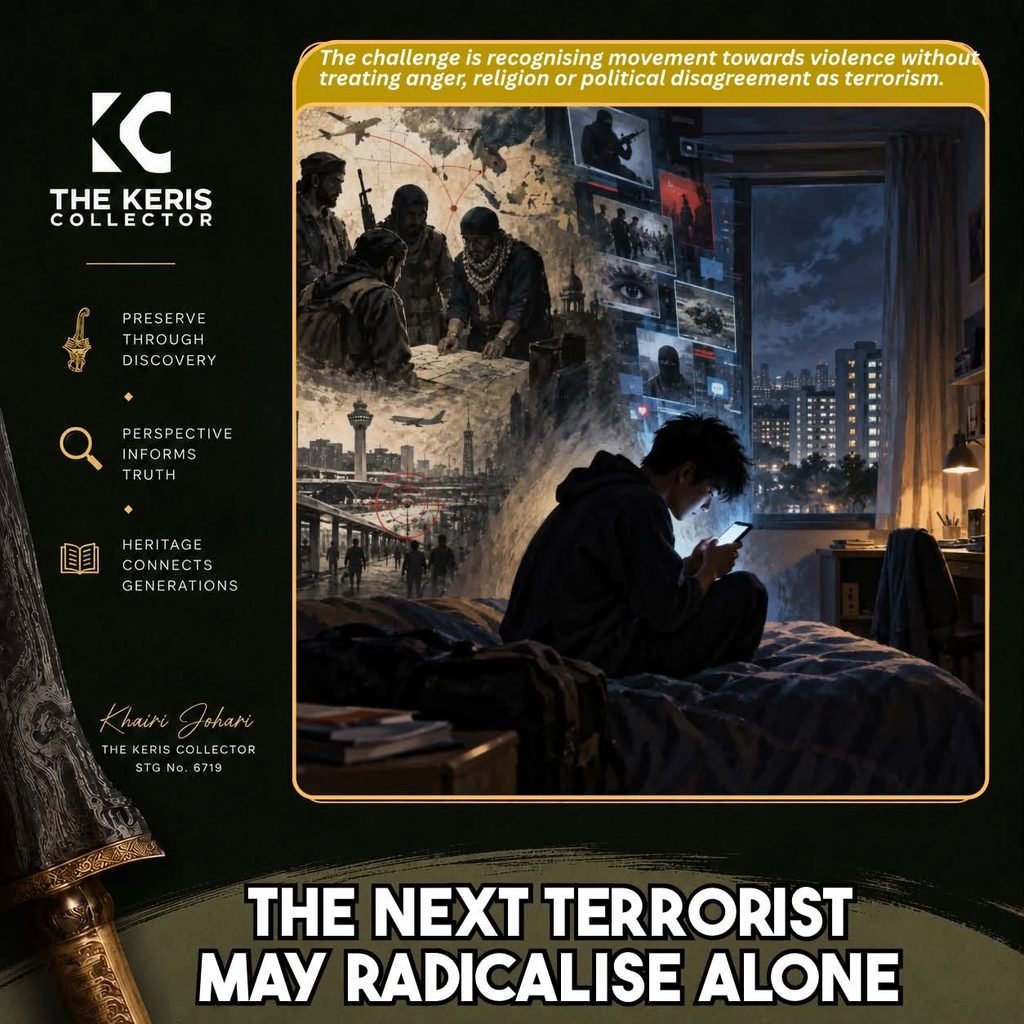
That is why the headline of this essay is deliberately provocative. A self-radicalised individual is not literally a terrorist cell, and a phone is not itself terrorist infrastructure. Behind the screen may be extremist communities, propaganda, violent videos, manifestos, previous attackers turned into icons and recommendation systems. Physically, however, there may be only one person sitting in one bedroom, developing an increasingly closed worldview.
And there may still be a period in which somebody can reach him.
I do not want Singaporeans looking around wondering which neighbour might secretly be a terrorist. That would be madness. I want us to become better at recognising the difference between anger and intent, an offensive opinion and support for violence, fantasy and preparation, somebody saying something appalling and somebody genuinely beginning to move towards an attack.
None of us needs to become an intelligence officer.
We do need to remain responsible Singaporeans.
Twenty-four years ago, Mr. Gunaratna remembers Mr. Lee saying that his highest priority was to protect Singapore.
The priority has not changed. The threat has.
Sometimes protecting Singapore will still mean intelligence officers tracking networks across borders. Sometimes it may begin much closer to home, with a parent noticing that anger has become an obsession with violence, a teacher realising that a disturbing joke is no longer a joke, a friend hearing someone move from they deserve it towards I am going to do it, or a counsellor reaching somebody before an extremist does.
Singapore spent decades making itself difficult for terrorist organisations to operate in.
Now there is another task: make Singapore difficult to radicalise.
That does not require us to become more suspicious of one another. Quite the opposite. It requires a society that remains difficult to divide while becoming better at recognising the rare occasions when somebody is genuinely moving towards violence.
Sometimes there is still time to reach that person.
That may be the intervention that prevents the next attack.
CONCISE SOURCE / REFERENCE NOTE
Mr. Rohan Gunaratna’s 8 August 2026 reflection is the source for his recollections of private meetings with Mr. Lee Kuan Yew, including the attributed statement, “My highest priority is to protect Singapore.” Those private remarks are therefore presented as Mr. Gunaratna’s recollections rather than as independently authenticated transcripts. The broader historical setting is independently supported by Singapore government accounts of the Jemaah Islamiyah investigations, including reconnaissance of Singapore targets and the Yishun MRT plot. Mr. Lee’s September 2004 Charlie Rose interview provides separate public evidence of his engagement with terrorism and Iraq during this period.
The contemporary assessment relies principally on ISD’s Singapore Terrorism Threat Assessment Report 2026, official releases concerning recent youth cases and MHA material on Composite Violent Extremism. ISD assesses the terrorism threat to Singapore as high while stating that there is no specific or credible intelligence of an imminent attack. Official figures also document the increased number of youth ISA cases, recent self-radicalisation cases and Singapore’s first CoVE cases.
The discussion of vigilance, reporting and rehabilitation follows ISD, SGSecure and MHA guidance. These sources distinguish credible indicators of radicalisation and movement towards violence from demographic identity or ordinary political and religious opinion. Official material also documents the use of counselling, family involvement, mentoring, education and reintegration, as well as cases in which rehabilitated individuals have subsequently been released.