
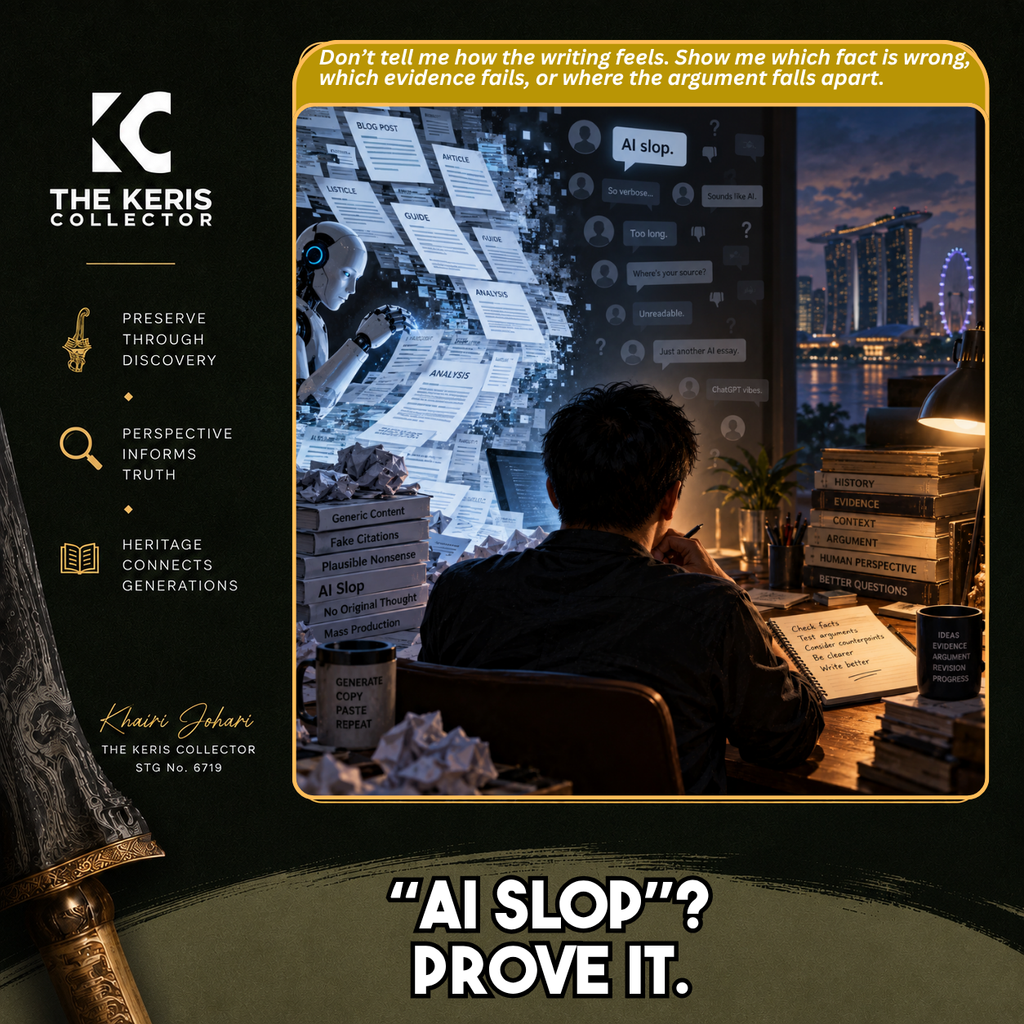
Don’t Tell Me It Sounds Like AI. Show Me Where I’m Wrong.
If My Writing Is Bad, Tell Me Why
AI slop is real. So is bad human writing. In an age when machines can generate plausible prose by the thousand, we need to separate three questions that are increasingly being confused: How was something written? Is it well written? And, most importantly for serious argument, is it true?
Someone recently described one of my essays as “AI slop.”
I will admit that irritated me. Not because he disliked the essay. Readers are perfectly entitled to dislike what I write. Buried inside his comment was also a criticism I think is fair:
“You can explain your point in clean, clear prose with economical paragraphing. This stream of consciousness AI-slop style makes it really hard to follow your reasoning. Imagine speaking to someone in this way!”
Take away the “AI slop” part and there is useful editorial feedback there.
Clean prose matters. Economical paragraphing matters. If I break every thought into a dramatic little paragraph, pile rhetorical questions on top of one another and keep interrupting an argument with fragments intended to sound important, eventually the style begins obstructing the reasoning.
Fair enough. I can use that, and I already have. This essay is deliberately written differently.
What interested me was everything contained in those other two words.
“AI slop.”
What exactly does that tell me about the essay?
If you think an argument fails, show me where. Which claim is wrong? Which source doesn’t support it? Which inference fails? Which counterargument did I avoid? Which paragraph is doing no useful work?
Give me something I can actually examine.
If the answer is simply that the prose feels like something AI might have produced, then we have stopped criticising the argument and started guessing how the sentences were made.
Those are not the same thing.
AI slop is real
I have no interest in pretending otherwise.
The phrase has become popular because the internet genuinely is filling with cheap synthetic material: generic articles, meaningless images, fake books, automated social posts, fabricated information and thousands of words that somehow manage to say almost nothing.
Merriam-Webster chose “slop” as its 2025 Word of the Year, defining the contemporary sense as low-quality digital content produced, usually in quantity, using artificial intelligence.
The phenomenon deserves a name.
Generative AI can produce plausible nonsense with extraordinary confidence. It can invent citations, flatten different writers into similar voices, reproduce formulaic structures and manufacture enormous quantities of disposable material at a scale ordinary human bad writing could never achieve.
I am not defending that.
Call it slop. The shoe fits.
But once “AI slop” becomes a label for anything long, polished, rhetorical, structured or merely suspected of AI assistance, the phrase stops identifying a problem. It becomes a substitute for identifying one.
And I think we are beginning to confuse three separate questions.
How was this made?
Is it well written?
Is it true or defensible?
They overlap, certainly. They are not interchangeable.
A piece can be entirely human and badly written. It can be entirely human, beautifully written and completely wrong. AI-assisted prose can be ugly but factually sound. It can also be elegant and fabricated from beginning to end.
“AI slop” may sometimes tell us something useful about the first two questions.
It tells me almost nothing about the third.
Long is not the same as verbose
I have already written about verbosity in On Verbosity [VERBOSITY KEEPS THE IDIOTS AWAY] because I don’t believe length is a virtue.
I don’t believe brevity is one either.
A 3,000-word essay may contain 500 words of thought padded with 2,500 words of performance. Cut it.
Another essay of exactly the same length may need the space because the evidence is complicated, the obvious counterargument deserves an answer and the conclusion requires qualifications that cannot honestly be compressed into an Instagram caption.
Keep it.
Long describes size; verbose describes inefficiency.
The test I increasingly apply to my own writing is whether every paragraph earns its place. If I can remove three paragraphs without weakening the evidence, reasoning, voice or meaning, those paragraphs probably should go. If removing them destroys an important qualification or leaves a serious counterargument unanswered, perhaps they belong there.
Almost anything can be made shorter. That doesn’t automatically make it better.
The original comment has nevertheless made me look harder at my own paragraphing. There is a difference between using a short paragraph for emphasis and turning an entire essay into a succession of dramatic pauses.
I have probably crossed that line sometimes.
Good. Now I know something I can improve.
But what exactly are we criticising?
Suppose I publish a historical claim tomorrow and somebody demonstrates that I have misread the primary source.
I want to know.
Suppose someone discovers that a reference I cited doesn’t actually support the proposition attached to it. Or that I confused correlation with causation. Or ignored evidence that substantially changes the interpretation.
Tell me.
That criticism can change my mind.
But tell me that a paragraph “sounds AI” and I am left with a much less interesting question about stylistic resemblance.
There is a cultural habit developing here that bothers me. We increasingly seem tempted to ask:
Was this written by AI?
before asking:
Is this true?
Authorship matters, but that ordering can become backwards.
A completely human-written paragraph can be factually wrong, intellectually dishonest and badly reasoned. A sentence edited with an AI tool does not become false because software touched it.
Nor does AI involvement make something good.
The evidence still has to exist. The source still has to support the claim. The reasoning still has to work.
And somebody has to answer for the result.
The machine doesn’t get my byline
I use AI.
There is no great revelation there.
I use it inside a writing process built around testing premises, research, contradictory evidence, drafting, fact-checking and editing. The process is intended to make the work better.
It does not guarantee that I will always get things right.
That qualification matters because it would be absurd for me to argue for authorial responsibility while treating my own workflow as some kind of certificate of accuracy.
I can still misunderstand evidence.
I can still trust the wrong source.
I can still make a bad inference.
I can still write a lousy paragraph.
And if I publish any of those things under my name, I cannot point at a machine afterwards and say, ChatGPT did it.
My name is on the page. The machine doesn’t get the byline.
I do.
So I inherit responsibility for the claim, the evidence, the interpretation, the omissions, the judgement and the mistakes.
That doesn’t mean AI is simply another typewriter.
A typewriter cannot invent my argument, fabricate a reference or produce 5,000 plausible words while I make coffee. Generative AI introduces genuinely new problems involving scale, synthetic authorship, provenance, homogenisation and the ease with which plausible falsehoods can be produced.
Those problems deserve serious discussion.
They are also another reason why the person publishing the finished work should be prepared to defend what survives into it.
Research on AI-writing detection complicates attempts to reconstruct the writing process from prose alone. Detectors can produce false positives, and human writing can be edited or polished by machines to varying degrees. That doesn’t make questions about authorship or disclosure irrelevant. It simply means stylistic resemblance cannot carry more evidentiary weight than it deserves.
For me, responsibility begins somewhere simpler.
My name is attached to it.
Ask me to defend it.
My first reaction wasn’t a particularly good argument either
I confess that my immediate response to the comment was roughly:
AI slop? What have you written that’s worth sharing?
Satisfying.
Also logically weak.
A reader does not need to publish a book before being allowed to recognise bad writing. I don’t need to be a chef to know when somebody has burned my dinner.
Readers are entitled to judge writers. They don’t owe us credentials first.
They don’t even owe us detailed criticism. Someone can dislike my essay, type “AI slop”, close Facebook and continue with his day. He has no obligation to prepare an editorial report for my benefit.
But neither am I obliged to treat every drive-by label as substantial criticism.
If someone wants to say, “I dislike your writing style,” fair enough. Personal taste requires no dissertation.
If someone wants me to reconsider an argument, I need an argument to reconsider.
There is still a useful challenge buried inside my original irritation. When somebody prescribes how other people ought to write, I become interested in the standard being applied.
What would you remove?
How would you structure the argument?
What deserves 300 words and what deserves 3,000?
How would you handle evidence that complicates your preferred conclusion?
You don’t need to prove yourself worthy of criticising me.
Give me enough substance to understand the criticism.
Perhaps you will persuade me.
The original commenter already has, at least partly.
The criticism changed this essay
That is the part I rather enjoy.
He criticised fragmented paragraphing, so I examined mine.
He said the reasoning was difficult to follow, so I paid more attention to how one paragraph leads into the next.
And he asked me to imagine speaking to somebody this way.
That turns out to be a useful editing test.
Would I explain the argument approximately like this if an intelligent person were sitting across the table from me?
Writing is not transcribed speech, obviously. But if every second sentence is an aphorism, every thought has been separated merely to manufacture drama and I would sound ridiculous saying it aloud, the prose probably needs work.
That criticism survives my disagreement with the rest of his comment.
There is no contradiction in saying so.
In fact, I think that is what intellectual confidence should permit. You don’t have to reject everything someone says simply because part of it irritates you.
Take what survives scrutiny.
Discard what doesn’t.
Human versus AI is not the divide I care about most
The distinction I increasingly care about is accountable thinking versus disposable content.
A human can produce slop.
A machine can produce slop at industrial scale.
A human working with a machine can produce slop remarkably efficiently.
And someone using AI carefully can still research, test claims, reject bad evidence, rewrite poor prose and publish something he is prepared to defend.
The method matters.
The finished writing matters.
The evidence matters.
But responsibility matters most.
This becomes especially obvious in historical writing.
The internet rewards attention. History rewards evidence.
If AI produces a beautiful paragraph telling me that some ancient Malay kingdom possessed technology for which no credible evidence exists, the paragraph remains bad history.
If I type exactly the same nonsense myself with two fingers on a mechanical typewriter, it does not become scholarship through the purity of my suffering.
The question remains the same:
How do you know?
That is the standard I want applied to AI-assisted writing.
It is also the standard I want applied to human writing.
I still want disagreement
My time is finite, and I am becoming more selective about where I spend it.
That doesn’t mean public comments are beneath me. This entire essay exists because one public comment contained enough useful criticism to make me reconsider part of my writing.
But noticing a comment and sustaining a serious discussion are different things.
Longer disagreements need continuity, context and people willing to remain with an argument beyond one comment and one reply. That is partly why I built The Keris Collector Society, my private subscriber community.
I don’t want it to become an echo chamber.
Quite the opposite.
I want someone prepared to tell me that my source doesn’t establish what I think it does. That I’ve misunderstood something. That I’ve ignored the strongest counterargument. That a paragraph is indulgent. That my conclusion doesn’t follow.
Then defend that criticism when I push back.
That is the sort of disagreement from which everybody involved can learn.
If that sounds like your kind of conversation, you are welcome there.
I will continue reading criticism. Some of it will change how I write.
This particular comment already has.
Cleaner prose, more economical paragraphing, fewer theatrical fragments. Fair criticism, and useful.
But if you want me to reconsider an argument, give me an argument in return. Tell me what I got wrong, show me the evidence I missed or point to where the reasoning fails.
I may disagree with you.
I may discover that you are right.
Either outcome is considerably more interesting than “AI slop.”
And if you are prepared to disagree properly, I am interested in hearing from you.
I am not looking for people who agree with everything I write.
I am looking for people who can tell me, properly, why they don’t.
CONCISE SOURCE / REFERENCE NOTE
The essay uses “AI slop” in its now-common sense of low-quality digital material produced at scale with generative AI. Merriam-Webster selected slop as its 2025 Word of the Year and defined the relevant sense as “digital content of low quality that is produced usually in quantity by means of artificial intelligence.” Merriam-Webster: 2025 Word of the Year
The discussion of AI detection is deliberately limited. Research has documented false positives and significant difficulties distinguishing fully human writing from text that has been edited or polished using generative AI. That supports only a narrow conclusion here: authorship cannot always be reliably reconstructed from stylistic resemblance alone, and an authorship judgement does not independently establish whether an argument is factually sound.
The earlier essay On Verbosity is established in my writing archive, the publication copy retains [VERBOSITY KEEPS THE IDIOTS AWAY] rather than inventing one. The same applies to the subscriber destination, which remains [THE KERIS COLLECTOR SOCIETY].