
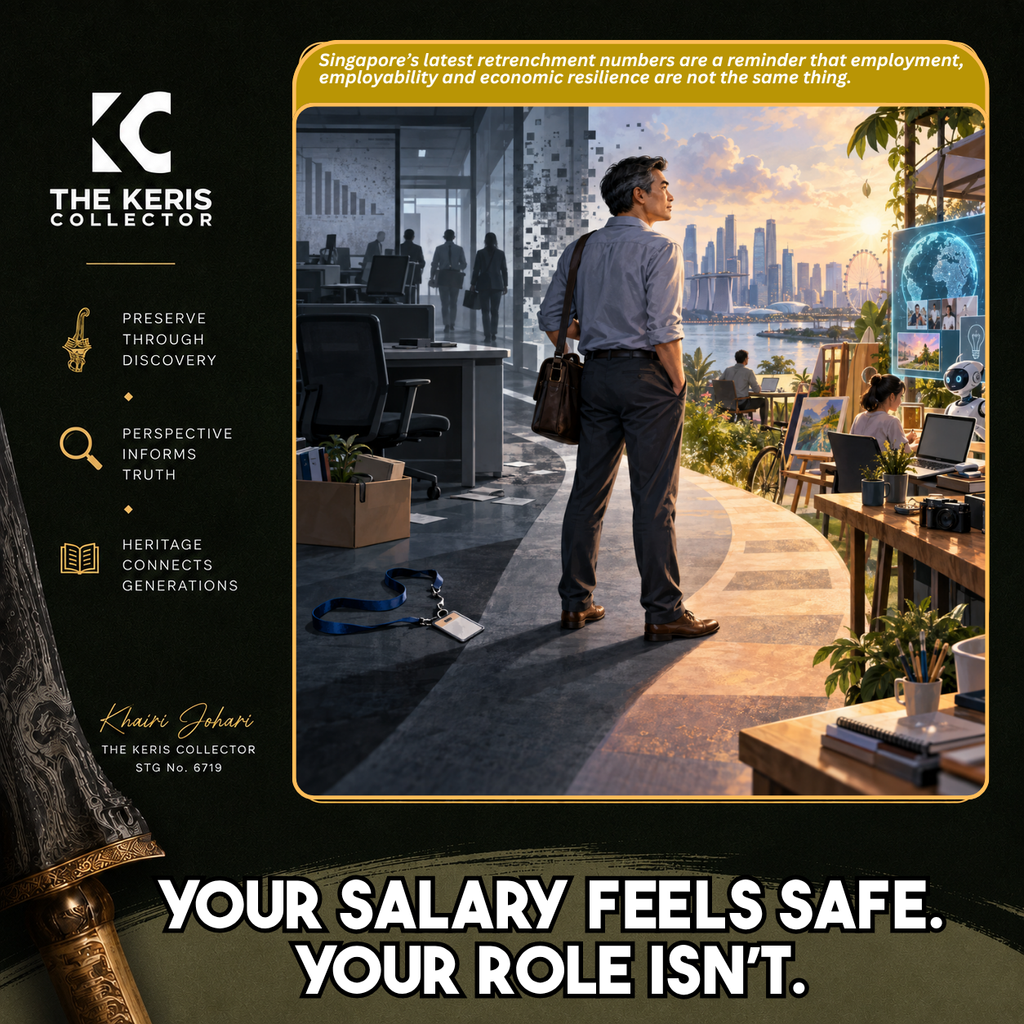
If You Don’t Own Your Job. What Do You Own?
Your Company Can Value You and Still Stop Needing Your Role.
Singapore’s latest retrenchment figures do not show a labour market in collapse, nor do they prove that AI is taking everyone’s job. They reinforce something I started preparing for several years ago: a salary can provide real stability without guaranteeing that an employer will need the same role indefinitely. For experienced workers, the more durable question is whether our capabilities remain useful beyond the organisation currently paying for them.
The latest Singapore labour-market numbers caught my attention because they describe a risk I have been thinking about for several years.
Retrenchments rose from 3,830 in the first quarter of 2026 to 4,620 in the second. The proportion of retrenched residents who had returned to employment within six months fell from 60.7 per cent to 54.9 per cent. Workers in their 50s continued to record the highest retrenchment incidence among resident employees, at 3.6 per 1,000.
Those figures deserve attention, but not panic. Singapore is not experiencing a labour-market collapse. Total employment still grew by 11,400 in the quarter, unemployment remained low, and there were 1.48 vacancies for every unemployed person in June. MOM described the labour market as continuing to expand, although some indicators were softening.
That qualification matters because I do not want to turn one quarter of weaker numbers into a grand theory about the death of employment.
My interest is more personal.
I have spent roughly 25 years working in IT-related roles. But I did not wait for somebody to tell me that my job was disappearing before thinking about what might come after conventional salaried IT work. Around 2020, I began preparing for a different future.
I could see that technology was changing quickly. I was getting older. Roles change, companies restructure, industries reorganise and salaries that make sense at one stage of a career may eventually be examined against a very different business environment.
I did not know exactly when the change would come or what my eventual model would look like. I simply became increasingly uncomfortable with the idea that one employer, one profession and one monthly salary should determine whether the capabilities I had accumulated over decades continued to have economic value.
That led me to a distinction I wish I had considered much earlier: employment, employability and economic resilience are related, but they are not the same thing.
The International Labour Organization defines employability partly through portable competencies and qualifications that help someone secure and retain work, move between jobs and cope with technological and labour-market change. That word has become increasingly important to me. What matters is not only what I can do inside my present organisation, but what remains useful when removed from that particular environment.
A salary can provide considerable security. It gives predictability, CPF contributions, leave, structure and cash flow. What it cannot provide is a guarantee that the organisation will need the same role indefinitely.
A company can value you and still stop needing the role
I do not think the useful lesson from rising retrenchments is that employers are disloyal or that companies do not care about their workers.
Good employers should treat people fairly. Employees themselves are important stakeholders. Businesses benefit from trust, institutional knowledge, relationships and years of accumulated expertise. Companies can also damage themselves badly by cutting experienced people without understanding what those people actually contribute.
Singapore’s own approach recognises these responsibilities. MOM says retrenchment should be carried out responsibly and fairly. Employers are expected to use objective criteria related to future business needs, avoid discrimination, treat affected employees with dignity and consider alternatives before retrenching. Employers with at least 10 employees must also notify MOM when they retrench workers.
So I reject the crude argument that businesses owe workers nothing.
But responsibility towards employees is different from an obligation to preserve every existing role forever.
Businesses have to remain viable. Customer demand changes. Technology changes. Work can be consolidated, outsourced, automated, moved elsewhere or stopped completely. Sometimes a company discovers that a process that once required ten people can now be performed differently.
That does not necessarily mean the workers were poor at their jobs.
Sometimes the economics of the job changed.
A company can genuinely appreciate twenty years of contribution and still conclude that it does not need the same role for the next twenty. Long service may create trust and expertise, but it does not create a permanent claim on future demand.
That is uncomfortable. I also think experienced workers are better served by understanding it before circumstances force them to.
Experience matters, but the market does not pay for birthdays
The Q2 figures make the position of older workers worth watching carefully. Residents in their 50s had the highest retrenchment incidence, while their unemployment and long-term unemployment rates also increased. MOM said the combination suggested greater exposure to involuntary displacement and potentially more difficult job searches.
That does not prove that companies are systematically replacing older workers with younger and cheaper ones. The available evidence does not justify that conclusion.
Nor does it mean experience has become irrelevant.
Twenty or thirty years in a profession can produce judgement a newcomer simply has not had time to develop. Experience can mean recognising patterns, understanding difficult clients, knowing where a project is likely to fail, handling ambiguity better, managing risk and making decisions with information that is incomplete.
But years accumulated and value currently created are not automatically the same thing.
That is the part I think experienced workers, myself included, have to confront.
If my compensation has risen substantially over my career, I should be able to explain what has grown alongside it. Perhaps I solve more difficult problems. Perhaps I require less supervision, manage greater risk, make better decisions, lead people, protect customer relationships or prevent mistakes that would cost far more than my salary.
Those are commercially meaningful consequences of experience.
Merely having been present for twenty-five years is different.
This is not a statement about human worth. A person’s value as a parent, spouse, friend, citizen or human being has nothing to do with his employability. I am talking about the narrower economic relationship between an organisation and a capability it currently chooses to buy.
Keeping those two ideas separate matters, particularly when somebody loses a job. A role becoming redundant does not mean the person occupying it has become redundant as a human being.
It does, however, create a practical question: what can that person do next that another organisation, client or market considers valuable?
AI changes tasks before it necessarily eliminates jobs
Artificial intelligence makes this discussion more urgent, but the current Singapore evidence does not support an AI employment apocalypse.
MOM’s 2026 study found that 71.5 per cent of surveyed firms had yet to adopt AI. Among those that had adopted it, only 6.2 per cent reported reduced headcount. Job redesign was more common, at 18.9 per cent, and 13.9 per cent reported creating new AI-related jobs. MOM’s assessment was that AI was primarily transforming tasks rather than producing widespread displacement at that stage.
That complicates the popular narrative in a useful way.
AI does not need to abolish an occupation tomorrow to affect the economics of work today.
If part of a job that previously required several hours can now be completed in a fraction of the time, the organisation may eventually redesign how that work is performed. The role may survive. The number of people required may change. The skills expected from each person may change. The price a business is willing to pay for a previously scarce task may change.
This is why I use AI extensively rather than treating it simply as something to fear.
The objective is not to hand everything to a machine. It is to understand which parts of my work can be accelerated, which should be automated, where verification is necessary and where judgement remains valuable.
Anyone who has used these tools seriously knows that speed and productivity are not identical. AI can save hours when used well. It can also produce an impressive-looking mistake in thirty seconds.
Expertise therefore still matters. In some circumstances it may matter even more, because somebody has to recognise whether the machine’s answer is useful, incomplete or confidently wrong.
The productivity discussion should also apply to management.
If organisations are asking whether junior employees can automate reporting, research or routine administration, there is no reason senior layers should be exempt from similar scrutiny. Management creates value when it improves decisions, coordinates complexity, manages risk, develops people or enables execution. Technology may also reduce some of the reporting, presentation preparation, information synthesis and administrative coordination surrounding management work.
The productivity test should apply throughout the organisation, not only where salaries are lowest.
What can I carry outside the company?
This is where my own preparations since 2020 become relevant.
I started thinking less about the next job title and more about what I could actually carry between organisations and markets.
Some of the answer came from interests that existed long before I considered them economically useful. The Keris Collector had already developed from collecting and research into a public body of work. Over time I began building capabilities around cultural research, writing, talks, experiences and advisory work. I later became a licensed tourist guide.
That process was gradual.
It was not an emergency response to being made redundant. I was not made redundant.
I was preparing because I could see redundancy as a realistic possibility in any long career, particularly one exposed to technological and organisational change. I also knew that I did not want conventional IT employment to remain my only conceivable source of economic value indefinitely.
That does not mean I believe everyone should become an entrepreneur.
A salary remains attractive for very good reasons. It transfers substantial risk away from the individual. An employee does not personally have to find enough customers every month to meet payroll. The business carries much of the commercial uncertainty.
Independent work simply exchanges one set of risks for another.
Customers can disappear. Cash flow can become unpredictable. A promising service can discover that nobody wants to buy it. Marketing, sales, administration and delivery all become somebody’s problem, and if you own the business that somebody is usually you.
I am still living through that uncertainty myself.
That is also why I would not present my preparation since 2020 as proof that everyone can simply do the same thing. Having time to prepare before a crisis is itself an advantage that not every worker has. Family responsibilities, finances, health, opportunity and simple luck affect how much room somebody has to experiment outside a full-time job.
Agency matters. Circumstances matter too.
There may be another market for experience
One idea I have become increasingly interested in is what happens when experienced professionals stop thinking exclusively in terms of permanent employment.
An organisation does not always need to purchase somebody’s entire working week indefinitely.
A smaller business may not need a full-time project manager, transformation specialist, technology adviser or operations professional. It may need that expertise for an implementation, a migration, a review, several months of transition or one difficult project.
Businesses already purchase expertise in this way. Enterprise Singapore’s Enterprise Development Grant, for example, recognises third-party consultancy as a qualifying project cost. That certainly does not prove that fractional or project-based work will replace salaried employment, and I have not found evidence strong enough to make such a prediction. It does demonstrate that useful expertise already has markets outside permanent hiring.
For some experienced PMETs, this offers another question alongside “Who will employ me?”
Who has a problem my accumulated experience can solve?
That sounds similar, but economically it can be quite different.
A company’s reluctance to carry a senior professional’s full-time salary does not necessarily mean the expertise itself has no value. The business may be willing to buy a defined outcome, a project or a period of specialist involvement.
That path is not automatically easier. In some ways it is harder because the professional has to explain precisely what he can do, demonstrate credibility, find buyers and deliver an outcome.
Twenty-five years of experience cannot remain merely an autobiography.
It has to become useful to somebody.
Economic agency without blaming workers
This argument can go badly wrong if it turns into another lecture telling retrenched workers that they should have adapted faster.
A capable person can still lose a role because operations move overseas. An industry can contract. Companies can make poor decisions. Discrimination can affect hiring. Geopolitics and economic cycles matter. Sometimes someone does everything reasonably well and still ends up on the wrong side of a restructuring.
Singapore’s labour-market policies recognise that individuals cannot manage every transition alone. Career Conversion Programmes provide employers with support to train mid-career switchers, while other schemes help workers with reskilling and career transitions.
So individual resilience is not a substitute for responsible employers or sensible labour policy.
But structural factors do not eliminate personal agency either.
I cannot decide whether an employer will restructure five years from now. I can decide whether everything I know five years from now remains useful only inside that organisation.
I cannot control how rapidly AI changes my profession. I can learn enough about the technology to understand which parts of my work are changing.
I cannot guarantee that independent professional work will succeed. I can test whether people outside one employer are willing to pay for capabilities I possess.
That is a much more useful way for me to think about security.
What I was actually preparing for
I still value employment.
A good salaried job provides income, structure, experience, professional relationships and opportunities that can be difficult to reproduce independently. There is no virtue in abandoning all that simply to call yourself an entrepreneur.
What I question is allowing a stable job to become a substitute for thinking about what survives beyond it.
That was what I started preparing for around 2020.
I began developing knowledge outside my original profession. I built a public body of work. I became licensed in another field. I started thinking more seriously about how knowledge, experience and reputation might be converted into services that more than one organisation or customer could buy.
The transition remains unfinished. I do not yet know whether my eventual model will be primarily entrepreneurship, advisory work, cultural work, professional assignments or some combination of them.
That uncertainty is probably useful. It stops me from presenting a work in progress as a success story.
What I do know is that I no longer want my economic usefulness to be demonstrated only by the existence of a monthly salary.
A good employer can provide an excellent job for many years. It can value you, develop you and reward you well. Its needs can still change.
The capabilities that survive beyond that job are therefore worth building long before circumstances force us to discover whether we have them.
CONCISE SOURCE / REFERENCE NOTE
Singapore’s Q2 2026 labour-market figures were checked against MOM’s Labour Market Report, Second Quarter 2026, released on 21 September. Retrenchments increased from 3,830 to 4,620, the six-month re-entry rate among retrenched residents fell to 54.9 per cent, unemployment remained low, and vacancies continued to outnumber unemployed persons by 1.48 to one. MOM characterised the labour market as continuing to expand while showing signs of softening.
The age-specific discussion draws on MOM data reported by CNA showing that residents in their 50s had the highest retrenchment incidence in Q2, at 3.6 per 1,000 resident employees. Employer obligations were checked against MOM’s current responsible-retrenchment guidance.
The AI discussion uses MOM’s April 2026 survey of private-sector establishments with at least 10 employees. Most firms had not adopted AI, and among adopters role redesign and creation of AI-related positions were reported more often than headcount reduction. The employability discussion follows the ILO’s established concept of portable competencies and qualifications rather than treating “economic resilience” as a formal labour-economics category.
The essay deliberately does not claim that AI is causing mass retrenchment in Singapore, that older workers are generally being replaced by younger workers, that permanent employment is disappearing, or that project-based professional work will replace salaried employment. Current evidence does not justify those broader conclusions.