
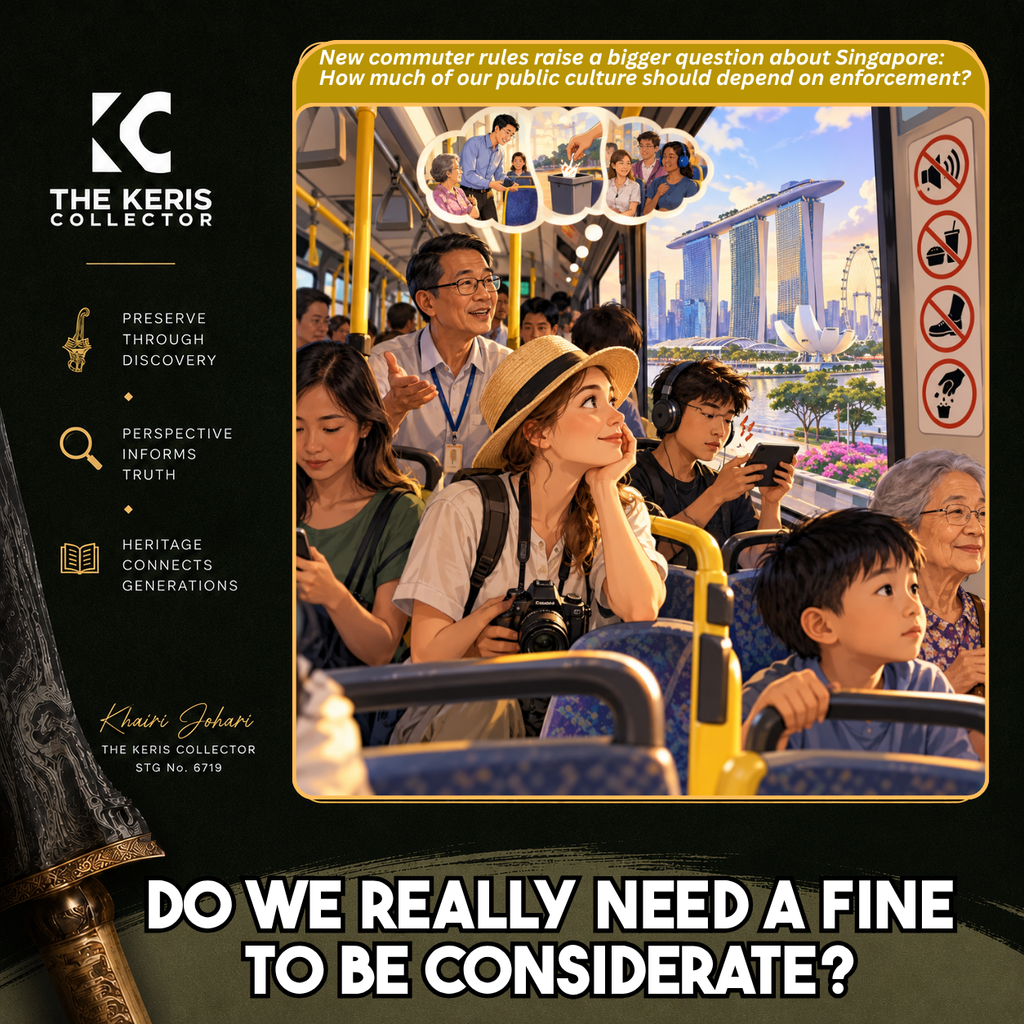
What Tourists Learn About Singapore on the Bus?
When Courtesy Has to Become Law?
Becoming a licensed tourist guide has changed the way I look at ordinary Singapore. New rules against nuisance behaviour on public buses made me think about something larger than fines: how much of our public culture is created by regulation, and how much depends on the small accommodations we make for strangers every day?
Being a tourist guide has changed the way I look at Singapore. I used to board a bus or MRT train simply because I needed to get somewhere. These days, I sometimes catch myself looking around and wondering what somebody encountering Singapore for the first time is seeing.
It is an occupational hazard, I suppose. Once you start guiding, Singapore becomes two places at once. There is the country you have known all your life, and there is the country you are temporarily trying to see through somebody else’s eyes.
That was what came to mind when I read the news on 21 September about new regulations covering nuisance behaviour on public buses and at bus interchanges and terminals. Like many commuters, my first reaction was fairly simple: good. I have no particular attachment to listening to somebody else’s video at full volume, and I doubt many people are campaigning for the freedom to put their feet on bus seats.
The actual regulations are more measured than the S$500 figure in the headlines might suggest. From 23 September 2026, behaviour including playing audio loudly enough to cause nuisance or annoyance, putting feet on seats, littering, and eating or drinking on buses can constitute offences carrying a maximum penalty of S$500. More serious conduct, including causing obstruction or danger at bus interchanges or terminals and soiling buses or interchange premises, can carry a maximum penalty of S$5,000. LTA says the framework is intended to align the treatment of nuisance and disruptive behaviour across buses and trains.
That does not mean playing a loud video automatically costs S$500. The figure is a maximum penalty. Bus captains will not issue the new Administrative Notifications of Offence because their primary responsibility is operating the bus safely. They can still advise passengers to stop disruptive behaviour, require an uncooperative passenger to alight and seek assistance in more serious cases. LTA has also said that operators will exercise discretion and fairness, particularly where physical or mental health conditions are involved.
The rules did not suddenly appear this week either. They follow earlier Conditions of Carriage for buses and legislation passed in October 2025 to enable closer alignment between the bus and rail regulatory frameworks. LTA’s stated objective is straightforward: public transport is a shared space, and nuisance or disruptive behaviour can make that space less safe or pleasant for everyone else.
I find that reasonable. What interests me more is what happens beyond the legislation.
I can spend considerable time preparing what I want visitors to understand about Singapore. I can explain how the city developed, how different communities came to live alongside one another, why our urban landscape looks the way it does, how our transport system works, and why certain institutions emerged from particular historical circumstances.
Meanwhile, the visitor is conducting his or her own investigation.
The experience begins before I say anything. It may begin at Changi Airport, immigration, the taxi queue or an MRT platform. It continues on the pavement outside the hotel, inside a hawker centre and during the journey between attractions. When the tour ends, Singapore does not.
This is one reason I find guiding so interesting. I can interpret a country, but I cannot control it. I cannot control the weather, traffic, construction work, queues, businesses, commuters or what somebody two seats away decides to play through a phone speaker. Once we move through ordinary Singapore, what happens around us becomes part of the visitor’s experience whether I planned for it or not.
That does not mean one noisy commuter somehow damages Singapore’s international reputation. Nobody sensible changes his opinion of an entire country because somebody watched a video too loudly on the bus. But think about how we experience other places ourselves. We remember more than monuments. We remember the airport, the train, the street outside the hotel, the person who helped when we were lost, the queue nobody respected, the unexpectedly clean public toilet and the ordinary rhythms of people who had no idea we were observing them.
No single encounter defines a country. Together, those encounters contribute to what being there actually felt like.
This initially tempted me towards a familiar conclusion: perhaps Singaporeans are becoming less considerate and the Government now has to regulate behaviour that previous generations understood instinctively.
The historical record makes that difficult to sustain.
Singapore’s first National Courtesy Campaign was launched in 1979. Interestingly, it grew out of a Singapore Tourist Promotion Board initiative from the previous year encouraging Singaporeans to be more polite and friendly towards tourists. Mr. Lee Kuan Yew broadened the idea because he believed kindness, consideration and thoughtfulness should apply to Singaporeans’ treatment of one another, not merely to visitors.
The campaign continued for decades in various forms. Singapore used publicity, education, competitions, slogans and the familiar Singa mascot to encourage courteous behaviour. In other words, previous generations also needed reminding.
That is worth remembering whenever we complain about people nowadays.
I could not find convincing evidence that Singaporeans as a whole have recently become less gracious. What we can say is that some forms of nuisance have changed. The smartphone is an obvious example. It allows an intensely private activity to travel almost anywhere with us. Earphones largely preserve the boundary between what I am watching and the environment around me. A speaker removes it.
The technology is contemporary. The underlying social question is much older: how much of my personal preference am I entitled to impose on strangers who have no practical choice but to share the space with me?
A bus makes that question unusually visible. People who may have almost nothing else in common occupy the same vehicle, and every passenger has a legitimate claim to be there. A crowded bus works because people make small accommodations for one another. They move further in, make room for passengers to alight, keep the aisle reasonably clear and take their rubbish with them. None of this is heroic. Most of the time we barely notice it.
No enforcement officer witnesses most of those decisions.
That complicates any neat choice between law and culture. Singapore has never relied entirely on voluntary graciousness, and there is little reason to romanticise that possibility now. Rules establish boundaries. Campaigns make expectations clearer. Enforcement provides consequences when persuasion fails. Yet no practical regulatory system can supervise every ordinary interaction in a city of millions. Shared spaces remain usable because most people follow most expectations without calculating the penalty first.
This is why I do not find the new regulations inherently troubling. If persistent nuisance is making journeys unpleasant or unsafe, regulation can be a reasonable response. LTA itself describes public transport as a shared space and says enforcement will continue alongside efforts to encourage considerate behaviour.
There also needs to be room for judgement. Behaviour that appears inconsiderate may sometimes have an explanation another passenger cannot see. LTA’s explicit reference to physical and mental health conditions is important for precisely that reason. Graciousness cannot mean becoming self-appointed enforcement officers who photograph strangers, post them online and invite thousands of people to punish somebody without context.
That would be a rather peculiar way to create a more considerate society.
Visitors themselves are not exempt from any of this. Tourists can block walkways, misunderstand local practices or simply bring different expectations of public space with them. Sometimes a polite explanation or a little patience is more appropriate than indignation. Shared-space etiquette works in both directions.
And this is where guiding leads me somewhere more interesting than my initial reaction to the new rules.
I do not think Singaporeans should behave considerately because tourists might be watching. Public transport is not a tourism exhibit. It exists primarily for the people who live and work here. If I lower my phone volume, move aside for another passenger or leave a seat clean, I am not doing the Singapore Tourism Board a favour. I am recognising that the stranger beside me has the same claim to that shared space that I do.
A visitor seeing that behaviour is secondary, but perhaps that is precisely why the observation means something. What the visitor encounters has not been staged for him. He is simply seeing how people negotiate life together when nobody is consciously presenting Singapore.
That brings me back to the origins of the Courtesy Campaign. It began with tourists, but the ambition quickly became larger. Courtesy made little sense if it was something Singaporeans switched on for visitors and switched off with one another. The historical lesson is not that a campaign solved the problem. The continued existence of campaigns and regulations suggests something more ordinary: maintaining shared standards is ongoing work.
A living country is not a museum display. I can explain Singapore’s planning, institutions, transport system and the compromises involved when millions of people share a small island, but what happens around that commentary belongs to Singapore itself.
The new bus regulations establish clearer boundaries around behaviour that can make a shared journey unpleasant. There is a reasonable case for doing that. What regulations cannot do is supervise every small accommodation that allows a dense city to function. Most of those decisions are too ordinary ever to become offences or news stories. Someone makes room, waits for another passenger to alight, takes his rubbish with him or turns the volume down because other people occupy the space too.
After thinking about it, I don’t believe this is principally a tourism question. We should want considerate public spaces because we live in them. Visitors merely encounter the culture we create for ourselves.
My job is to explain Singapore. By the time I begin, they have already started seeing it.
CONCISE SOURCE / REFERENCE NOTE
The immediate trigger was CNA’s 21 September 2026 report, checked against LTA’s primary-source announcement issued the same day. LTA confirms that the Bus Services Industry (Control of Conduct and Activities – Public Bus) Regulations 2026 and Bus Services Industry (Control of Conduct and Activities – Bus Interchange) Regulations 2026 take effect on 23 September 2026. Specified nuisance offences carry a maximum S$500 penalty, while specified more serious offences carry a maximum S$5,000 penalty. Empowered operator staff, rather than bus captains, may issue Administrative Notifications of Offence before LTA investigates. LTA also expressly says discretion and fairness will apply, especially in cases involving commuters with physical or mental health conditions.
The historical discussion draws principally on National Library Board records. Singapore’s first National Courtesy Campaign was launched on 1 June 1979 after an earlier Singapore Tourist Promotion Board initiative encouraging courtesy towards tourists. Mr. Lee Kuan Yew broadened the campaign towards kindness, consideration and thoughtfulness between Singaporeans generally. The campaign’s long history is evidence that encouraging considerate public behaviour is not a new concern, but it does not establish that Singaporeans today are more or less gracious than previous generations.
I have therefore deliberately avoided claiming that nuisance behaviour is increasing, that smartphones have caused a measurable decline in graciousness, or that individual incidents materially affect Singapore’s international reputation. Those propositions were not established by the evidence reviewed.