
Your Guru Is Still Just a Man. No Title Gives You Rights Over My Child
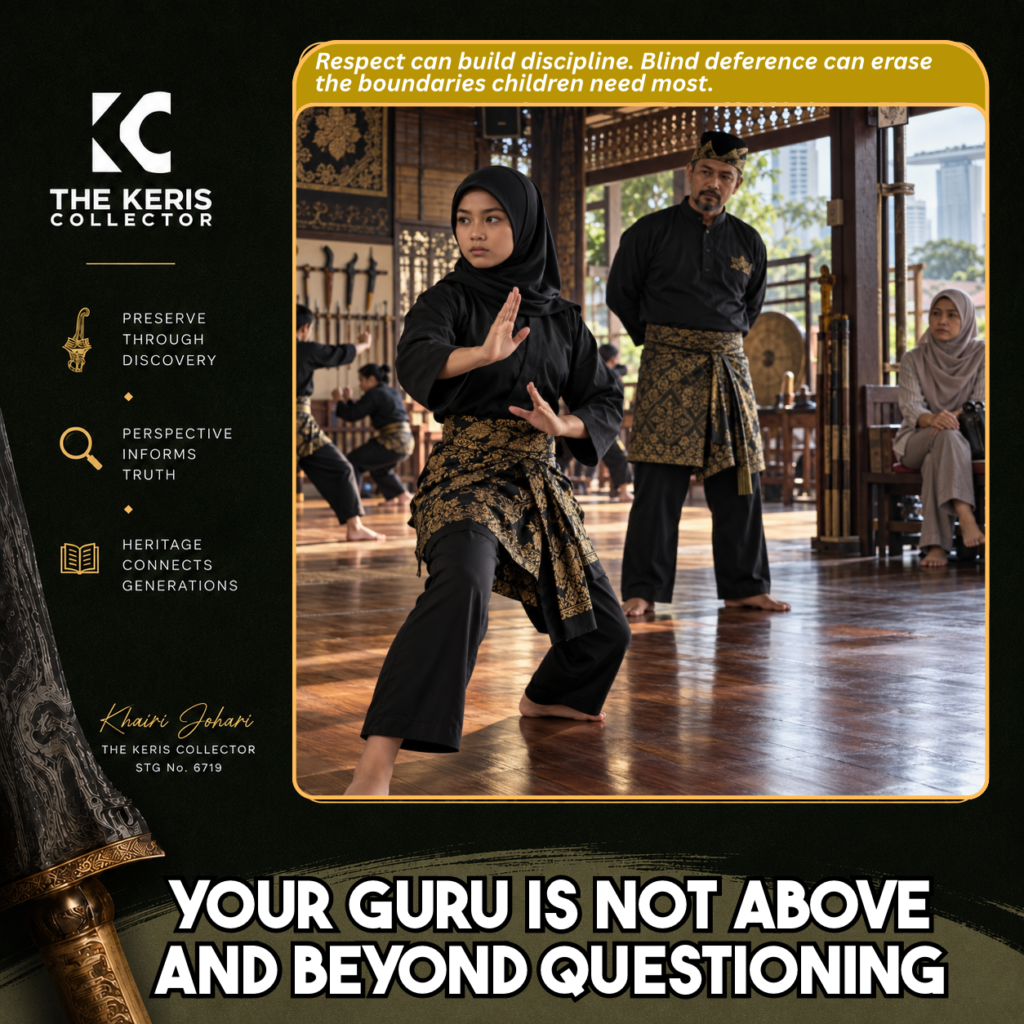
A recent Singapore court case involving a silat instructor and a 14-year-old student should not become an indictment of silat. It should make us examine something harder: how respect for a teacher can become deference, and why safeguarding children cannot depend on believing that respected adults are necessarily good adults.
I have become increasingly uncomfortable with the way the word guru is sometimes used.
Not because teachers deserve no respect. I have spent enough time around silat communities to know practitioners and instructors whose knowledge, discipline and character I genuinely admire. Good teachers matter, especially in traditions where knowledge is passed carefully from one generation to another.
What I no longer accept is the idea that the title itself should command unquestioning deference.
A recent Singapore court case is an ugly reminder of why.
A 59-year-old silat instructor was sentenced to five months and five weeks’ imprisonment after pleading guilty to one count of molestation and one count of sexual communication with a minor. Two additional molestation charges were taken into consideration. His student was 14, and her identity is protected by a gag order.
According to court reporting, the girl began attending silat lessons in November 2024. During a traditional salam after one lesson, she held the instructor’s hand and brought it towards her forehead. He then used his grip to pull her towards him, hugged her and kissed her forehead over her hijab. Similar conduct occurred again, and on a later occasion he kissed her cheek.
There was nothing inherently improper about the traditional greeting itself. What mattered was how an adult in authority used a familiar interaction to obtain physical access that went beyond the greeting.
The digital behaviour later became even more troubling. The instructor communicated with her through Telegram using disappearing messages and invited her to ask him about sexual matters. The girl herself recognised that this was inappropriate for a teacher and preserved screenshots before the messages disappeared. Her mother later discovered them, and the police were alerted.
That detail matters because the girl was not simply passive in this story. She understood that something was wrong and preserved evidence.
The question for the rest of us is whether we create environments in which children know they are allowed to trust that judgement even when the adult making them uncomfortable is respected.
When respect becomes deference
I began thinking this was an essay about the word guru. I no longer think it is.
A football coach can misuse authority. So can a tuition teacher, religious instructor, schoolteacher, swimming coach, family friend or respected elder. The problem is not the vocabulary. It is what happens when an adult is given authority, regular access to children and a level of deference that makes refusal feel improper.
Silat simply gives the problem a particularly interesting setting because physical proximity is part of legitimate instruction.
A teacher may need to correct stance, balance, positioning or movement. Martial arts cannot be taught through a rule that adults never touch students. That would be absurd.
But professional contact has a purpose.
A technique correction is different from unnecessary affection. A controlled demonstration is different from an embrace. Physical contact that makes sense within instruction is not the same as contact justified only by the adult’s status.
Singapore’s Safe Sport framework already recognises this distinction. It addresses unequal power relationships between coaches and athletes, inappropriate physical contact, one-to-one interactions and electronic communication with minors. It does not assume that every coach is dangerous. It assumes something more practical: good safeguarding should not depend on guessing which adults are safe.
That is the point I think matters most.
Parents cannot reliably identify every unsafe person by appearance, reputation or title. Organisations cannot either. People capable of harmful behaviour do not necessarily present themselves as harmful people.
Safeguarding therefore cannot be built around character alone.
Most adults working with children may behave perfectly well. Some will not. We cannot always know in advance who belongs in which category, so the boundaries should exist regardless of reputation.
That protects children.
It also protects good teachers.
Good teachers should not need exceptional trust
My discomfort comes partly from familiarity with silat, not hostility towards it.
I have been around these circles long enough to meet practitioners and teachers whom I respect deeply. I have also learned not to treat seniority, religious presentation, traditional knowledge, public reputation or a large following as proof of moral character.
Those things are neither evidence of goodness nor evidence of wrongdoing.
They are simply poor substitutes for safeguards.
As a parent, I remain responsible for deciding how much access another adult has to my child. I do not surrender that responsibility because the person is called guru, coach, teacher or anything else.
That is particularly clear to me as a Muslim father. I am conscious of physical boundaries between my children and unrelated adults, but I do not need to turn this essay into a religious ruling on martial-arts instruction to make the broader point.
A respected title does not create additional physical entitlement over somebody else’s child.
And this argument should make sense regardless of religion.
Parents often choose teachers precisely because they want another trusted adult to influence their children positively. A good mentor can provide discipline, confidence, knowledge, cultural transmission and forms of guidance a parent may not be able to provide personally.
That is valuable.
The mistake is confusing delegated authority with surrendered responsibility.
A mentor can become important to a child without becoming beyond question.
Safeguarding should feel ordinary
The healthier approach is not suspicion of every instructor.
It is making reasonable boundaries normal.
Singapore’s Safe Sport framework provides useful examples. One-to-one interactions with minors should generally be observable and interruptible. Organisations should think carefully about electronic communication, physical contact, changing areas and reporting mechanisms. Parents should understand how adults working with their children are expected to behave.
None of this requires a parent to sit beside a child at every lesson.
Nor does it require secretly monitoring every message a teenager sends.
The goal is oversight combined with communication.
Parents should know who is teaching their children, how private communication is handled and whether the organisation has somewhere for a child to report discomfort. More importantly, children should know that telling a parent about an uncomfortable interaction will not automatically result in blame, embarrassment or an accusation that they were disrespectful.
That last part may be more important than any phone inspection.
In this case, the mother found the screenshots while looking through her daughter’s phone. I would not turn that fact into a universal rule that parents should constantly search teenagers’ devices.
What transfers much better from this case is that the girl recognised the communication was inappropriate and preserved evidence.
We should want children to develop that judgement.
We should also make it safe for them to use it.
The same applies to disappearing messages. Such messages are not inherently suspicious. Plenty of adults use them for ordinary privacy.
The context changes when an adult in authority is communicating privately with a minor.
A professional relationship with a child should usually benefit from greater visibility, not less. Deliberately ephemeral private communication deserves closer scrutiny when it has little or nothing to do with the activity the adult is supposed to be teaching.
That does not mean every deleted message proves grooming.
It means secrecy and authority are a poor combination when children are involved.
Respect should strengthen good teaching, not silence children
The answer is not to eliminate respect.
Silat would lose something valuable if discipline, humility and reverence for knowledge were replaced with suspicion of every instructor. Traditional teacher-student relationships can encourage commitment, patience and serious learning. Good mentors can influence a child for life.
Those things are worth preserving.
What should not be preserved is the assumption that respect requires obedience beyond the legitimate teaching relationship.
Listening carefully is respect.
Learning seriously is respect.
Acknowledging expertise is respect.
None of those requires private loyalty, physical affection, secrecy or silence when an interaction feels wrong.
This is where I think the lesson from the case extends far beyond silat.
Authority over children should come with more accountability, not less.
The triggering case involves an adult man and a teenage girl, but the safeguarding principle is not gender-specific. Boys can be abused. Women can offend. Any adult-child relationship involving authority deserves boundaries appropriate to the setting.
That also means background checks, where available, can only ever be one layer. A clean record does not prove somebody is safe, just as a respected reputation does not.
A better system assumes that adults working with children should be able to operate comfortably within visible, professional boundaries whether anybody suspects them of wrongdoing or not.
Good teachers should welcome that.
They should be comfortable with parental scrutiny. They should not need secret communication. They should understand why unnecessary physical affection is different from legitimate instructional contact. And they should be able to hear a child say no without treating that refusal as insubordination.
That is not hostility towards teachers.
It is what trustworthy authority looks like.
I still want children to respect good teachers. I want them to learn discipline, humility and the value of receiving knowledge from people who know more than they do.
But respect should strengthen a healthy teaching relationship, not silence a child within it.
The lesson I take from this case is therefore not that parents should trust nobody. It is that trust is not a safeguarding system.
A child can admire a teacher, learn from him and still know that saying no does not become disrespect simply because the adult is called guru.
And a parent can respect a tradition without surrendering responsibility for the child entrusted to it.
CONCISE SOURCE / REFERENCE NOTE
The triggering case is based on The Straits Times’ court report on the sentencing of a 59-year-old silat instructor who pleaded guilty to one count of molestation and one count of sexual communication with a minor; two additional molestation charges were taken into consideration. The student was 14, and her identity is protected by a gag order. The reported conduct included pulling her towards him during salam, hugging and kissing her, and later communicating sexually through disappearing Telegram messages.
The broader safeguarding analysis draws on Singapore’s Safe Sport framework, which addresses power imbalances, inappropriate physical contact, one-to-one interaction and electronic communication with minors. These standards are useful here because they distinguish legitimate sporting contact from inappropriate behaviour rather than treating all contact as suspicious.
The Islamic perspective in the essay is deliberately kept personal rather than presented as a religious ruling. I have not relied on an adjacent MUIS ruling to establish a specific rule for silat instruction. The broader point does not require one: respected cultural or religious status does not remove the need for appropriate boundaries around children.