
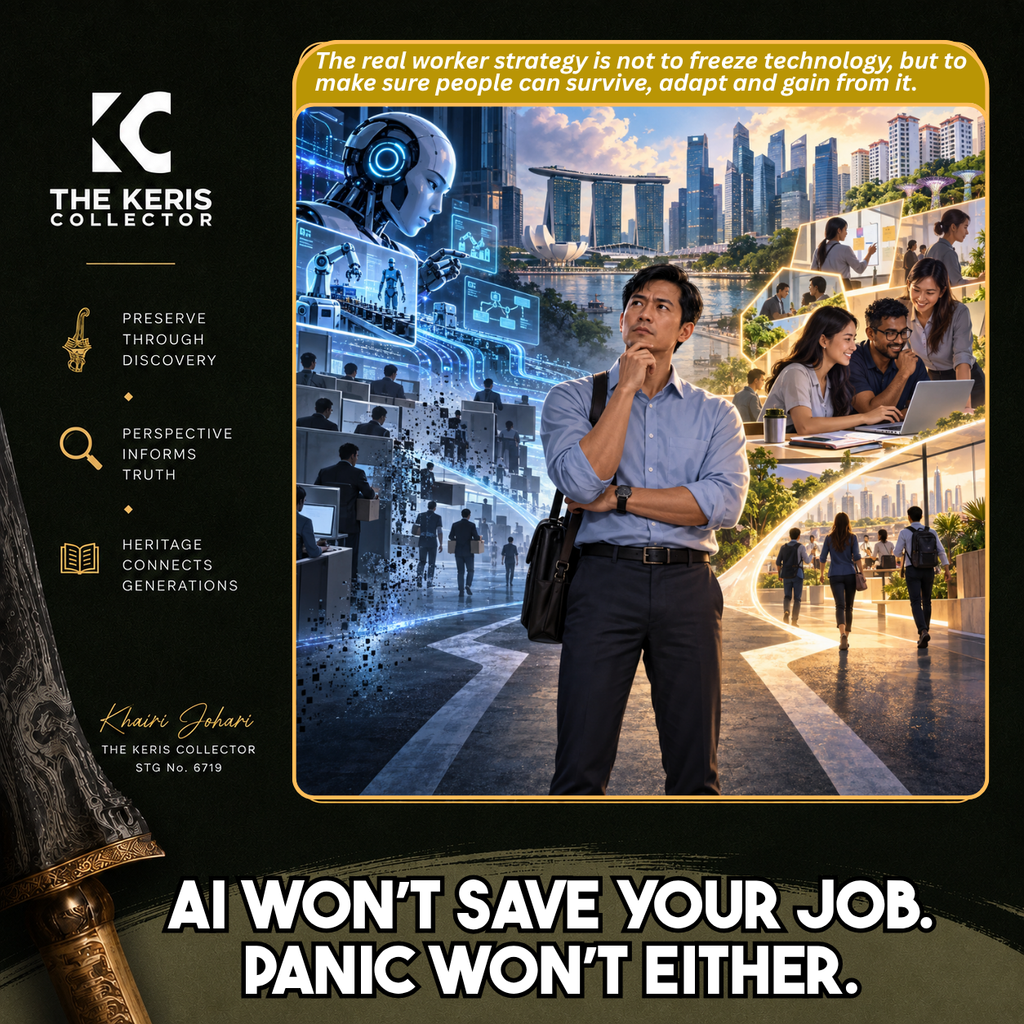
Fearing AI Will Not Protect Workers If AI Makes Businesses Stronger, Why Shouldn’t It Make Workers Stronger?
A recent Workers Make Possible video raises legitimate questions about surveillance, retrenchment and who benefits when AI raises productivity. Where I disagree is with the way financial risk, CPF, geopolitics and job displacement are drawn into one escalating narrative. Singapore workers need protection through technological change. They also need the ability to participate in the productivity that technology creates.
I recently watched a Workers Make Possible video about artificial intelligence and workers in Singapore. I expected to disagree with much of it. After looking more closely at the claims, I found that several of its concerns deserve serious attention.
Workers should care about intrusive workplace monitoring. Retrenchment can impose substantial costs on individuals and families. If an employer introduces technology that materially changes how someone’s performance is measured or whether a role continues to exist, workers have a legitimate interest in understanding what is happening. And when technology raises productivity, asking who receives the resulting gains is a perfectly reasonable labour question.
Workers Make Possible itself describes its mission as advancing workers’ rights, providing labour analysis, mobilising workers and assisting people facing workplace crises. Its recent public material also shows a broader concern with working time, worker organisation and AI displacement.
Where I became less convinced was with the larger argument built around those concerns.
The video moves across AI-company valuations, Singapore’s investments in OpenAI and Anthropic, CPF, the Israel-Palestine conflict, job losses, workplace surveillance, working hours and retrenchment protections. Some of these issues may be connected at certain points, but evidence for one does not automatically establish the next.
An ethical objection to a technology company does not establish that the company is financially overvalued. Singapore investment institutions holding stakes in AI companies does not mean an individual’s CPF account rises and falls with those investments. The possibility that AI may eventually eliminate significant numbers of jobs does not establish that it is already causing mass retrenchment in Singapore.
Those distinctions matter because the actual risks are serious enough without making them larger than the evidence allows.
Singapore’s labour market is softening in places. Retrenchments rose from 3,830 in the first quarter of 2026 to 4,620 in the second. The proportion of retrenched residents who had returned to work within six months fell from 60.7 per cent to 54.9 per cent. But unemployment remained low, total employment continued to grow, and there were still 1.48 vacancies for every unemployed person in June. MOM’s overall assessment was that the labour market remained resilient, although conditions had become less favourable for some resident workers.
That is a more complicated picture than an AI jobs crisis.
What AI is actually doing to Singapore jobs so far
The claim that employers may eventually use AI to reduce labour is entirely plausible.
If a business can produce the same output with fewer hours of human work, management will have a reason to reconsider how that work is organised. Sometimes that will mean redesigned jobs. Sometimes fewer hires. In some occupations, it may eventually mean fewer workers.
But current Singapore evidence does not show widespread AI-driven displacement.
MOM’s inaugural 2026 study found that 71.5 per cent of surveyed firms had not yet adopted AI. Among those that had, 6.2 per cent reported reducing headcount after adoption. Job redesign was more common, at 18.9 per cent, while 13.9 per cent reported creating new AI-related jobs. More than 70 per cent of adopters reported improvements in worker productivity. MOM concluded that there was no indication of significant job displacement at that point.
That finding should not be converted into complacency. It tells us what is happening now, not what will happen several years from now.
It does suggest that AI may initially transform tasks faster than it eliminates entire occupations.
The distinction is important. A study of more than 5,000 customer-support agents found that access to a generative AI assistant increased productivity by about 14 per cent on average, with far larger gains among newer and lower-skilled workers and relatively little benefit for the most experienced workers. The research was later published in the Quarterly Journal of Economics.
That does not mean every worker becomes 14 per cent more productive. It shows how uneven the effects can be.
If a task that previously required three hours can now be performed reliably in one, the economics of that task have changed even if the job remains. Expectations may rise. Teams may shrink. Some skills may become cheaper. Other capabilities, including judgement, verification and domain expertise, may become more valuable.
Workers can lose from that process.
They can also gain from it.
That possibility deserves more attention.
Singapore’s AI investments deserve scrutiny, but the financial structure matters
The video also raises questions about Singapore’s exposure to major AI companies.
That is fair territory for scrutiny.
GIC led Anthropic’s US$30 billion Series G financing in February 2026, valuing the company at US$380 billion. Anthropic subsequently raised another US$65 billion at a US$965 billion post-money valuation in May. Those are extraordinary numbers, and it is entirely reasonable to ask whether expectations have run ahead of eventual returns.
It does not follow that AI itself is therefore a bubble.
A technology can transform an economy while particular companies are badly overpriced. Investors discovered that during the dot-com boom without disproving the value of the internet.
There is also an important distinction between Government spending and sovereign investment.
MOF states that the Government sets the overall mandates and objectives for GIC, MAS and Temasek, but does not direct their individual investment decisions. GIC manages Government assets professionally for long-term returns. Temasek owns the assets on its own balance sheet and makes individual investment decisions independently of Government direction.
That structure does not make bad investment decisions impossible. Nor does it remove the case for scrutiny. It simply means that describing every such investment as the Government directly “pouring taxpayer money” into AI companies is too imprecise.
The CPF connection needs even more care.
CPF savings are invested by CPF Board in Special Singapore Government Securities, which are issued and guaranteed by the Government. Those funds are pooled with other Government monies and invested on a consolidated basis by GIC. CPF members receive the stipulated CPF interest regardless of GIC’s performance over a particular period. Temasek does not manage CPF monies.
Investment performance still matters to Singapore. Returns from the reserves support public spending through the Net Investment Returns Contribution. Sustained poor investment performance would therefore have wider fiscal consequences.
But that is a much longer causal chain than saying an AI investment loses money and somebody’s CPF savings consequently disappear.
Before describing systemic danger, we need to know the scale of the exposure relative to the relevant portfolios. Public information does not appear sufficient to establish that the AI positions themselves pose a systemic threat to Singapore’s reserves.
There is also a commonly confused S$300 million figure. The OpenAI for Singapore initiative announced in May 2026 involves more than S$300 million committed by OpenAI to Singapore’s AI ecosystem. It is not a S$300 million Government payment to OpenAI.
When the argument concerns public wealth, those distinctions are not technical distractions. They are the argument.
Ethical investment and financial risk should not be treated as the same claim
The video’s reference to Palestine belongs in a separate category.
There are documented ethical questions about the use of commercial AI and cloud technology by the Israeli military. Associated Press reporting found that Israel expanded its use of US-developed commercial AI and cloud systems, including access to OpenAI models through Microsoft’s Azure infrastructure, in military operations.
That can support a serious discussion about corporate responsibility and ethical investment.
It does not establish whether OpenAI, Anthropic or any other AI company is financially overvalued.
A company may be profitable and ethically controversial. Another may be commercially disastrous and ethically unremarkable.
If an investment is objectionable on moral grounds, the case should be made from evidence about the conduct. If it is financially risky, the case should be made from valuation, exposure, expected return and portfolio risk.
One argument should not be used as evidence for the other.
That is enough on Palestine for this essay. The labour question is more important here.
Where the worker argument becomes stronger
The video’s workplace concerns are more substantial.
Algorithmic management is already changing how workers can be instructed, monitored and evaluated. OECD research across several countries found that such tools are becoming widespread and that managers themselves report concerns about unclear accountability, opaque decision-making and inadequate protection of worker health.
So consultation is not a frivolous demand.
A 2025 OECD experiment in German manufacturing firms found that consultation involving workers, managers and works councils could preserve productivity gains while improving job-quality outcomes, although the researchers themselves cautioned that the experiment was limited in scale and geography.
The challenge is proportionality.
Introducing an AI transcription tool is different from introducing a system that scores employees, determines schedules or contributes to disciplinary decisions. The greater the effect on someone’s working conditions, the stronger the case for meaningful consultation.
The same applies to surveillance.
An absolute rule of “no surveillance” is difficult to sustain when employers also have responsibilities involving cybersecurity, intellectual property, confidential customer information and regulated data. An employee at a bank cannot reasonably expect unrestricted freedom to upload sensitive records to an external AI service.
That does not justify unlimited monitoring.
A more defensible standard is monitoring that is proportionate to the risk, disclosed to workers, limited to legitimate purposes and subject to accountability.
On employer-required AI tools, there may be relatively little disagreement. If a company requires employees to use a particular commercial system for their work, treating that system as a business expense is a reasonable starting point. An optional subscription somebody buys independently is different.
The more difficult issue is productivity.
If AI allows a business to produce more with the same workforce, there is no economic rule saying the gain must become shorter hours at unchanged pay. It might appear as higher wages, lower prices, increased output, investment, profits or some combination of these.
But there is equally no rule saying every productivity gain should flow to owners of capital.
That is where the worker-centred concern deserves more attention.
Who captures productivity is a question about bargaining power, institutions and the design of the employment relationship.
Why must the worker stand outside the technology?
This is where my disagreement with the video’s overall framing becomes more fundamental.
The worker is largely presented as someone upon whom AI will act. Employers buy the technology, employers deploy it, employers restructure around it, employers monitor through it, and workers organise themselves in defence.
That is one possible relationship with technology.
It is not the only one.
Workers can use AI too.
An accountant with domain knowledge can automate parts of routine analysis. A technician may use it to search documentation or diagnose problems faster. A researcher can process information more efficiently. A programmer can accelerate parts of software development. An experienced professional may be able to produce work independently that previously required a larger support structure.
None of this guarantees better wages or job security.
That distinction is crucial.
A worker becoming more productive does not mean the worker automatically receives the value of that productivity. An employee can become significantly more efficient while receiving exactly the same salary.
Individual capability and collective bargaining therefore solve different problems.
Capability affects what the worker is able to produce.
Labour institutions, collective organisation and employment policy influence how the resulting benefits and risks are distributed.
There is no contradiction in supporting both.
This is where I think a more useful worker-centred AI strategy begins. It should ask not only how workers are protected when employers deploy AI, but whether workers themselves are gaining access to the technology and learning how to use it.
If AI becomes a source of economic leverage, workers should not arrive at that future as spectators.
Protecting workers does not always mean preserving the job
The same distinction applies when jobs disappear.
Singapore already expects employers to consider alternatives to retrenchment, including training, redeployment, flexible schedules and shorter work weeks. Employers that do retrench must do so responsibly and fairly, and companies with at least 10 employees must notify MOM.
That is sensible.
Redeployment can preserve valuable people when real work exists elsewhere in the organisation.
What cannot always be preserved is the underlying task.
If technology genuinely removes the need for particular work and there is no productive alternative role, keeping someone nominally employed does not eliminate the economic problem. It delays it.
That is why I find the principle of protecting workers more useful than promising to protect every existing job.
It does not mean removing protections after displacement. Quite the opposite.
Singapore’s SkillsFuture Jobseeker Support scheme provides eligible involuntarily unemployed workers with up to S$6,000 over six months while they undertake active job search.
Retrenchment benefits are not currently a universal statutory entitlement. MOM says the amount depends on employment contracts, collective agreements or negotiation where no provision exists. The prevailing norm is between two weeks and one month’s salary for each year of service. Around nine in ten eligible workers in notified retrenchments between 2020 and 2025 received benefits, and about eight in ten of those received at least two weeks’ salary per year of service.
The arrangement is also under review. MOM said in September that the tripartite partners were examining ways to strengthen support for retrenched workers and provide greater clarity on employers’ obligations.
Whether Singapore should legislate a statutory minimum is a legitimate policy question. Greater certainty for workers has advantages. Additional costs imposed on firms, especially distressed smaller businesses, also matter.
There is no need to pretend that trade-off has an easy answer.
What matters is recognising that transition support and job preservation are not synonymous.
Worker power should mean more than slowing down change
Workers Make Possible is right about one fundamental thing: AI is a labour issue.
Where I differ is in how worker power should be imagined.
It can include protection against abusive monitoring. It can include consultation where technology materially changes employment. It can include stronger bargaining over how productivity gains are shared. It can include retrenchment benefits, temporary income support and credible routes into new work.
But it should also include the worker’s own productive capability.
A worker who understands the technology changing his occupation has more options than one who encounters it only after management has redesigned the role.
That does not mean everyone can become an entrepreneur or consultant. Some occupations will shrink. Some jobs may disappear entirely. Workers with caregiving responsibilities, limited savings or specialised skills may find transitions particularly difficult.
A serious adaptation strategy has to acknowledge that.
It also means the productivity test should not stop with junior employees.
AI can compress reporting, presentation preparation, administrative coordination and information synthesis in managerial work just as it can automate routine tasks elsewhere. Management remains valuable where it contributes judgement, accountability, leadership and coordination. But technology does not naturally stop at the management layer.
The relevant question throughout an organisation is what value remains when routine work becomes cheaper.
That question can be uncomfortable for everybody.
A better worker strategy begins with separating risks
After examining the claims, I do not think the worker concerns in the video should be dismissed.
AI can displace labour. Algorithmic monitoring can become intrusive. Some firms may capture far more of the productivity gain than workers do. Retrenchment causes real hardship. Singapore’s transition protections are legitimate subjects for debate.
The weaker part of the argument is treating those concerns as though they prove one another.
Current evidence does not show mass AI unemployment in Singapore. CPF members do not directly hold stakes in individual AI companies. Government does not direct every GIC or Temasek investment. Ethical objections to military uses of commercial technology do not establish that AI valuations will collapse.
Correcting those propositions does not amount to defending every AI company or every employer.
It makes the worker question more precise.
Singapore needs to think about how AI affects bargaining power, working conditions, transition costs and the distribution of productivity. Employers need room to adopt technology where it genuinely improves operations, but that does not absolve them from responsibility towards people whose work is affected. Workers need credible support when jobs disappear.
And workers themselves need the opportunity to become users of the technology rather than merely subjects of it.
That, to me, is the more demanding worker-centred position.
The goal cannot be to make technological change stop at the factory door, office entrance or laptop screen.
It should be to make sure that when work changes, the person who performed it still has the capability, bargaining power and support needed to move with it.
Fear can tell us where the danger might be.
Worker power requires considerably more than fear.
CONCISE SOURCE / REFERENCE NOTE
Current Singapore labour-market conditions were checked against MOM’s Labour Market Report, Second Quarter 2026, released on 21 September. Retrenchments rose to 4,620, six-month re-entry weakened to 54.9 per cent and vacancies still exceeded unemployed persons by 1.48 to one.
MOM’s April 2026 AI survey found no evidence of widespread displacement at that stage: 6.2 per cent of AI-adopting firms reported headcount reductions, compared with 18.9 per cent reporting job redesign and 13.9 per cent creating AI-related jobs. Productivity evidence was checked against the Brynjolfsson, Li and Raymond study of customer-support workers.
Claims concerning Singapore’s AI investments and CPF were checked against MOF, GIC, CPF Board and MDDI. Government does not direct GIC or Temasek’s individual investment decisions; CPF savings are held through Government-guaranteed SSGS rather than direct stakes in individual companies; and the S$300 million-plus OpenAI for Singapore commitment is funding committed by OpenAI into Singapore’s ecosystem.
Workplace-AI concerns were checked against OECD research on algorithmic management and worker consultation. Singapore’s retrenchment framework, Jobseeker Support and current retrenchment-benefit arrangements were checked against MOM and official scheme materials.