
Did Singapore Civil Servants Really Trade on MRT Secrets?
Singapore Should Welcome Scrutiny. But the Scrutiny Must Survive Scrutiny Too.
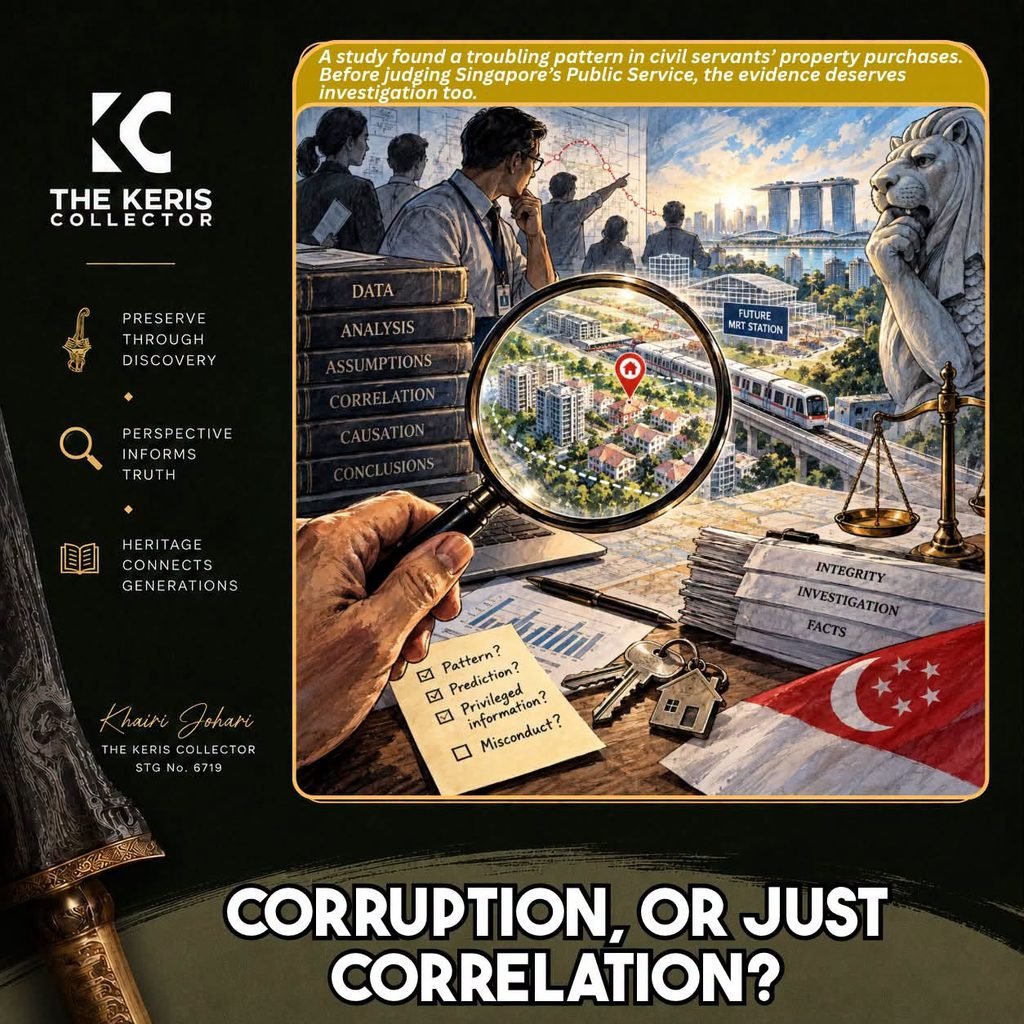
A new NBER working paper has found a troubling pattern in property purchases by people it classifies as Singapore civil servants. The finding deserves investigation. But evidence of unusual behaviour is not yet proof that public officers exploited confidential MRT information.
If Singapore civil servants used confidential MRT plans to buy property for personal gain, I want them investigated.
No excuses.
If the evidence establishes wrongdoing, take action.
Singapore’s reputation for clean government demands exactly that.
But if researchers are going to make an allegation this serious, I want their evidence scrutinised too.
That is not defensiveness.
It is the same standard.
A new working paper by Tomasz Piskorski, Amit Seru, Jian Zhang and Chun Zhao reports something genuinely concerning.
Before Singapore publicly announced certain new MRT stations, people the researchers classified as civil servants bought private properties near those future stations more frequently than otherwise similar buyers used as a comparison group.
The difference was concentrated one to two years before the announcements.
The researchers also report stronger patterns among officials in agencies associated with rail planning, among officials they classify as mid-level, and among people they describe as relatives.
They call this “clear evidence of informed trading by civil servants”.
That is a serious claim.
And it raises a simple question:
What exactly did the researchers prove?
What the Study Actually Found
Strip away the academic language and the research question is quite straightforward.
The researchers essentially asked:
Before Singapore announced new MRT stations, did people identified as civil servants buy nearby private properties more often than otherwise similar people?
Their answer is yes.
Then they tried to determine whether something innocent could explain the difference.
Perhaps civil servants were simply better at understanding publicly available information.
So the researchers compared them with property agents and corporate directors, groups that might also be expected to understand markets and development patterns.
Those groups did not display the same pre-announcement increase.
The researchers conducted other tests too, including a comparison involving the more regulated HDB market. They also found stronger purchasing patterns among officials in agencies involved in rail planning.
Those results make me take the paper more seriously, not less.
This is not a study that should be dismissed with “correlation is not causation” and forgotten.
The authors anticipated several obvious objections and tested them.
But there is still a missing link.
They do not actually observe a civil servant receiving confidential MRT information and deciding to buy a property because of it.
Instead, the researchers observe who bought property.
They estimate who was a civil servant.
They infer who may have been closer to MRT planning.
From the timing and location of purchases, they infer possible access to privileged information.
And from those patterns, they infer informed trading.
Every step may be reasonable.
But every step also adds uncertainty.
The further a conclusion travels from what the data directly observe, the stronger the evidence needs to be.
That distinction matters enormously when the conclusion carries an implication of misconduct.
A Working Paper Is Evidence to Examine, Not a Verdict
The research was circulated as NBER Working Paper 35756.
That gives it credibility worth taking seriously. The National Bureau of Economic Research is a major American economic research organisation, and the authors are academics from Columbia University, Stanford University and the University of Hong Kong.
But we should not transform “NBER working paper” into “NBER proved this”.
The paper itself states that NBER working papers are circulated for discussion and comment and have not been peer-reviewed or undergone the NBER Board review associated with official NBER publications.
That does not make the research worthless.
Quite the opposite.
It means this is exactly the stage at which the evidence is supposed to be challenged.
So challenge it.
Was the Buyer Actually a Civil Servant at the Time?
This is the first question I would want resolved.
The researchers linked property buyers to snapshots of Singapore’s Government Directory to identify civil servants and trace their transactions.
That is clever.
But a directory snapshot is not the same thing as a complete employment history.
The property transactions stretch across many years. A person appearing as a civil servant in a Government directory at one point does not by itself establish that the person held that position on the exact date of every property purchase.
Likewise, someone absent from one snapshot could have joined or left the service between observations.
This does not automatically invalidate the result. Researchers regularly work with imperfect datasets.
But the distinction becomes important when we move from:
“People we classify as civil servants display this pattern”
to:
“Civil servants engaged in informed trading.”
Interestingly, the Public Service Division has been careful about precisely this distinction, describing the subjects as civil servants “as classified by the authors”. PSD says it is now reviewing the paper’s data and methodology.
Singapore authorities should be able to answer this question much more precisely than an academic dataset can.
Were these people actually public officers when they bought the properties?
That should be established first.
“Unannounced” Does Not Necessarily Mean “Secret”
Then comes perhaps the most important methodological question.
The study examines properties near MRT stations that had been planned but not yet publicly announced.
But:
Officially unannounced is not necessarily the same as unknowable without confidential information.
Singapore plans infrastructure over long periods.
People speculate about future MRT lines, roads, housing estates and development areas all the time.
Property professionals do it.
Residents do it.
Urban planners do it.
Engineers do it.
Sometimes they are wrong.
Sometimes the logic of how an area is developing makes an educated prediction possible.
So the crucial question is not merely:
Had the Government officially announced the station?
It is:
Could its likely location reasonably have been anticipated using information already available outside Government?
The researchers anticipated this objection.
Their comparison with property agents and corporate directors did not show the same pre-announcement purchasing pattern, which strengthens their argument that civil servants possessed something those sophisticated outsiders did not.
That is evidence in the authors’ favour.
But it still does not completely distinguish between confidential knowledge and specialised professional inference.
A transport planner or urban planner might understand how Singapore’s infrastructure develops differently from a property agent without necessarily opening a secret MRT plan.
That possibility does not explain away the paper.
It simply means the paper cannot directly observe what the buyer actually knew.
Agency Is Not Access
The finding I would take most seriously is the reported concentration among officials in agencies involved in rail planning.
If that survives official scrutiny, it deserves attention.
But again:
Agency is not access.
A large government organisation can contain engineers, planners, finance staff, administrators, HR officers, communications staff and senior decision-makers.
They do not necessarily possess the same information.
Working for an agency connected with rail development does not establish that a particular employee knew the confidential location of an unannounced station.
Department matters.
Role matters.
Timing matters.
Actual access matters.
The researchers cannot see all of that from the outside.
Singapore authorities potentially can.
That is exactly why this paper should be treated as an investigative lead rather than a verdict.
The AI Classification Is Interesting, But Secondary
The paper’s claim about “mid-level officials” has attracted attention partly because the researchers used a large language model to classify job titles by seniority.
There is nothing inherently wrong with using AI for classification.
The question is whether the classification is accurate.
Government job titles do not always map neatly onto actual seniority, decision-making authority or access to confidential information.
So I would be cautious about building too much of the behavioural story around who supposedly faced the greatest “temptation”.
But this criticism should not be exaggerated either.
The paper’s main finding does not disappear merely because we question the AI classification.
The broader pre-announcement purchasing pattern exists independently of that exercise.
“Relatives” Does Not Mean Proven Information Leakage
The researchers also report a similar pattern among people they describe as relatives of civil servants.
That is potentially concerning.
But consistent with information leakage is not the same thing as proof of information leakage.
Families share many things besides confidential information.
They share financial advice.
Housing preferences.
Neighbourhood preferences.
Resources.
Investment strategies.
Social networks.
If relatives show similar behaviour, that is another reason to investigate.
It is not by itself evidence of a secret being passed across a dinner table.
Again, the pattern generates a question.
It does not answer it.
S$270 Million of Property Is Not S$270 Million of Profit
This distinction is especially important for public discussion.
The researchers estimate hundreds of millions of dollars in property acquisitions associated with the excess purchasing pattern.
That figure can easily sound like hundreds of millions in illicit gains.
It is not.
The value of property purchased is not the same as profit earned.
Purchase value is one thing.
Subsequent appreciation is another.
Realised profit after selling is another again.
The paper attempts to examine economic gains, but limited subsequent sales make some conclusions about realised returns harder to establish firmly.
If a person bought a S$1.5 million apartment, that does not mean he made S$1.5 million from privileged information.
Numbers this large attract headlines.
They also require context.
Something Changed After 2011. But Why?
One of the paper’s most interesting findings is that the suspicious pre-announcement purchasing pattern largely disappears after 2011.
The researchers connect this change to stronger formal enforcement.
Perhaps they are right.
But something else happened at almost exactly the same time.
Singapore was tightening its property market.
Additional Buyer’s Stamp Duty was introduced in December 2011 as part of measures intended to moderate residential-property demand. Other cooling measures were also being imposed around this period.
Those policies changed the economics of property investment.
So if the unusual purchasing pattern declined after 2011, there is another question:
Was it because officials became more afraid of enforcement?
Because property investment became more expensive?
Because of some combination of both?
Or because of something else?
The statistical change is interesting.
Its cause is not self-evident.
That matters because explaining why the behaviour disappeared is a larger claim than merely showing that it disappeared.
The Paper Has Found Something
After examining the study, I would not dismiss its central result.
Some of my initial scepticism does not survive contact with the authors’ additional tests.
The researchers have found something that deserves explanation.
The timing is unusual.
The difference from the comparison group is significant.
The property-agent comparison makes the public-information explanation less comfortable.
The reported concentration in agencies connected with rail planning makes the result more concerning.
Those findings should not be waved away simply because Singapore has a strong reputation for public-sector integrity.
But neither do they complete the evidential chain.
The researchers do not observe confidential information being obtained.
They do not observe it being transmitted.
They do not observe a decision to purchase because of that information.
And they do not establish misconduct by identifiable officers.
They observe a statistical pattern that they interpret as evidence of informed trading.
That is why I think the phrase “clear evidence of informed trading by civil servants” goes further than I would.
A more careful conclusion could have been equally serious:
The study identifies a statistically unusual purchasing pattern consistent with possible use of non-public information and sufficiently concerning to warrant investigation.
That says plenty.
Without pretending the investigation has already happened.
The Acknowledgement Mess Does Not Disprove the Research
There is also the strange issue surrounding the paper’s acknowledgements.
NUS professors Ivan Png and Jessica Pan have said they had no knowledge of the paper and asked for their names to be removed. Png said he provided neither comments nor data. Pan said her inclusion was a mistake. Other academics contacted by CNA gave varying accounts of their involvement, with Chang-Tai Hsieh confirming that he had discussed the research while also questioning aspects of its results.
That is embarrassing.
The authors should explain it.
But:
A mistaken acknowledgement does not disprove the statistical analysis.
The research stands or falls on its data and methodology.
Sloppiness in attribution can reasonably invite closer scrutiny of the research process. It cannot logically be used as proof that the empirical results are false.
The same caution applies in the other direction.
I began examining this controversy suspicious that the paper might have been framed with hostility towards Singapore.
I found no evidence sufficient to establish that.
So I am dropping that suspicion.
The identities, universities or political views of people named in an acknowledgement do not establish a conspiracy.
If the authors have interpreted their results too aggressively, methodological overconfidence is a sufficient explanation. Malice does not need to be invented.
Now Singapore Has to Investigate
PSD’s response so far is the correct institutional response.
It says it takes integrity concerns extremely seriously, is reviewing the paper’s data and methodology, and will refer the matter to CPIB if there is a material basis to do so.
That is what should happen.
Not:
Singapore has a clean Public Service, therefore this cannot be true.
And not:
Academics from famous universities found it, therefore Singapore civil servants must be corrupt.
Investigate.
Singapore’s reputation is not protected by declaring allegations impossible.
It is protected by finding out whether they are true.
And Singapore authorities can potentially answer questions that the researchers cannot.
Was each buyer actually a civil servant at the time?
Where did the officer work?
What was the officer’s role?
Did that person have access to confidential MRT information?
When did the information become available internally?
What was already publicly knowable?
Were there legitimate explanations for the purchases?
Do the transactions identified by the statistical analysis survive examination at the individual level?
If the answers establish a material basis for suspicion, CPIB should investigate.
If public officers abused confidential information for personal gain, take action according to the evidence and the law.
If the classifications are wrong, establish that.
If the transactions happened but have innocent explanations, establish that too.
And if the researchers have genuinely uncovered misconduct that Singapore’s own systems failed to detect, then Singapore needs to know that most of all.
Scrutiny Must Survive Scrutiny
There are two easy reactions to this controversy.
“See? Singapore is corrupt.”
Or:
“Foreign academics are trying to smear Singapore.”
Neither is justified by the evidence currently available.
What we have is something more interesting and more uncomfortable.
A serious academic study has detected a statistical pattern that is difficult enough to explain that Singapore should investigate it.
But the study still relies on inference to move from unusual purchasing behaviour to privileged information and from privileged information to misconduct.
Those distinctions matter.
Academic freedom includes the freedom to investigate governments.
It should.
Singapore should not fear serious research.
But freedom to investigate carries a responsibility to distinguish between what the data show, what they suggest, and what they actually establish.
Singapore owes its public officers the same fairness.
Do not convict them through statistical inference.
But Singapore owes its citizens something too.
Do not use methodological uncertainty as an excuse to ignore an uncomfortable finding.
If the paper is right, Singapore must know.
If the paper is wrong, Singapore must know that too.
That, to me, is the genuinely pro-Singapore position.
Protect the integrity of the Public Service.
Protect innocent officers from unsupported accusations.
Protect CPIB’s credibility.
And protect public confidence that genuine misconduct will be pursued wherever the evidence leads.
A clean government proves its integrity not by being immune from accusation, but by being willing to test credible accusations rigorously.
Singapore should never be afraid of scrutiny.
But scrutiny must itself withstand scrutiny.
CONCISE SOURCE / REFERENCE NOTE
The principal research examined is Tomasz Piskorski, Amit Seru, Jian Zhang and Chun Zhao, “Do Social Norms Substitute for Enforcement? Evidence from Public Officials’ Home Purchases in Singapore,” NBER Working Paper 35756 (September 2026). The paper reports higher pre-announcement private-property purchasing near future MRT stations among people classified as civil servants and conducts several additional tests intended to distinguish privileged information from alternative explanations. It remains an NBER working paper circulated for discussion and comment rather than a peer-reviewed or NBER Board-reviewed official publication. CNA reported on 14 September that PSD is reviewing the data and methodology and will refer the matter to CPIB if there is a material basis. CNA subsequently reported that NUS professors Ivan Png and Jessica Pan disputed their inclusion in the acknowledgements; this raises a legitimate research-process question but does not itself establish anything about the validity of the empirical results.