
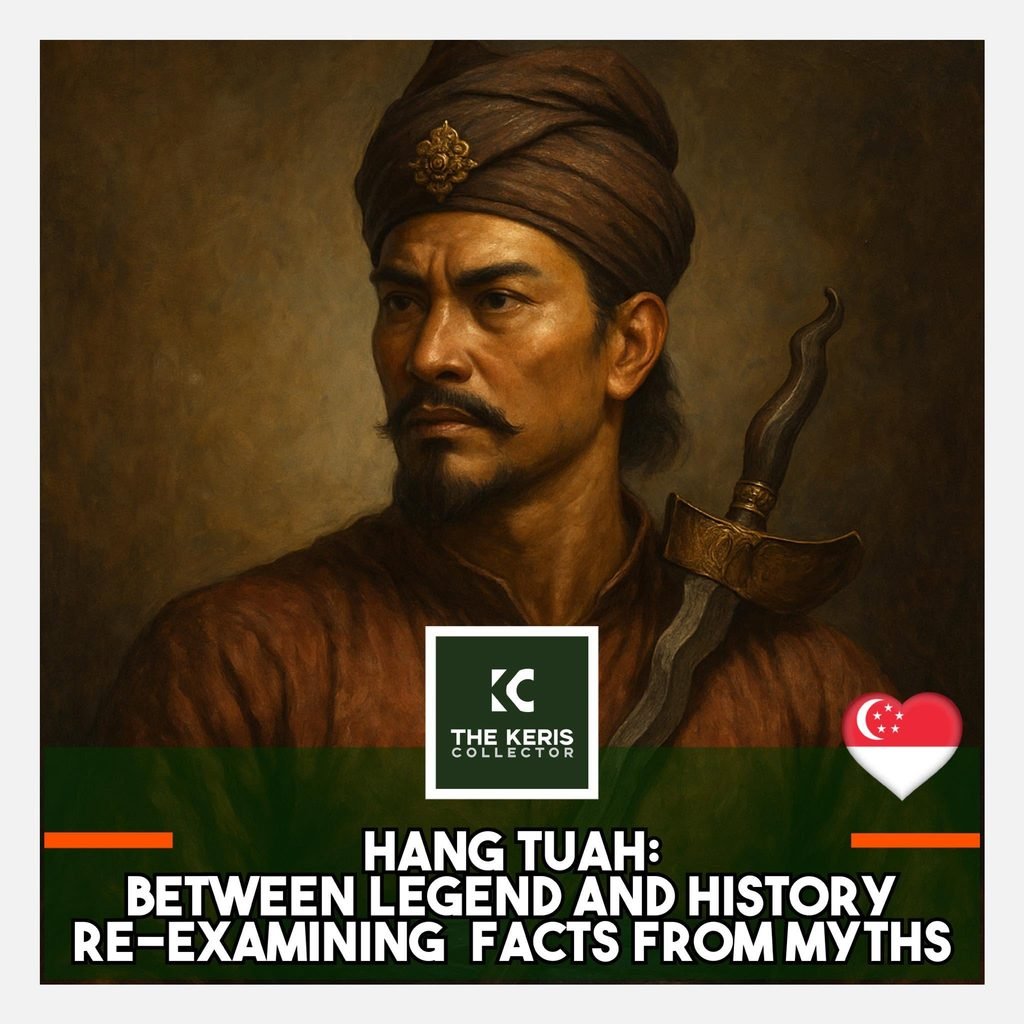
Author’s Note | Revisited, September 2026
I first published this essay on Facebook on 5 July 2025.
Its central argument was simple: cultural importance is not the same thing as historical proof. Hang Tuah can matter profoundly to Malay cultural memory without every story associated with him having to be literally true.
I still stand by that principle.
But revisiting the essay more than a year later has exposed weaknesses in some of my own claims.
Most importantly, I was too categorical when discussing external diplomatic evidence. I wrote that stories of Hang Tuah’s diplomatic activities existed in the literary tradition but not in diplomatic or administrative records.
That needs correction.
There is fifteenth-century correspondence between Melaka and the Ryukyu Kingdom preserved in the Rekidai Hōan. Modern researchers have connected some of those documents with the Laksamana of Melaka and, further, identified that Laksamana as Hang Tuah.
Portuguese evidence also records an elderly and highly regarded Laksamana of Melaka around the Portuguese conquest of 1511.
These are not insignificant details. They deserve to be taken seriously.
But taking evidence seriously also means resisting exaggeration in the opposite direction.
Evidence for a historical Laksamana of Melaka is not automatically evidence that every later story about Hang Tuah describes that same historical individual.
So the question is no longer simply:
Was Hang Tuah real or fictional?
A better question is:
What does the surviving evidence actually allow us to say about the historical figure, or figures, behind the Hang Tuah tradition?
That is the question I should have asked more carefully in 2025.
Part I | The Original Essay
Originally published on Facebook, 5 July 2025
Between Legend and History: Rethinking Hang Tuah with Facts, Not Fantasies
In recent years, a surge of populist nostalgia has swept through social media, reviving figures like Hang Tuah as symbols of national pride and cultural resurgence. One such post claims that Hang Tuah, the famed warrior of the Malaccan Sultanate, is not a myth, but a historically proven figure “respected around the world.” It lists several “facts” as evidence of his existence, blending folklore, selective historical interpretation, and emotional appeal.
Let’s take a closer look, not to dishonour heritage, but to strengthen it with honest inquiry.
The Key Claims and Why They Don’t Hold Up Under Scrutiny
Claim 1: Hang Tuah is mentioned in Sulalatus Salatin and Hikayat Hang Tuah.
True, but context matters.
These texts are rich literary works, written in a stylized, courtly Malay centuries after the events they describe. The Hikayat Hang Tuah is widely acknowledged by scholars as a romanticised epic, not a historical record. Likewise, Sulalatus Salatin (Sejarah Melayu) is filled with symbolic storytelling and supernatural motifs. Citing these works as “evidence” of historical fact is akin to proving King Arthur existed because he appears in Le Morte d’Arthur.
Fallacy: Appeal to Tradition / Confusing Literary Source with Historical Record
Claim 2: Cheng Ho’s records mention a Melakan diplomat with Hang Tuah’s characteristics.
Unsupported and speculative.
There is no conclusive evidence in the Ming Dynasty records of Admiral Zheng He (Cheng Ho) explicitly naming Hang Tuah. References to envoys and diplomats are present, yes, but the leap to equating any such figure with Hang Tuah is an exercise in confirmation bias.
Fallacy: Hasty Generalisation / Confirmation Bias
Claim 3: A 1511 Portuguese manuscript mentions a wise Admiral from Melaka, assumed to be Hang Tuah.
Assumption, not verification.
Portuguese accounts, like those of Tomé Pires (Suma Oriental) and others, do mention Melakan officials, but the “wise admiral” is not named. Assuming that this unnamed figure is Hang Tuah relies more on desire than evidence. Moreover, given that Hang Tuah was supposedly most active during Sultan Mansur Shah’s reign (r. 1459–1477), it’s questionable that he would still be a key figure in 1511.
Fallacy: Argument from Ignorance (“We don’t know who it was, so it must be Hang Tuah”)
Claim 4: Hang Tuah was sent abroad as a diplomatic envoy to Siam, Majapahit, and China.
Plausible in folklore, but unverified in hard history.
Again, these stories exist within the literary corpus of Malay hikayat, but not in diplomatic logs or administrative records. That doesn’t mean it didn’t happen. It means we don’t know. A myth can be inspiring, but presenting it as historical certainty crosses the line into fiction.
Fallacy: Equivocation between Mythical Narrative and Historical Fact
Claim 5: Keris Taming Sari is still kept in the Perak palace, tied to Hang Tuah.
Anecdotal at best.
There is a keris kept in the royal regalia of Perak known as Taming Sari. But proving that it belonged to a man who may not have existed, over 500 years ago, with no documented chain of custody, is more romantic than rational. The keris itself may be centuries old, but legends surrounding it evolved later, often retrofitted to fit the Hang Tuah narrative.
Fallacy: Post Hoc Attribution / Appeal to Antiquity
Claim 6: Hang Tuah’s leadership style lives on in Malay customs today.
Symbolically yes, but not proof of his existence.
Many modern cultures carry forward values and motifs from their mythological figures. But the influence of a legend doesn’t prove the existence of the person. Cultural memory is powerful and often shaped more by what people believe than what was.
Fallacy: Non Sequitur. Influence ≠ Proof of Existence.
Claim 7: People doubt Hang Tuah because of “mental colonisation” and efforts to erase our true heroes.
Nationalist sentiment masking critical thinking.
This is a common rallying cry used to frame doubt as betrayal. But being sceptical of unverifiable claims is not “mental colonisation”. It’s intellectual responsibility. To suggest otherwise is to shut down discussion and reinforce blind belief.
Fallacy: Strawman / Ad Hominem / Appeal to Emotion
So, Was Hang Tuah Real?
We don’t really know. And that’s okay.
He might have been based on a real person, or a composite of several. Or he might be entirely mythical, created to express ideals of loyalty, courage, and diplomacy during a time when Malay polities were defining themselves.
Either way, Hang Tuah serves a cultural function that doesn’t depend on historical certainty. Legends, after all, aren’t less valuable because they’re not factual. They’re valuable because of what they mean.
But we must be careful.
When we dress up folklore as undisputed fact, we do a disservice to both history and our critical faculties. We teach future generations to value feelings over evidence, and that’s a dangerous path, especially in an age where misinformation spreads faster than fire in dry grass.
Final Thoughts
Believing in Hang Tuah as a symbol? No problem.
But claiming he is historically proven, while citing poetic texts and speculative connections? That’s misleading and unhelpful.
Let’s honour our stories without making them lies. Let’s teach our children to respect heritage and to ask questions. Let’s stop pretending that doubt equals betrayal. It doesn’t. In fact, doubt is how real discovery begins.
TL;DR: Most claims about Hang Tuah’s historical existence are based on literature, speculation, or cultural pride, not verified fact. The argument relies heavily on fallacies: appeal to tradition, hasty generalisation, and emotional manipulation. Legends are powerful, but conflating them with historical truth undermines honest scholarship.
Call to Action: Let’s build a stronger Malay identity, one rooted not in fantasy, but in courage, clarity, and intellectual rigour. Celebrate Hang Tuah as a symbol, but don’t make truth a casualty of belief.
Part II | Revisiting the Argument
I Made the Question Too Simple
Reading this again in 2026, I can see that I framed the problem too easily as a contest between legend and history.
Historical traditions do not always divide neatly into “true” and “fictional”.
A literary hero may preserve memories of a historical person. Several people can become compressed into one character. A historical office can become associated with a named hero. Genuine events can acquire supernatural embellishments. Oral traditions can preserve information while simultaneously transforming it.
None of those possibilities proves that Hang Tuah existed.
But neither can they simply be dismissed.
The better historical question is therefore not whether every episode in Hikayat Hang Tuah happened.
It is whether there was a historical person, perhaps a Laksamana of Melaka, behind some part of the tradition that eventually developed into the Hang Tuah we know today.
On that narrower question, I was too dismissive in 2025.
Claim 1 Revisited: Sejarah Melayu and Hikayat Hang Tuah
My warning about treating literary narratives as straightforward chronicles remains valid.
But I treated the category of “literature” too simplistically.
Hikayat Hang Tuah is recognised as a traditional Malay epic and literary classic. The two manuscripts held by the National Library of Malaysia and registered under UNESCO’s Memory of the World programme are written on European paper and described as approximately 200 years old. They contain no colophon identifying an author.
That makes them very different from contemporary eyewitness documentation of fifteenth-century Melaka.
Yet that does not make them historically worthless.
Noriah Taslim’s study of Hang Tuah examines the development of the character from the comparatively ordinary figure appearing in Sejarah Melayu into the extraordinary hero of Hikayat Hang Tuah. Her analysis discusses the borrowing, transformation, inversion and appropriation of materials involved in constructing the epic hero.
Muhammad Haji Salleh goes further in showing that Hang Tuah exists across several overlapping traditions: historical, fictional and oral. Oral narratives concerning Hang Tuah continued to develop in different parts of the Malay Archipelago.
These works therefore provide evidence for historical memory, literary development, cultural values and the evolution of the Hang Tuah tradition.
What they cannot establish by themselves is that every event they describe happened as narrated.
My comparison with King Arthur made a rhetorical point.
Historically, however, it was too crude.
Claim 2 Revisited: What About Zheng He?
My original caution largely survives here, but the framing needs improvement.
Claims that “Cheng Ho’s records prove Hang Tuah existed” need to identify the actual document, date and wording being cited.
But I also allowed criticism of that particular claim to create the impression that there was no relevant East Asian documentary evidence.
There is.
The more important material comes from the diplomatic records of the Ryukyu Kingdom, particularly the Rekidai Hōan.
And that evidence forces the biggest correction to my original essay.
Claims 3 and 4 Revisited: The Ryukyu Evidence
In 2025 I wrote:
“these stories exist within the literary corpus of Malay hikayat, but not in diplomatic logs or administrative records.”
I got that wrong.
The Rekidai Hōan preserves correspondence between Melaka and the Ryukyu Kingdom.
Hashim Musa, Rozita Che Rodi and Salmah Jan Noor Muhammad published a study in 2018 examining this material. They identify three Melakan documents from 1480, 1480 and 1481 as directly associated with the Laksamana whom they identify as Hang Tuah.
Their conclusion is strong: they argue that the documentary evidence establishes Hang Tuah as a historical figure.
That argument deserves to be taken seriously.
But there is an important methodological distinction.
The reproduced documents are described in their study as communications involving the Laksamana. The identification of that Laksamana specifically as Hang Tuah is the researchers’ historical interpretation.
That does not make the identification wrong.
It means that two propositions must not be collapsed into one:
There was a Laksamana involved in Melaka’s diplomatic relations.
and
That Laksamana was the historical individual remembered as Hang Tuah.
The first proposition has direct documentary support.
The second requires us to connect that office-holder with the personal identity preserved in later Malay tradition.
That connection may be plausible. But it is precisely the connection that must be demonstrated.
This is much more substantial evidence than my 2025 essay acknowledged.
The Portuguese Laksamana
Portuguese evidence makes the problem even more interesting.
Afonso de Albuquerque’s Commentaries describe a Melakan Lassamane, or Laksamana, around the Portuguese conquest of Melaka.
The account describes him as about eighty years old, a respected soldier and a man of considerable knowledge. After the fall of Melaka, he reportedly settled in Singapore and subsequently appeared near Muar while considering a return to Portuguese-controlled Melaka.
That matters.
In my original essay I suggested that chronology itself made the identification doubtful because Hang Tuah was traditionally associated with Sultan Mansur Shah’s reign.
But an approximately eighty-year-old Laksamana in 1511 would have been around his late forties in 1480.
Chronologically, therefore, service during the later fifteenth century is entirely possible.
I would no longer use age alone as an argument against the identification.
But the same evidentiary problem remains.
The Portuguese source gives us a Laksamana.
The passage does not itself identify that man by the personal name Hang Tuah.
Once again, evidence for the office-holder and identification of that office-holder with Hang Tuah are related questions, but they are not identical questions.
Could the Ryukyuan and Portuguese Laksamana Be the Same Person?
Possibly.
A senior Melakan Laksamana appearing in diplomatic activity around 1480–1481 and an elderly Melakan Laksamana recorded by the Portuguese around 1511 could chronologically be the same individual.
That possibility deserves investigation.
But chronological compatibility is not identity.
To move from “these could be the same man” to “these are the same man, and that man was Hang Tuah” requires additional evidence.
This is exactly where the debate becomes more interesting than either unquestioning belief or automatic dismissal.
Claim 5 Revisited: Taming Sari
My original argument here concerned provenance, and the basic principle remains sound.
There is a royal tradition in Perak surrounding a keris known as Taming Sari.
But several propositions need to be separated:
- A keris known as Taming Sari exists within Perak royal tradition.
- That object has a historical association with Perak royalty.
- It is the same object described in the Hang Tuah literary tradition.
- It belonged personally to the historical individual remembered as Hang Tuah.
Establishing the first proposition does not automatically establish the fourth.
For an object supposedly surviving more than five centuries, provenance matters enormously.
We would want to investigate documented custody, earlier descriptions, material characteristics, alterations, dating and the development of the tradition surrounding the object.
I would therefore remove my original unsupported suggestion that the legend had simply been “retrofitted”.
That went beyond the evidence I had presented.
The better conclusion is narrower:
The existence of a royal keris called Taming Sari demonstrates an important material and royal tradition. By itself, it cannot establish the historical biography of Hang Tuah.
Claim 6 Revisited: Cultural Memory Is Evidence of Significance, Not Automatically Biography
Here I would change very little.
Hang Tuah’s cultural importance does not depend on proving every episode of his biography.
Muhammad Haji Salleh’s research is particularly useful here because it demonstrates how traditions surrounding Hang Tuah continued developing across different communities and places.
That process is itself historically important.
But cultural endurance demonstrates significance.
It does not automatically demonstrate that every story attached to the figure is historically factual.
Claim 7 Revisited: “Mental Colonisation”
I still reject the idea that questioning Hang Tuah’s historicity is, by itself, evidence of “mental colonisation”.
That argument attempts to settle an evidentiary question by questioning the identity or mentality of the sceptic.
But there is another lesson I would add today.
Scepticism should not become its own performance of intellectual superiority.
Rejecting a claim because it sounds nationalistic is no more rigorous than accepting it because it makes us proud.
The standard should be the same in both directions:
What does the evidence actually allow us to say?
The answer to bad nationalist history is not anti-nationalist bad history.
It is better history.
So, Was Hang Tuah Real?
In 2025 my answer was:
“We don’t really know.”
I would still give that answer today.
But I would now explain it very differently.
There is documentary evidence for the office of Laksamana in the Melakan world.
There is external evidence for a Melakan Laksamana participating in diplomatic relations in the late fifteenth century.
There is Portuguese evidence for an elderly and respected Melakan Laksamana around the conquest of 1511.
There are Malay textual and oral traditions connecting the name Hang Tuah with the office of Laksamana and the Melakan court.
What remains difficult is demonstrating securely that these different bodies of evidence describe one identifiable historical individual named Hang Tuah, and then determining how much of the later biography attached to him reflects that person’s life.
That is a considerably narrower uncertainty than simply declaring:
“Hang Tuah was a myth.”
But it is also different from declaring:
“Hang Tuah has been historically proven exactly as tradition remembers him.”
Scholars themselves do not approach the question identically.
Hashim Musa and collaborators argue strongly that the Ryukyuan material provides historical confirmation.
Historian Ahmat Adam has approached the historicity of Hang Tuah much more critically, examining how far Sejarah Melayu and Hikayat Hang Tuah can legitimately be used as historical sources.
Noriah Taslim studies the literary construction and transformation of the hero.
Muhammad Haji Salleh demonstrates how Hang Tuah also lives through a large and changing body of oral tradition.
These approaches remind us that “Hang Tuah” is simultaneously a problem of history, literature, oral memory and identity.
What I Got Wrong in 2025
The central principle of my original essay survives:
Heritage should not be confused with historical proof.
But some of my arguments do not.
I was wrong to say that the diplomatic traditions had no support in diplomatic records.
I understated the significance of external evidence for a historical Melakan Laksamana.
I treated literary sources too simply when I should have distinguished their value as evidence for events from their value as evidence for memory, political ideas and literary development.
I used chronology too confidently against the Portuguese Laksamana when his reported age actually makes late fifteenth-century activity chronologically possible.
I also framed the entire debate too easily as facts versus fantasies.
If I were writing the title for the first time today, I might not choose those words.
The evidence now allows a more interesting argument.
There were historical Laksamana serving Melaka.
External records attest individuals holding that office.
Some of those records are chronologically compatible with traditions later associated with Hang Tuah.
Whether those traces can securely be joined into the biography of one historical Hang Tuah remains a question requiring careful interpretation.
That distinction matters.
Final Thoughts
I began the original essay because I was uncomfortable watching cultural pride turn uncertainty into certainty.
I remain uncomfortable with that.
But evidence-led history imposes exactly the same obligation on sceptics.
If evidence complicates our argument, we do not hide it.
We change the argument.
That is not abandoning critical thinking.
That is critical thinking.
Hang Tuah does not need to be reduced either to an unquestionably factual superhero or to a meaningless fictional character.
He can be studied as a possible historical figure, a literary creation, an evolving body of oral tradition and one of the most powerful cultural symbols produced by the Malay world.
The responsible question therefore is not:
“Do you believe in Hang Tuah?”
History is not a referendum.
The question is:
What does the evidence actually allow us to say?
And when the evidence changes our answer, we should be willing to change with it.
Preserve Through Discovery.
References & Further Reading
Ahmat Adam. Antara Sejarah dan Mitos: Sejarah Melayu & Hang Tuah dalam Historiografi Malaysia. Petaling Jaya: Strategic Information and Research Development Centre, 2016. ISBN 978-967-0960-14-2.
Albuquerque, Afonso de. The Commentaries of the Great Afonso Dalboquerque, Second Viceroy of India. Translated and edited by Walter de Gray Birch. London: Hakluyt Society, 1875–1884.
Hashim Musa and Rohaidah Kamaruddin. Hang Tuah: Catatan Okinawa. Serdang, Selangor: Universiti Putra Malaysia Press, 2015. ISBN 978-967-344-478-6.
Hashim Musa, Rozita Che Rodi and Salmah Jan Noor Muhammad. “Surat Hang Tuah kepada Raja Ryukyu: Kebijaksanaan Ilmu Diplomasi Melayu Tradisional.” Jurnal Melayu Sedunia, Vol. 1, No. 1 (2018): 162–190.
Muhammad Haji Salleh. “Hang Tuah in the Sea of Oral Malay Narratives.” Malay Literature 25, no. 2 (2012): 121–158. DOI: 10.37052/ml.25(2)no1.
Noriah Taslim. “The Making of the Medieval Malay Hero Hang Tuah: Stories Behind the Epic Scene.” Malay Literature 25, no. 2 (2012): 159–176. DOI: 10.37052/ml.25(2)no2.
UNESCO Memory of the World. “Hikayat Hang Tuah.” Registration year 2001.