
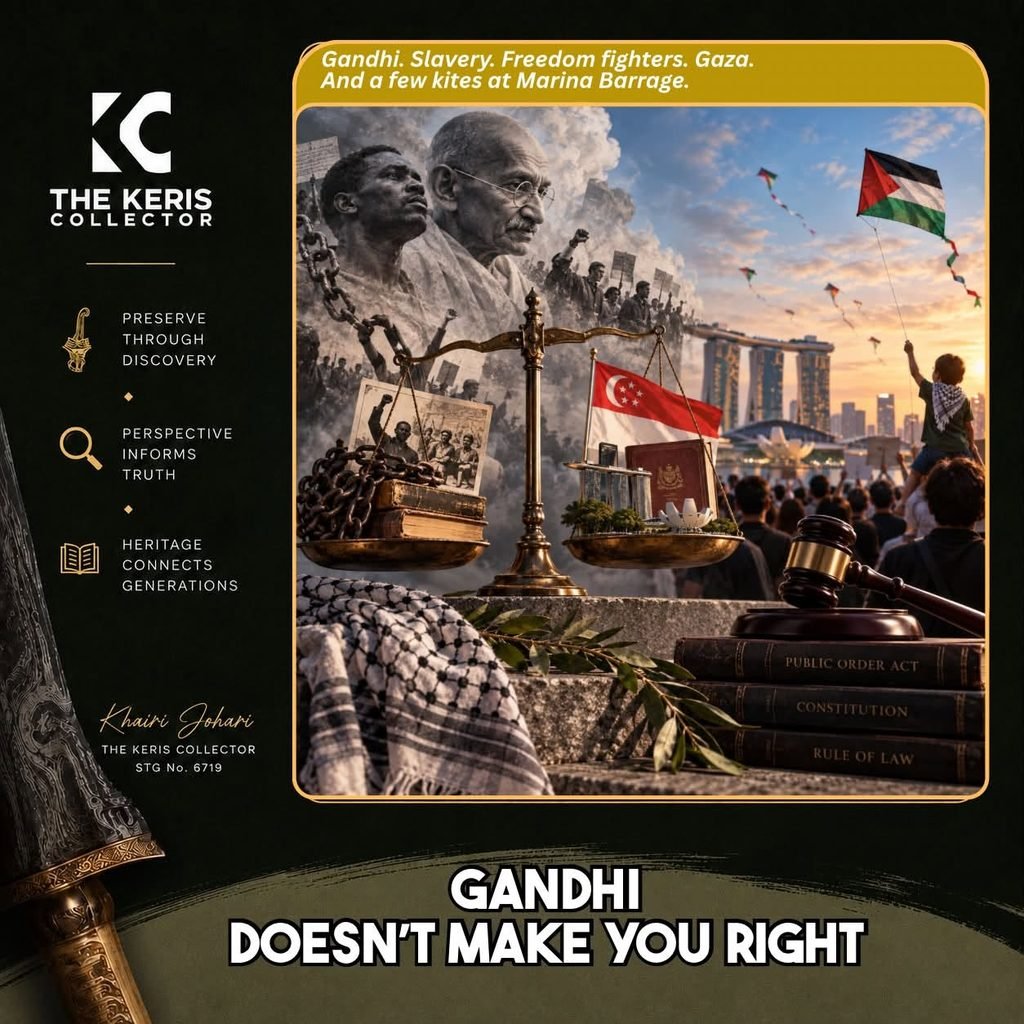
Gandhi. Slavery. Freedom fighters. Gaza. And a few kites at Marina Barrage.
That is a remarkable amount of history to load onto one Singapore public-order controversy.
A recent response to the charges against six people over various alleged processions and assemblies argues, in substance, that restrictive laws have always been used against people fighting for justice. Had freedom fighters not challenged oppressive boundaries, the argument goes, Black people might still be enslaved. Gandhi challenged British rule through non-violent resistance. The Singapore activists were supposedly neither aggressive nor loud. Flying kites to remember children killed in Gaza was simply an act of compassion.
There is a serious argument buried inside this.
History absolutely teaches us that laws can be unjust.
But that does not settle the present argument.
Peaceful Is Not the Same as Lawful
The six people charged on 9 September were not accused over one identical Palestine protest. The cases concern different alleged activities at different locations, including the Istana, Marina Barrage, NUS and the State Courts. Their cases remain before the courts, and allegations should not be confused with findings of guilt.
But one point is already clear from Singapore law: an assembly does not have to become violent, aggressive or loud before it can be regulated.
The Public Order Act regulates assemblies and processions according to matters including their purpose, location, permit status and applicable exemptions. An activity intended to demonstrate support for a cause or commemorate an event can fall within that framework even when everyone involved behaves peacefully.
So “they weren’t aggressive or loud” does not, by itself, answer the legal question.
Neither does compassion.
Flying kites to commemorate children killed in Gaza can be peaceful, sincere and compassionate. It can also constitute political expression subject to Singapore law.
All those things can be true simultaneously.
The emotional meaning of an act does not determine its legal classification.
That does not mean the law is necessarily morally right. It means we have arrived at the question that actually matters:
Is the law itself unjust?
Gandhi Does Not Make That Argument for You
This is where the historical comparison becomes much weaker.
Yes, slavery was once protected by law.
Yes, colonial governments enforced unjust laws.
Yes, Gandhi deliberately challenged political authority through non-violent resistance.
Therefore:
A law can be legal and still be unjust.
I agree completely.
But it does not follow that whatever law an activist challenges today must therefore be unjust.
The struggle against racial slavery concerned human beings denied fundamental liberty and subjected to systems that treated people as property. A contemporary argument about how Singapore regulates political assemblies must be examined on its own facts.
If Singapore’s Public Order Act is unjust, demonstrate where it becomes disproportionate, why its public-order justification fails and what Singapore should replace it with.
That is the missing argument.
Invoking slavery does not supply it.
Invoking Gandhi does not supply it either.
The present activists do not become equivalent to Gandhi merely because their actions were peaceful. Nor does prosecution under Singapore’s Public Order Act transform contemporary Singapore into the British Raj.
Historical analogy requires more than:
They broke rules for a cause. We broke rules for a cause.
History can illuminate an argument.
It cannot substitute for one.
But What If Singapore’s Law Really Is Too Restrictive?
This is where defenders of Singapore’s system should be equally careful.
“Just apply for a permit” is not a complete answer.
Singapore’s public-order regime is restrictive. Speakers’ Corner provides an avenue for qualifying political expression without a Police permit, but it remains subject to conditions. And in relation to the Israel-Hamas conflict, Police have imposed restrictions because of assessed public-safety, security and religious-harmony concerns.
More importantly, Police have stated that they will not grant permits for assemblies advocating political causes of other countries or foreign entities, or where there is potential to stir emotions and cause public-order incidents.
That creates a legitimate question:
Does Singapore leave enough room for meaningful peaceful protest?
Singaporeans are entitled to argue that it does not.
Our Constitution protects peaceful assembly, subject to restrictions Parliament considers necessary or expedient for purposes including public order. Singapore’s courts have upheld the constitutionality of the relevant public-order restrictions. But constitutional validity does not prevent citizens from arguing that Parliament should liberalise them.
That distinction is crucial.
“This law is too restrictive and should be changed” is a serious political argument.
“My cause is righteous, therefore this law should not apply to me” is not the same argument.
And this is where Gandhi becomes useful again, although perhaps not in the way intended.
Civil disobedience does not require pretending that the law disappeared.
A person may knowingly disobey a law because conscience tells them that compliance would perpetuate injustice.
That person can say:
I know what the law requires. I believe the law is unjust. I am deliberately challenging it, and here is why.
Now we have something worth debating.
Legal consequences may follow. That does not require the activist to agree that those consequences are morally just. Challenging the prosecution or punishment may itself form part of the protest.
But the intellectual burden remains:
Why is this particular act of disobedience justified?
That requires evidence, logic and context.
Borrowing Gandhi’s moral authority is not enough.
Singapore First, Not Government First
Singapore’s caution towards political mobilisation did not appear from nowhere.
Our formative history included political unrest and serious racial and religious disorder. The 1964 communal riots alone left people dead and hundreds injured. Those experiences helped shape Singapore’s institutional instinct to prevent political, racial, religious and foreign conflicts from escalating into domestic disorder.
That history explains Singapore’s caution.
It does not permanently justify every restriction.
We should still ask whether particular rules remain necessary, proportionate and appropriate for Singapore today.
But we should ask Singapore questions.
Does the restriction genuinely protect public order?
Does it leave sufficient room for political expression?
Is it proportionate?
Is it applied consistently?
Should Parliament change it?
Those questions are more difficult than invoking Gandhi. They are also considerably more useful.
And there is a simple test for whether we really believe in the principle.
Reverse the politics.
Suppose supporters of Israel organise an unauthorised political demonstration tomorrow.
Suppose Chinese nationalists mobilise Singaporeans around PRC political interests.
Suppose Malay nationalists import Malaysia’s racial politics into Singapore.
Would the people currently arguing that compassion should override public-order restrictions apply exactly the same principle?
They should.
Singapore first means the rule cannot change according to whose foreign cause we emotionally prefer.
That does not mean Government first.
Blind obedience is not patriotism.
Singaporeans should criticise bad policy. Challenge bad laws. Campaign. Vote. Organise through lawful avenues. Seek judicial remedies where appropriate. Persuade fellow citizens. Argue for Parliament to change legislation.
And if someone concludes that a situation is so morally serious that civil disobedience is justified, then make that case openly and accept scrutiny of that decision.
Patriotism is not obedience to whichever government happens to hold office.
It is respect for Singapore’s constitutional order combined with the courage to argue when that order should change.
This Is Not Singapore Versus Palestine
None of this requires indifference towards Palestinians.
Singapore’s actual foreign policy is more complicated than the accusation that enforcing domestic public-order law somehow makes Singapore “Zionist”.
Singapore maintains diplomatic relations with Israel. It also supports a negotiated two-state solution, has provided substantial humanitarian assistance to Gaza, supports capacity-building for the Palestinian Authority, regards Israeli settlements in the West Bank as illegal under international law, and has stated that Israel’s military response in Gaza breached international humanitarian law.
Foreign policy is not a football match. Singapore does not need to choose a jersey before deciding what serves Singapore’s interests.
A Singaporean can grieve for Palestinian civilians.
A Singaporean can condemn Israeli actions.
A Singaporean can support Palestinian statehood.
And that same Singaporean can believe that Singapore’s laws continue to apply to political mobilisation concerning Palestine.
There is no contradiction.
Nor does enforcing a public-order law prove that Singapore authorities are somehow “threatened by compassion”.
That is an assertion about motive.
It requires evidence.
Perhaps the Public Order Act is too restrictive.
Then argue that.
Perhaps peaceful demonstrations should enjoy greater freedom.
Make that case.
Perhaps Singapore has reached a stage where the balance between public order and political expression should shift.
That is a debate worth having.
But Gandhi does not settle it.
Slavery does not settle it.
Freedom fighters do not settle it.
History teaches us that laws can be unjust.
It does not appoint every modern activist as the successor to those who fought them.
If Singapore’s Public Order Act is unjust, show us where it goes too far. Argue for Parliament to change it. Challenge its application through the institutions available to us. And if conscience ultimately demands civil disobedience, explain why that exceptional step is justified.
What we should not do is allow the righteousness of a cause to substitute for the argument.
Support Palestine.
Oppose Israel’s conduct.
Oppose the death penalty.
Criticise the Government.
Demand greater political freedom if you believe Singapore needs it.
But apply the same standard when the cause belongs to somebody you dislike.
That is the test.
Singapore first does not mean Government first. It means Singapore’s interests, liberties, institutions and cohesion come before imported political tribalism.
Singapore’s laws can be challenged.
Singapore’s laws can be changed.
But Singapore should decide that debate on Singapore’s terms.
CONCISE SOURCE / REFERENCE NOTE
Principal references: CNA and Singapore Police Force reporting/statements on the September 2026 charges; the Public Order Act and Ministry of Home Affairs guidance on public assemblies; Police guidance concerning Speakers’ Corner and Israel-Hamas-related activities; Wham Kwok Han Jolovan v Public Prosecutor [2020] SGCA 111; official Singapore historical material concerning the 1964 racial riots; and Ministry of Foreign Affairs statements on Israel, Gaza, humanitarian assistance and Singapore’s support for a negotiated two-state solution. The current criminal cases remain pending, and references to the accused’s conduct describe allegations rather than findings of guilt.