
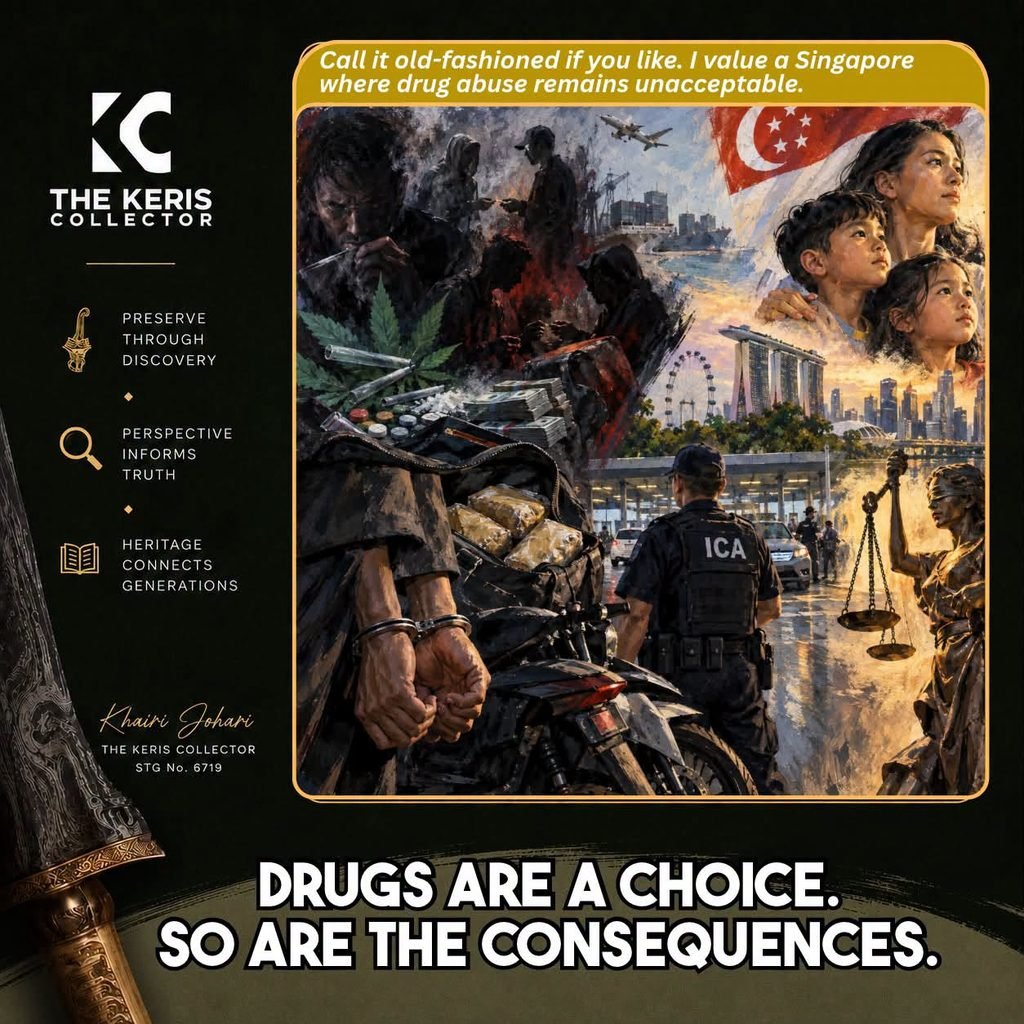
I Want Singapore to Stay Hard on Drugs. Yes, Even When the Punishment Is Death.
I oppose drug abuse, pushing and trafficking, and I support severe punishment for those lawfully convicted. But supporting capital punishment creates an obligation of its own: prove the case, confront the evidence honestly, protect due process and explain why the ultimate punishment remains justified.
I am strongly against drug abuse.
Against using it. Against pushing it. Against trafficking it.
And I don’t accept that cannabis becoming legal, fashionable or socially acceptable somewhere else settles the question for Singapore.
Their country. Their laws. Their consequences.
This is Singapore.
If you knowingly break our drug laws, are properly prosecuted and are found guilty beyond reasonable doubt, then face the punishment prescribed by our laws.
Yes, I support capital punishment for the most serious drug-trafficking offences.
No apology from me.
But here is where I make things harder for myself.
If I am going to support the state deliberately taking a human life, then I owe myself, and everybody reading this, a better argument than:
They knew the law. Too bad.
That may feel satisfying.
It isn’t enough.
Ten kilograms
That was the number that stopped me when I read the latest report from Tuas.
On 15 September, a 36-year-old man and 35-year-old woman, both Malaysians, arrived at Tuas Checkpoint on a Malaysia-registered motorcycle.
According to ICA, officers found four bundles of vegetable matter believed to be controlled drugs beneath the motorcycle seat. CNB officers subsequently found another six bundles in a haversack.
The ten bundles were found to contain approximately 10.1kg of cannabis, with an estimated value exceeding S$203,000. ICA said that quantity could potentially feed the addiction of about 1,450 abusers for a week.
That is a lot of cannabis.
But before anybody gets carried away, two words matter:
They were arrested.
They have not been convicted.
I don’t know what each person knew. I don’t know what role each allegedly played. I haven’t seen the evidence. I don’t know what defences may eventually be raised.
Neither do you.
So investigate properly.
Prosecute properly.
Test the evidence.
Let the defence answer it.
Let the courts decide.
Being hard on drugs does not require abandoning the presumption of innocence.
Quite the opposite.
If you want severe punishment, you had better be damned sure you have convicted the right person of the right offence.
And 10.1kg is not somebody experimenting with a joint
This is where drug debates often become ridiculous.
Different questions get bundled together as though they were interchangeable.
Someone smoking cannabis is not the same as someone importing kilograms of it.
An addict is not necessarily a pusher.
A courier is not necessarily a syndicate boss.
Possession is not trafficking.
Consumption is not large-scale importation.
Singapore law itself makes distinctions.
For unauthorised trafficking in cannabis, more than 500g falls within the capital-punishment band. Between 330g and 500g, the punishment is already severe: between 20 and 30 years’ imprisonment, or life imprisonment, plus 15 strokes of the cane.
The 10.1kg reportedly seized at Tuas is therefore more than twenty times the 500g capital threshold.
Twenty times.
But even that does not mean the equation is simply:
10.1kg = death.
Section 33B of the Misuse of Drugs Act allows the court not to impose death in certain circumstances. Among other requirements, the law distinguishes restricted roles such as couriers and provides routes to life imprisonment where the statutory conditions are satisfied.
That is why I don’t particularly like the chest-thumping slogan:
“You traffic drugs, you hang.”
I understand the sentiment.
Legally, it is sloppy.
The offence matters. The drug matters. The quantity matters. Knowledge matters. The accused person’s role matters. The evidence matters. The sentencing provisions matter.
So my position is not:
Catch them and hang them.
My position is:
Prove the bloody case.
Then apply the law.
And if, after conviction, appeals, proper application of the statutory provisions and the remaining constitutional processes, the lawful sentence is death?
I support carrying it out.
That is where I stand.
And yes, I am against drug users too
I want to be clear about this because I think we have become strangely uncomfortable talking about personal responsibility once drugs enter the conversation.
If you knowingly buy and consume illegal drugs in Singapore, you are doing something I oppose.
Full stop.
There is a demand side to the drug trade.
Somebody buys.
Somebody supplies.
Somebody profits.
And somebody further up that chain may profit considerably more.
But here is where I refuse to switch off my brain merely because I want a hard line.
Condemning drug abuse is not the same thing as declaring every drug-dependent person beyond redemption.
Dependence complicates agency. Mental health can matter. Family circumstances can matter. Some people get themselves into a terrible situation and genuinely need help getting out of it.
Fine.
Help them get out.
Rehabilitate them.
Treat the dependency.
Work with their families.
Help them rebuild their lives.
I want people off drugs.
That is precisely why rehabilitation makes sense to me.
What I won’t do is confuse rehabilitation with acceptance.
Drug abuse remains unacceptable.
The person struggling with dependency may need treatment.
The person deliberately selling drugs presents another problem.
The person knowingly moving large commercial quantities presents another again.
We can be intelligent enough to understand all three without pretending any of them is harmless.
Cannabis is not heroin
There.
That shouldn’t be controversial.
Different drugs have different effects and different risk profiles.
I have no interest in ridiculous arguments suggesting that somebody touches cannabis once and inevitably becomes a heroin addict.
That is not serious drug policy.
Nor do I accept the opposite leap:
Cannabis isn’t heroin, therefore Singapore should legalise it.
Why?
Because Canada did?
Because parts of America did?
Because attitudes have changed?
That isn’t an argument either.
Singapore should study what happens elsewhere.
Of course we should.
Look at consumption. Dependence. Mental-health outcomes. Youth exposure. Impaired driving. Commercialisation. Black markets. Legal markets. Risk perception.
Look at evidence that supports prohibition.
Look at evidence that challenges it.
Then make a judgement for Singapore.
Singapore First doesn’t mean refusing to learn from foreigners.
It means foreigners don’t make the final decision for Singapore.
And personally?
I don’t want recreational drug use normalised here.
I don’t want cannabis becoming just another consumer lifestyle product.
I don’t want young Singaporeans growing up believing getting high is simply another recreational choice everybody makes.
I don’t want an industry eventually built around selling intoxication and then defending its commercial interests.
I value living in a society where illegal drugs remain socially unacceptable.
That social norm is worth something to me.
Vaping taught me something too
Not that vaping automatically leads to drug addiction.
I am not making that claim.
What caught my attention about the Kpod problem was something much simpler.
Markets adapt.
Delivery systems evolve.
Suppliers discover new products.
A device culturally associated with recreational nicotine use became a delivery mechanism for etomidate and other substances.
That doesn’t prove some grand gateway theory.
It does demonstrate why I am sceptical whenever somebody confidently tells me where the normalisation of an illicit recreational market will stop.
Markets have a habit of ignoring the boundaries we draw for them.
That is the lesson.
Nothing more is required.
Now comes the annoying question for someone like me
Does the death penalty actually work?
Not:
Do severe punishments deter people?
The harder question is:
Does death deter more effectively than life imprisonment?
Those are not the same proposition.
I went looking because I didn’t want to write an essay that simply collected evidence agreeing with me.
Singapore does have evidence worth taking seriously.
MHA’s research examining the introduction of the capital threshold for cannabis reported a 15 to 19 percentage-point reduction in the probability that traffickers chose quantities above that threshold in the four years after its introduction. Research involving convicted traffickers has also found evidence of what researchers call restrictive deterrence: some traffickers consciously limited quantities because they were aware of severe legal consequences.
That matters.
It is evidence consistent with traffickers responding to the threat of capital punishment.
I am not going to pretend it doesn’t exist simply because abolitionists dispute the policy.
But I am also not going to pretend it proves more than it does.
Showing that traffickers respond to a capital threshold is one thing.
Demonstrating precisely how much additional deterrence execution provides over life imprisonment is considerably harder.
Even MHA has previously acknowledged limitations in making that comparison and said more work would have to be done over time.
That is inconvenient for my position.
Fine.
Leave it there.
I still support capital punishment.
But I won’t manufacture certainty to make myself feel better about supporting it.
Which forces me to admit what my argument really is
If somebody could demonstrate tomorrow that life imprisonment produces exactly the same deterrent effect as execution, would I automatically abandon capital punishment?
I had to think about that.
My answer is no.
And that means I cannot pretend my position rests entirely on deterrence.
There is also culpability.
Proportionality.
Incapacitation.
Public protection.
And yes, retribution.
That last word makes people uncomfortable.
It shouldn’t.
Criminal punishment has always involved society making moral judgements about conduct and culpability.
I believe there can be cases of deliberate, exceptionally serious, large-scale drug trafficking where the offender’s culpability is grave enough for Singapore to reserve its severest punishment.
That is a moral judgement.
Not a scientific finding.
Not a regression model.
Not something I can prove by waving a survey around.
Someone else can examine the same moral question and conclude that no non-homicide offence ever justifies execution.
I disagree.
But at least now we know where the disagreement actually is.
And that is more honest than pretending deterrence has mathematically settled the matter.
There is another thing that bothers me about this debate
Look at where the compassion goes.
When an execution approaches, suffering suddenly becomes concentrated into one visible human being.
There is a name.
A photograph.
Parents.
Perhaps children.
A petition.
A date.
A person counting down the remaining days of his life.
Of course that affects people.
It should.
The condemned prisoner is still a human being.
But the harms associated with drug markets are dispersed.
They happen across different homes, relationships and years. Singapore’s own compilation of drug-related research points to harms extending beyond individual users to families and communities.
Dispersed suffering is harder to photograph.
It isn’t therefore less worthy of moral consideration.
There is the person whose dependency is consuming his life.
The parent trying to get a child off drugs.
The spouse living with the consequences.
The child growing up in a household destabilised by serious addiction.
I am not saying every drug user becomes addicted.
I am not saying every consignment inevitably produces some predetermined number of destroyed families.
And I certainly cannot tell you what would have happened to those 10.1kg allegedly seized at Tuas.
ICA’s estimate that the quantity could potentially feed about 1,450 abusers for a week is an official estimate, not a prediction that 1,450 identifiable people would inevitably have been harmed.
But the larger point remains.
The illicit drug trade does not exist in a moral vacuum between the offender and the state.
There are people downstream.
Compassion should not stop at the prison gate.
I can recognise the humanity of the person facing execution and still ask what obligation Singapore owes everybody its drug laws are intended to protect.
That, for me, is the moral centre of the argument.
And my side inherits a burden too
If I am going to say:
Carry out the sentence.
Then I become extremely demanding about everything that comes before it.
Proof beyond reasonable doubt.
Competent legal representation.
Evidence properly challenged.
Full appellate rights.
Correct application of the law.
Every statutory safeguard observed.
A meaningful constitutional clemency process.
Courts willing and able to correct error.
No shortcuts.
No “everybody knows he did it”.
No confusing an arrest with a conviction.
No treating death casually because the offence makes us angry.
There is nothing soft about due process.
Due process is what gives punishment legitimacy.
A prison sentence can, at least in principle, be interrupted if a miscarriage of justice is discovered.
An execution cannot be undone.
So the more severe the punishment, the more exacting I expect the state to be about proving guilt.
If the state wants the power to execute, it accepts an extraordinary responsibility to get the case right.
That is part of the bargain.
I disagree with abolitionists
Strongly.
But I don’t need to caricature them.
Their best arguments are uncomfortable precisely because they are serious.
Irreversibility.
Wrongful conviction.
The vulnerability of some couriers.
Proportionality.
Human dignity.
Whether life imprisonment could provide comparable protection.
The uncertain additional deterrent effect of death.
Those deserve answers.
Not name-calling.
And international criticism doesn’t become worthless merely because it comes from outside Singapore.
Read it.
Test it.
Look at what other countries have tried.
Look at what worked.
Look at what failed.
Then decide for ourselves.
That is Singapore First to me.
Not intellectual isolation.
Independent judgement.
So after making the argument harder for myself, did I change my mind?
No.
But I understand what I am actually defending much better.
I remain strongly against drug abuse.
I want illegal drug consumption discouraged and punished.
I want people suffering from dependency rehabilitated because I want them permanently away from drugs, not because I think their drug use should be normalised.
I want pushers prosecuted.
I want trafficking networks disrupted.
I want our borders to be an extremely unattractive proposition for anyone contemplating bringing large quantities of drugs into Singapore.
And for the most serious drug-trafficking offences, where guilt has been proved beyond reasonable doubt, the statutory requirements have been properly applied, appeals and safeguards have been respected, and the law ultimately requires the capital sentence, I support Singapore retaining and carrying out that punishment.
No apology.
But also no bloodlust.
I don’t need gallows imagery.
I don’t need to celebrate an execution.
I don’t need to pretend taking a human life is trivial.
Quite the opposite.
If we are prepared to impose the ultimate punishment, we should feel the full weight of what we are authorising.
Then decide.
I have.
And my answer remains yes.
If Singapore is going to retain capital punishment, we should be able to defend it without slogans, without exaggeration and without hiding from evidence that makes us uncomfortable.
Some of the evidence strengthens my position.
Some complicates it.
None gives me the absolute certainty that people on either side sometimes pretend exists.
I still support retaining the death penalty for the most serious drug-trafficking offences.
Not casually.
Not gleefully.
And not merely because they knew the law.
I support it because, after weighing the seriousness of the offence, the culpability of the offender, the uncertain but relevant deterrence evidence, the irreversible nature of execution and the people Singapore’s drug laws are intended to protect, I still believe there are cases serious enough for the state to reserve its severest punishment.
That is a harder position to defend than a slogan.
Good. It should be.
CONCISE SOURCE / REFERENCE NOTE
The Tuas account and 10.1kg quantity come from ICA information reported by CNA on 18 September 2026; the two arrested Malaysians remained under investigation at publication, so this essay makes no finding of guilt. The current Misuse of Drugs Act places unauthorised trafficking of more than 500g of cannabis in the capital-punishment band, while section 33B provides specified circumstances in which life imprisonment may be imposed instead of death.
MHA research reports evidence consistent with traffickers responding to capital thresholds, including a 15 to 19 percentage-point reduction in the probability of cannabis traffickers choosing quantities above the capital threshold following its introduction. That evidence supports a deterrence argument but does not by itself conclusively quantify the marginal deterrent effect of execution over life imprisonment, a distinction retained throughout this essay. MHA’s current research compilation also contains studies on drug harms, rehabilitation and public attitudes; survey beliefs about deterrence should not be confused with causal proof that those beliefs are correct.