
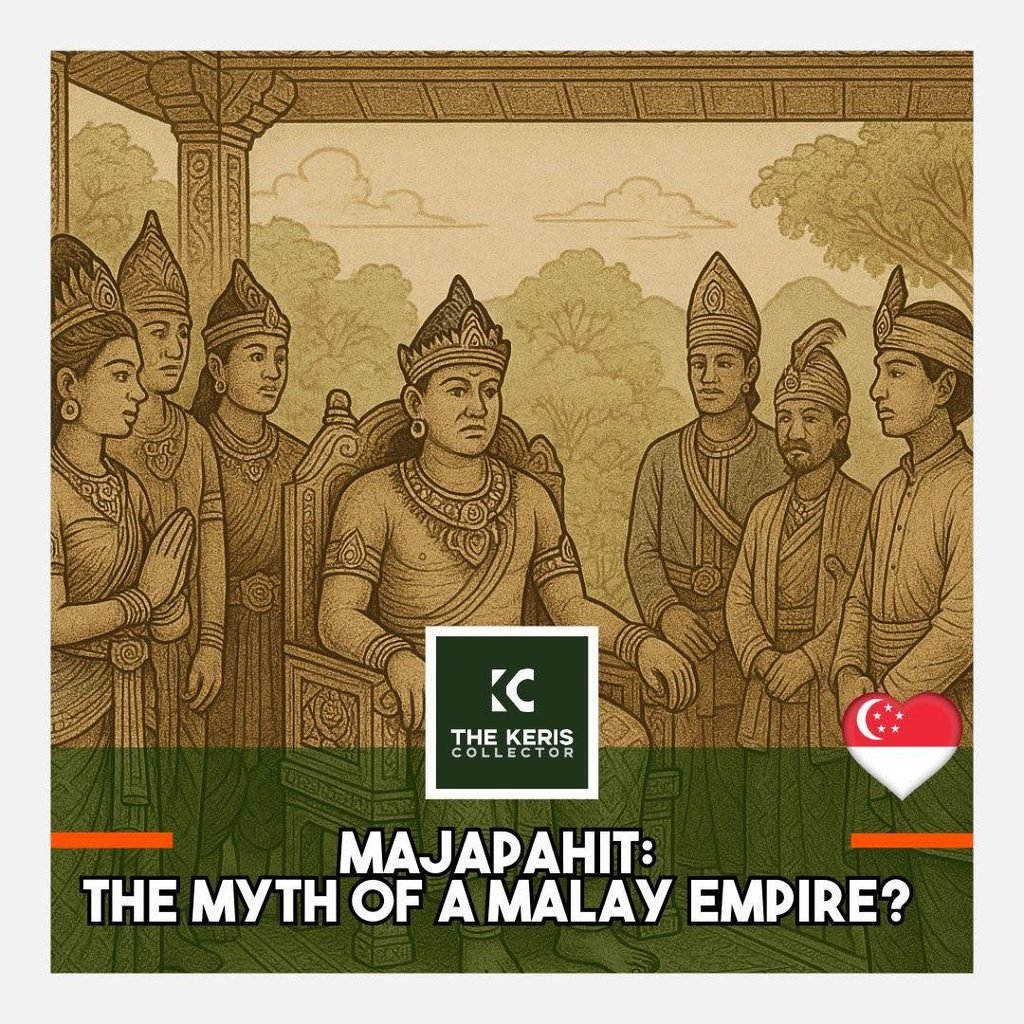
Author’s Note | Revisited, September 2026
I first published this essay on Facebook on 6 July 2025.
The argument was aimed at something I still consider problematic: attempts to recruit premodern Southeast Asian kingdoms into modern ethnic and nationalist arguments.
Majapahit becomes “ours”.
Srivijaya becomes “theirs”.
Historical interaction becomes ethnic ownership.
A marriage becomes proof of shared identity. A tributary relationship becomes proof that an entire modern country once belonged to somebody else’s empire.
That approach to history deserves criticism.
But rereading my original essay, I can see that I sometimes answered one oversimplification with another.
I described Majapahit too neatly as “Javanese” and Srivijaya too neatly as “Malay”. I was too dismissive of the complicated relationship between Majapahit and Malayu in Sumatra. I also treated the possibility of a Melaka-Majapahit marriage alliance as though it were barely present in the sources, when Sejarah Melayu explicitly preserves such a tradition.
Most importantly, I did not sufficiently distinguish modern ethnic identity from the political, geographical and cultural categories used in fourteenth- and fifteenth-century Southeast Asia.
So the central argument survives.
But it needs a better question.
Instead of asking:
“Was Majapahit Malay or Javanese?”
we should ask:
“What does the surviving evidence actually tell us about Majapahit’s political centre, its relationship with Malayu and other regional polities, and the meaning of its claims beyond Java?”
That produces a much more interesting history.
Part I | The Original Essay
Originally published on Facebook, 6 July 2025
Majapahit and the Myth of a Malay Empire: Setting the Record Straight
In recent years, a wave of romanticized history has emerged across social media, often reshaping premodern empires to fit modern identity politics. One such example is the growing claim that the Majapahit Empire, historically understood as a Javanese Hindu-Buddhist polity, was not only influenced by, but significantly Malay in nature. This rewriting attempts to frame Majapahit as a shared heritage between Javanese and Malay peoples, with an emphasis on Malay contributions supposedly buried or ignored.
Let’s take a sober look at these claims, and unpack where fact ends and fantasy begins.
1. The Claim: “Many Majapahit generals were of Malay descent”
Problem: This claim lacks direct historical evidence and conflates inter-island interactions with ethnic or political identity. While Majapahit’s influence extended to parts of Sumatra and the Malay Peninsula, there is little documentation confirming that “many generals” within its core structure hailed from Malay backgrounds.
Adityawarman, often cited as an example, was born in Sumatra and had connections to both Melayu and Javanese elites. However, his political trajectory shows that he ultimately broke away to form an independent kingdom (Pagaruyung), not continue as a loyal Majapahit officer. His legacy is more aligned with regional assertion rather than evidence of deep Malay integration into Majapahit command.
2. The Claim: “Old Malay was used in Majapahit inscriptions alongside Kawi”
Problem: This is misleading. The language of court, religion, and administration during the Majapahit period was primarily Old Javanese (Kawi) and Sanskrit, not Old Malay. While Old Malay was used in Srivijaya, which preceded Majapahit, and Malay eventually rose as the lingua franca of maritime trade, this development came after Majapahit’s decline.
The use of Old Malay in later Islamic sultanates does not retroactively insert it into the Majapahit palace archives.
3. The Claim: “Diplomatic marriage tied Majapahit and Melaka”
Problem: This is speculative at best and lacks corroborating evidence from either side’s chronicles. Majapahit and Melaka had strained relations. In Sejarah Melayu (Malay Annals), there is a record of conflict and tension between the two, not alliance by marriage. Even if there were isolated noble marriages, such unions were typical diplomatic tools across many premodern polities and do not imply shared ethnic or political identity.
4. The Claim: “Javanese texts mention Malay influence in administration”
Problem: This misreads or overextends what Javanese texts like the Nagarakretagama or Pararaton actually say. These texts document territories Majapahit claimed influence over, including parts of Sumatra and Borneo. But this doesn’t mean Malays were running Majapahit. There is a crucial difference between being part of an empire’s sphere of influence versus being inside its administrative apparatus.
Also, terms like “Melayu” in older texts often referred to the geographic polity of Dharmasraya or Jambi, not to a broader ethnic category we use today.
5. The Claim: “Majapahit expanded into the Malay world and ruled it indirectly”
Half-true, but distorted. Yes, Majapahit claimed suzerainty over a vast area. But “claiming” and actually controlling are separate matters. Many of these were loose tributary relationships at best. Local rulers maintained autonomy and could switch allegiances swiftly, especially when Islam started to spread and weaken Hindu-Buddhist legitimacy.
The Malay Peninsula during Majapahit’s height remained politically fragmented and frequently shifted power centers, for example Siam, Srivijaya remnants and emerging Melaka.
6. The Claim: “Majapahit had vassals and allies in the Malay world, not colonies”
This is largely true. Majapahit didn’t operate like a colonial empire with outposts and governors. Influence was often exercised via diplomacy, tribute, or trade, common across the Nusantara. But again, such influence doesn’t equate to Malays being a core part of Majapahit’s identity or machinery.
7. The Claim: “Modern education teaches Majapahit as something ‘foreign’ to Malays”
Misleading. The real issue is less about deliberate exclusion and more about academic precision. Majapahit was Javanese, just as Srivijaya was Malay in nature. Recognizing this is not an act of exclusion, but of respecting distinct civilizational identities. The idea that Malays were denied their “rightful place” in Majapahit reflects modern ethno-nationalist sentiment more than historical truth.
Conclusion: Let’s Respect the Past, Not Rewrite It
The history of Southeast Asia is richly interwoven, no doubt. There were constant flows of culture, migration, war, trade, and intermarriage. But attempts to overly “Malay-ify” a Javanese Hindu-Buddhist empire like Majapahit oversimplify this complexity.
To appreciate our regional past is to understand it in its own context, not to retrofit it with modern identity politics. We don’t need to insert ourselves into every empire to feel validated. Srivijaya, Langkasuka, Melaka, and the Johor-Riau-Lingga Sultanate are rich legacies of Malay civilization in their own right.
Let’s stop looking for borrowed glory and instead do justice to what truly belongs to us.
TL;DR: Majapahit was a Javanese empire with limited direct Malay involvement. Claims of Malay generals, language, and influence are mostly exaggerated or taken out of context. Romanticising history distorts real legacies like Srivijaya and Melaka. Knowing our history means understanding it on its own terms, not ours.
Part II | Revisiting the Argument
The First Problem: “Malay” and “Javanese” Are Not Timeless Boxes
This is the first thing I would change.
Saying simply:
“Majapahit was Javanese, while Srivijaya was Malay”
sounds straightforward.
Historically, it is much messier.
Majapahit was unquestionably centred in East Java. Its ruling court, political geography and major literary tradition belonged to the Old Javanese cultural world. The Nāgarakṛtāgama, composed by Mpu Prapañca in 1365 during the reign of Hayam Wuruk, is an Old Javanese court poem.
That matters.
But we should not turn “Javanese” into a fourteenth-century equivalent of modern Indonesian ethnicity or nationality.
The same caution applies to “Malay”.
The historical term Melayu could refer to a particular polity or political-geographical region in Sumatra. Over time, Malay identity acquired linguistic, cultural, religious and political meanings extending far beyond that earlier polity.
The “Malay world” itself has never been a perfectly fixed geographical or ethnic container.
So describing Majapahit as a Java-centred polity whose court operated primarily within an Old Javanese cultural and literary world is more precise than treating “Javanese” and “Malay” as mutually exclusive modern national categories.
That distinction changes much of the argument that follows.
Claim 1 Revisited: Were There “Many Malay Generals” in Majapahit?
The word many remains the problem.
I have not found convincing evidence establishing a large class of Majapahit military commanders whom we can confidently identify using the modern ethnic category “Malay”.
But Adityawarman deserves much more careful treatment than I gave him in 2025.
His career connected Java and Sumatra in ways that resist simple categorisation.
Adityawarman appears in fourteenth-century inscriptions and later became a ruler in the Malayu-Sumatran world. Scholarship has long discussed his relationship with both the Javanese court and Malayu.
J. G. de Casparis even described him as “Putera Melayu”, a Malay prince, in his study of Adityawarman’s role in Southeast Asia.
But what does that actually prove?
It does not make Majapahit a “Malay empire”.
Nor does Adityawarman’s career establish that Malay elites broadly dominated Majapahit’s military apparatus.
What it demonstrates more securely is that elite networks crossed the boundaries we are tempted to impose upon them today.
Java and Sumatra were not sealed ethnic containers.
People moved.
Dynastic relationships crossed seas.
Religious specialists travelled.
Political ambitions did not stop at modern ethnic boundaries.
That is historically more interesting than trying to decide which modern community gets to claim Adityawarman.
Claim 2 Revisited: Was Old Malay Used in the Majapahit World?
My original answer was too categorical.
Old Javanese and Sanskrit dominate the major courtly and epigraphic sources associated with Majapahit.
That remains important.
The Nāgarakṛtāgama is Old Javanese. Majapahit’s textual and inscriptional world strongly reflects Old Javanese and Sanskrit traditions.
But linguistic history in maritime Southeast Asia was never confined neatly by political borders.
The movement of people between the Sumatran and Javanese worlds makes absolute linguistic separation difficult to sustain.
What I should have challenged was the stronger proposition:
“Old Malay was an established language of Majapahit central administration alongside Old Javanese.”
That requires specific evidence.
Finding Malay linguistic material within the wider Majapahit-period world would not, by itself, establish that Old Malay functioned as a co-equal administrative language of the Majapahit court.
So the revised conclusion is narrower:
Majapahit’s central court and literary culture was overwhelmingly Old Javanese, with Sanskrit playing an important learned, religious and epigraphic role. Claims for Old Malay as a formal language of Majapahit central administration require more specific evidence.
That is considerably safer than pretending the wider linguistic environment was neatly divided into separate Malay and Javanese worlds.
Claim 3 Revisited: The Melaka-Majapahit Marriage
This is the clearest error in my original essay.
I wrote:
“In Sejarah Melayu, there is a record of conflict and tension between the two, not alliance by marriage.”
That is wrong.
Sejarah Melayu explicitly preserves a story in which Sultan Mansur Shah of Melaka travels to Majapahit and marries Raden Galuh Cendera Kirana, a daughter of the ruler of Majapahit.
The narrative describes Mansur Shah’s reception in Majapahit, his marriage and his eventual return to Melaka with the princess.
So I cannot legitimately say that Sejarah Melayu contains no marriage tradition.
It does.
The historical question is different:
Can that marriage be independently verified?
That is harder.
Sejarah Melayu survives as a literary-historical work compiled and transmitted later than the fifteenth-century events it describes. It contains valuable historical material, but also literary construction, genealogical concerns, political memory and episodes that cannot simply be treated as contemporary diplomatic documentation.
The marriage tradition therefore deserves to be reported as a tradition preserved in Sejarah Melayu.
Whether it describes an actual fifteenth-century diplomatic marriage requires corroboration from independent evidence.
And even if the marriage occurred, another distinction remains essential:
Dynastic marriage does not establish shared ethnicity.
Premodern rulers married across political and cultural boundaries precisely because marriage could connect different political houses.
So my original rebuttal was wrong.
But the stronger ethnic conclusion sometimes built upon the marriage still requires evidence.
Claim 4 Revisited: Does the Nāgarakṛtāgama Show “Malay Influence” in Majapahit Administration?
Not in the simple way sometimes claimed.
The Nāgarakṛtāgama is enormously important because it gives us a fourteenth-century Majapahit court view of the political world surrounding Java.
Its famous lists include places in Sumatra, the Malay Peninsula, Borneo and elsewhere.
Among the places associated with Sumatra are areas connected with Malayu.
But appearing in a Majapahit court poem does not tell us that people from those places administered the Majapahit state.
Territorial claim is not administrative personnel.
Political relationship is not ethnic identity.
And courtly representation is not automatically an administrative map.
This distinction matters because the Nāgarakṛtāgama is also a work celebrating Hayam Wuruk and his realm.
It tells us something extremely valuable about how the Majapahit court represented its political reach.
It does not give us a modern bureaucratic chart showing uniformly governed provinces.
Theodore Pigeaud, whose monumental study of the text remains fundamental, warned against interpreting Majapahit as though it were organised like a much later European territorial empire.
That warning remains useful.
Claim 5 Revisited: Did Majapahit Rule the “Malay World”?
This needs a more careful answer than either yes or no.
The Nāgarakṛtāgama lists numerous places beyond Java in connection with Majapahit’s political world.
These include places in Sumatra and on the Malay Peninsula.
That is evidence that the Majapahit court represented its sphere of political relationships as extending far beyond East Java.
But what kind of relationships were these?
That is where interpretation begins.
Political power in premodern maritime Southeast Asia did not necessarily operate through continuous territorial occupation, fixed borders and provincial administration.
Relationships could involve tribute, diplomatic acknowledgement, trade, marriage, military coercion, personal loyalty or varying degrees of political subordination.
Different places listed by Majapahit need not have had identical relationships with the Javanese centre.
Scholarship has long cautioned that claims concerning Majapahit supremacy over places on the Malay Peninsula should not automatically be interpreted as evidence of effective occupation.
So:
Did Majapahit claim an extensive political sphere reaching into areas we would today associate with the Malay world?
Yes.
Does that prove direct Majapahit administration across all those territories?
No.
Does it mean those populations became ethnically Javanese?
No.
Does their inclusion within Majapahit’s claimed sphere make Majapahit ethnically Malay?
Also no.
These are separate historical questions.
Claim 6 Revisited: “Vassals, Not Colonies”
The instinct behind this claim remains useful, but even the word vassal can mislead.
Majapahit was not the Dutch East Indies.
It was not the British Empire.
Its external relationships should not automatically be imagined through later European colonial structures.
But replacing “colony” with “vassal” does not solve everything.
Different relationships probably existed across Majapahit’s claimed sphere.
Some areas may have experienced military intervention.
Others may have acknowledged Majapahit symbolically.
Some rulers may have sent tribute.
Some relationships may have depended upon trade.
Others could have changed rapidly with shifts in local power.
The mistake is assuming that every place named in a court text occupied the same political category.
Premodern Southeast Asian political geography was often much more fluid than that.
Melaka Complicates the Story Further
My original essay also compressed chronology.
Majapahit’s greatest period under Hayam Wuruk belonged to the second half of the fourteenth century.
Melaka emerged later as a major political and commercial centre.
Their histories overlap, but they should not be flattened into a timeless Majapahit-versus-Melaka rivalry.
Evidence concerning Melaka’s early rulers points towards complicated relationships involving Palembang, Java, Siam and China.
Again, the region was interconnected.
But interconnected does not mean indistinguishable.
Claim 7 Revisited: Was Majapahit “Foreign” to Malays?
I would no longer answer this as confidently as I did in 2025.
The word foreign itself carries modern assumptions.
Majapahit was centred in Java.
Its ruling court was embedded in Old Javanese political and cultural traditions.
That does not make Majapahit irrelevant to the histories of Sumatra, the Malay Peninsula or the wider maritime region.
Majapahit interacted with those regions.
Its political claims extended into them.
People moved between them.
Later Malay historical traditions remembered Majapahit.
Sejarah Melayu itself devotes considerable narrative attention to Majapahit.
So there is nothing unreasonable about Malays studying Majapahit as part of the interconnected history of the region.
The problem begins when historical connection becomes a claim of exclusive ethnic ownership.
We do not need to own Majapahit for Majapahit to belong to our regional history.
That is an important distinction.
Another Correction: Srivijaya Was Not Simply “Malay” Either
My original essay said:
“Majapahit was Javanese, just as Srivijaya was Malay in nature.”
I would not write that sentence today without substantial qualification.
Srivijaya’s inscriptions provide some of our earliest substantial evidence for Old Malay.
That is enormously important to Malay linguistic history.
But language does not map automatically onto modern ethnicity.
Srivijaya was a maritime polity centred in Sumatra whose networks connected different peoples, ports and regions.
Calling it simply a “Malay empire” can be useful in particular historical and linguistic contexts.
But it can also invite exactly the same retroactive ethnic simplification I criticised when discussing Majapahit.
If I demand precision from people talking about Majapahit, I should demand it from myself when talking about Srivijaya.
Adityawarman Shows Why Modern Categories Can Fail Us
Adityawarman is perhaps the most useful figure through which to see the problem.
Was he Malay?
Javanese?
Both?
Neither in the modern sense?
Those questions may reveal more about us than about him.
He belonged to an elite political world connecting Sumatra and Java.
His inscriptions and career locate him within Sanskritic Buddhist kingship, Malayu political traditions and relationships with the Javanese world.
Trying to award him exclusively to one modern ethnic category risks destroying precisely what makes him historically valuable.
His life reminds us that maritime Southeast Asia was connected long before anyone drew the borders of Indonesia, Malaysia, Singapore or Brunei.
What I Got Wrong in 2025
Several parts of the original essay therefore require correction.
First, I treated “Malay” and “Javanese” too much like fixed modern ethnic categories.
Majapahit was centred in Java and its court culture was overwhelmingly Old Javanese, but that does not mean its political world can be understood through modern ethnic boundaries.
Second, I oversimplified Adityawarman.
His career is evidence of substantial Java-Sumatra elite interaction. It cannot simply be dismissed as an irrelevant exception.
Third, I was too categorical about language.
Old Javanese and Sanskrit dominate Majapahit’s central textual world, but the wider linguistic landscape was more complicated. The stronger claim that Old Malay functioned as a formal language of Majapahit central administration remains unproven from the evidence examined here.
Fourth, I was wrong about the Melaka-Majapahit marriage tradition.
Sejarah Melayu explicitly narrates Sultan Mansur Shah’s marriage to a Majapahit princess. Whether that event can be independently verified is another question.
Fifth, I treated Majapahit’s extra-Javanese political relationships too uniformly.
The Nāgarakṛtāgama genuinely claims an enormous sphere of relationships beyond Java. What those relationships meant in practice must be examined carefully rather than assumed from a list of place names.
Sixth, I described Srivijaya too simply as “Malay”.
Its importance to the history of Old Malay is undeniable. Turning that linguistic and historical connection into modern ethnic ownership requires greater caution.
These are not small corrections.
But they make the central argument stronger.
So, Was Majapahit a Malay Empire?
I would not describe it that way.
The political centre was in East Java.
Its royal and courtly world was deeply rooted in Old Javanese culture.
Its most important surviving court poem is Old Javanese.
Its political heartland was Javanese.
But that is not the end of the story.
Majapahit’s political imagination and relationships extended across a much wider maritime world.
Malayu and other Sumatran polities formed part of that world.
Adityawarman demonstrates movement between Sumatran and Javanese elite networks.
The Nāgarakṛtāgama records Majapahit claims involving numerous places beyond Java.
Later Malay tradition remembered Majapahit and constructed its own stories about relationships between the Javanese court and Melaka.
None of this turns Majapahit into a “Malay empire”.
But neither should Majapahit be isolated inside Java as though the surrounding maritime world barely mattered.
Perhaps the problem is the question itself.
When we ask whether Majapahit “belonged” to Malays or Javanese, we are asking fourteenth-century history to settle twenty-first-century identity arguments.
History owes us no such answer.
Final Thoughts: Past Glories Are Not Future Conquests
I ended the original essay by saying:
“Let’s stop looking for borrowed glory and instead do justice to what truly belongs to us.”
I would change that today.
The phrase “what truly belongs to us” reproduces part of the problem I was trying to criticise.
History is not property.
Majapahit does not need to “belong” to modern Malays for Malays to study it, appreciate it or recognise its place in regional history.
Srivijaya does not need to “belong” exclusively to Malays either.
Nor should modern Indonesians have to imagine every place named in the Nāgarakṛtāgama as territory once possessed in the modern national sense.
These kingdoms existed before our present borders.
Before our passports.
Before our modern racial classifications.
Before Indonesia and Malaysia existed as nation-states.
Their worlds overlapped.
Their rulers fought, traded and married.
People moved.
Languages travelled.
Political loyalties changed.
That complexity is not an inconvenience that needs to be cleaned up for national pride.
That complexity is the history.
So yes, challenge attempts to turn Majapahit into something the evidence cannot sustain.
But don’t replace one ownership myth with another.
We do not need to insert ourselves into every great kingdom of the past.
Neither do we need to build walls between historical societies simply because modern identities encourage us to see them as separate.
Study Majapahit as Majapahit.
Study Malayu as Malayu.
Study Srivijaya as Srivijaya.
Then study the connections between them.
That is where the interesting history begins.
Past glories are not future conquests.
And the past does not need to belong to us before it can teach us something.
Preserve Through Discovery.
References & Further Reading
Andaya, Barbara Watson, and Leonard Y. Andaya. A History of Malaysia. London: Macmillan, 1982.
Barnes, R. H. “The Majapahit Dependency Galiyao.” Bijdragen tot de Taal-, Land- en Volkenkunde 138, no. 4 (1982): 407–412.
Blagden, C. O. “Siam and the Malay Peninsula.” Journal of the Royal Asiatic Society of Great Britain and Ireland (1906).
de Casparis, J. G. “Peranan Adityawarman, Putera Melayu di Asia Tenggara.” Tamadun Melayu 3 (1995): 933–964.
Pigeaud, Theodore G. Th. Java in the 14th Century: A Study in Cultural History: The Nāgara-Kĕrtāgama by Rakawi Prapañca of Majapahit, 1365 A.D. 5 vols. The Hague: Martinus Nijhoff, 1960–1963.
Prapañca, Mpu. Deśawarṇana (Nāgarakṛtāgama). Translated by Stuart Robson. Leiden: KITLV Press, 1995.
Sejarah Melayu / Sulalatus Salatin. Consulted for the narrative concerning Sultan Mansur Shah’s visit to Majapahit and his marriage to Raden Galuh Cendera Kirana. Editions and manuscript recensions vary. The work should be read critically as a literary-historical source rather than treated as a contemporary fifteenth-century diplomatic record.