
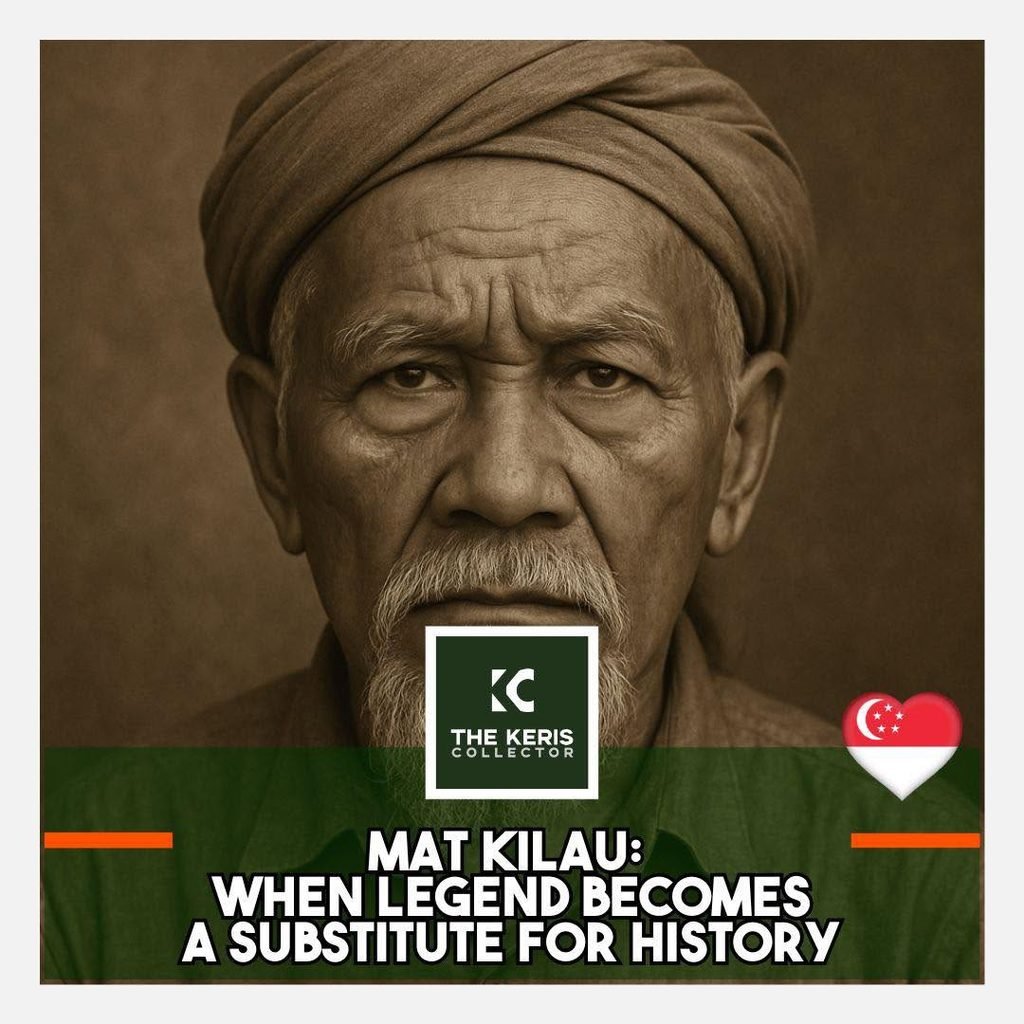
Revisiting Evidence, Memory and the Return of a Pahang Warrior
Author’s Note | September 2026
I first published this essay on my Facebook page on 3 July 2025.
At the time, I was responding to a viral social media post titled:
“Mat Kilau – Pahlawan Yang Bangkit Dari Kubur”
My concern was straightforward.
The story of Mat Kilau’s reappearance in 1969 was being presented in highly dramatic language, mixed with claims about science, hidden identities, warrior spirit and Malay revival. Historical events had become entangled with motivational storytelling.
I remain uncomfortable with that.
But after returning to my own essay and examining the historical record more closely, I also found something I needed to correct in my own writing.
In 2025, I described the investigation into the identity of the elderly man who claimed to be Mat Kilau as “informal” and lacking rigour.
That description was unfair.
The Pahang government did not simply accept his claim because a few elderly villagers recognised him.
A formal committee was established in January 1970 to investigate his identity. Its surviving report shows that the committee gathered numerous testimonies, examined conflicting accounts, considered earlier reports of Mat Kilau’s death, investigated his movements and aliases, considered identifying marks and attempted to assess the reliability of the evidence before reaching a conclusion.
The investigation obviously did not possess modern DNA analysis or today’s forensic identification methods.
But that is very different from saying there was no serious investigation.
The Pahang government ultimately accepted the committee’s findings and officially recognised the man known as Mat Siam, Muhammad or Muhammad Din bin Ibrahim as Mat Kilau bin Imam Rasu on 6 August 1970.
That requires a correction to my original argument.
At the same time, official recognition does not mean every later story attached to Mat Kilau automatically becomes historical fact.
That distinction is where I think the more interesting discussion begins.
So, as with several of my older essays, I have preserved the original below substantially as I published it on 3 July 2025, followed by how I would approach the subject today.
If I expect others to revise their claims when the evidence demands it, I should be prepared to do exactly the same.
Part I | The Original Essay
Originally published on Facebook, 3 July 2025
Mat Kilau: When Legend Becomes a Substitute for History
In 1969, a frail old man walked into a mosque in a quiet village in Pahang, Malaysia, and made a startling claim.
He said, simply:
“I am Mat Kilau.”
To many Malaysians today, especially the Malay community, that name might ring a bell. For others, especially younger generations or those outside the region, it likely won’t.
So let’s start there.
Mat Kilau was a Malay warrior and freedom fighter in the late 19th century who led uprisings against British colonial forces in Pahang. He was known for his courage, guerrilla tactics and fierce loyalty to his homeland.
Official records from that period suggest that he was either killed in battle or died in exile. For decades, his story was considered a closed chapter.
And then, seemingly out of nowhere, came this dramatic twist: someone claiming to be the long-lost hero, alive and well, having lived in secret for over 60 years.
Naturally, it made headlines.
It lit a spark.
For many, it felt like a spiritual resurrection of a national icon, a vindication of past struggle, and perhaps a timely reminder of forgotten pride.
But did anyone stop to ask:
Is it true?
Or more importantly:
Does it matter whether it’s true, if people want it to be true?
The Post That Went Viral
A social media post titled “Mat Kilau – Pahlawan Yang Bangkit Dari Kubur” has made its rounds online, reigniting this old tale.
It paints a dramatic picture: Mat Kilau, once hunted and declared a traitor by the British, had simply vanished, only to resurface in old age and reveal himself at the right moment.
The post calls him a warrior who “waited to return in the spirit of the youth,” and invites readers to “share” the story if they feel that spirit within themselves.
If you’re reading this without context, it might sound like folklore.
And that’s part of the problem.
It is folklore.
But it’s being shared, consumed and passed on as unquestioned historical fact.
What Actually Happened?
Yes, in 1969, a man did come forward and claim to be Mat Kilau.
The state government of Pahang accepted the claim after conducting interviews and gathering testimonies from people who said they remembered him.
However, there was no concrete evidence, no photographs from the 1890s to compare, no DNA tests, which weren’t yet available, no written records linking the old man to the young warrior of legend.
The verification process was informal and lacked the kind of rigour we’d expect for such a bold historical claim.
Despite this, his identity was publicly acknowledged, and a hero’s funeral was held when he passed away in 1970.
His story was reabsorbed into the national memory, not just as a man, but as a symbol.
Where the Post Goes Wrong
Now back to that viral post.
It makes several uncritical and problematic assertions:
- That scientific tests “confirmed” the man’s identity, which they didn’t.
- That he chose to disappear for over 60 years to protect a noble cause, with no personal writings or direct evidence to support this.
- That his return was a kind of prophetic moment for the Malay people, a spiritual metaphor masquerading as historical fact.
The post leans heavily on emotional appeal and identity politics.
It says, “Share this if you feel the warrior spirit is alive in you.”
That’s not historical discourse.
That’s marketing.
It’s not asking you to understand.
It’s asking you to belong.
Why It Matters
At first glance, this might seem harmless.
A little inspiration, a touch of myth, a reminder of past struggles.
But if we keep blurring the lines between myth and history, we risk losing both.
History becomes distorted, and myth loses its poetic power when forced to carry the burden of truth.
We forget that the real strength of historical figures isn’t just in the stories we tell. It’s in how we investigate them.
In how we preserve nuance, question inconsistencies and refuse to settle for what’s comforting over what’s true.
Romanticising resistance heroes is a common thread in many cultures, and for good reason. It offers inspiration, continuity and a sense of pride.
But when we blur the line between myth and history, we run into three problems:
- We risk distorting historical truth, replacing complexity with caricature.
- We oversimplify resistance, ignoring the collective efforts of lesser-known but equally courageous figures.
- We stifle critical thinking, making scepticism feel like betrayal rather than necessary inquiry.
It’s not wrong to admire Mat Kilau.
But it’s dangerous to build unquestionable legends out of uncertain claims, especially when these stories are weaponised to stoke uncritical nationalism or exclusionary identity politics.
Final Thought
Mat Kilau may or may not have returned in 1969.
We may never know.
But what’s undeniable is this: stories like his continue to matter, especially in times when identity feels threatened or uncertain.
Let’s just be careful.
Let’s not let the desire to feel heroic replace the duty to think critically.
And when we honour our past, let’s do so not by repeating slogans, but by asking difficult questions, respecting evidence and remembering that sometimes truth is more complex, and more powerful, than legend.
JoFe
Part II | Revisiting the Argument
September 2026
More than a year later, there is one sentence in that essay I would no longer write:
“Mat Kilau may or may not have returned in 1969. We may never know.”
It sounds appropriately sceptical.
But scepticism should not become a performance either.
If evidence deserves scrutiny when it supports a story we want to believe, it deserves exactly the same scrutiny when it challenges an argument we ourselves have made.
And when I returned to the evidence, I discovered that the story was more substantial than my original essay allowed.
What Actually Happened in 1969?
On Friday, 26 December 1969, an elderly man known locally as Mat Siam, and also recorded under names including Muhammad or Muhammad Din bin Ibrahim, appeared at the mosque at Kampung Pulau Tawar in Jerantut, Pahang.
There, before the congregation, he declared that he was actually Mat Kilau, son of Tok Gajah, who had participated in the resistance to British intervention in Pahang during the 1890s.
The declaration caused a sensation.
There was good reason for that.
Mat Kilau had effectively disappeared from the historical record decades earlier.
Contemporary reports in 1895 had claimed that he was dead.
A report by acting Pahang Resident D. H. Wise recorded his reported death. Newspaper reports also circulated a story that Mat Kilau had been badly wounded while resisting capture and subsequently died from blood loss.
So when an elderly man appeared more than seventy years later claiming:
“I am Mat Kilau.”
this was not simply the return of an elderly veteran.
It challenged the accepted account of what had happened to him.
The Government Did Not Simply Take His Word for It
This is where my 2025 essay needs its clearest correction.
I previously described the verification process as informal.
It wasn’t.
On 8 January 1970, the Pahang government established a committee specifically to investigate whether the elderly man claiming to be Mat Kilau was actually him.
The surviving report makes fascinating reading.
The committee collected testimony from people connected to different periods of Mat Kilau’s life.
Some claimed to have known him.
Some had fought alongside him.
Others knew the man later called Mat Siam.
The committee examined stories surrounding Mat Kilau’s supposed death.
It considered conflicting testimony.
It investigated accounts of his movements.
It considered the different names under which he had lived.
It examined identifying marks and scars.
And, importantly, it did not simply ignore evidence contradicting the claim.
The report discusses testimony asserting that Mat Kilau really had died in the 1890s and attempts to weigh that against evidence supporting Mat Siam’s claim.
That does not make the investigation equivalent to modern forensic identification.
It wasn’t.
But calling it an informal acceptance based simply on villagers remembering him seriously understates what actually happened.
I got that wrong.
Was There a Scientific Test?
Here, however, an important distinction remains.
I have found no reliable evidence that a modern-style scientific test conclusively established his identity.
There was no DNA identification.
DNA profiling did not yet exist.
Nor have I found evidence of some laboratory procedure capable of scientifically proving that Muhammad bin Ibrahim and the Mat Kilau who disappeared in the 1890s were the same person.
The investigation was primarily historical and testimonial.
It depended upon witnesses, personal recognition, remembered events, identifying physical features, chronology and comparison between competing accounts.
That is evidence.
But it is not the same thing as forensic proof.
If a viral post claims simply that “scientific tests proved he was Mat Kilau”, I would still want to see the evidence for that particular statement.
I have not found it.
What Did the Pahang Government Decide?
The committee eventually completed its investigation and submitted its findings to the Pahang government.
The matter went before the state authorities and received the consent of Sultan Abu Bakar Ri’ayatuddin Al-Mu’adzam Shah.
Then, on 6 August 1970, Menteri Besar Tan Sri Haji Yahya bin Muhammad Seh officially announced, on behalf of the Pahang government, that the elderly man known as Muhammad bin Ibrahim, Muhammad Din bin Ibrahim or Mat Siam was indeed:
Mat Kilau, son of Tok Gajah.
That is an important historical fact.
It means we should distinguish between two statements:
“An elderly man claimed to be Mat Kilau.”
and:
“An elderly man claimed to be Mat Kilau, his claim was formally investigated for months, and the Pahang government subsequently recognised him as Mat Kilau.”
The second is a much more accurate description of what happened.
Does Official Recognition End the Historical Question?
Not necessarily.
And this is where history becomes interesting.
Government recognition is historically significant evidence.
It should not be dismissed simply because we lack DNA.
At the same time, government recognition does not magically transform every piece of testimony considered by the committee into independently verified fact.
The investigation depended heavily upon human memory.
And the events being reconstructed had occurred many decades earlier.
Some witnesses were extremely elderly.
Different accounts contradicted one another.
Even the circumstances surrounding Mat Kilau’s supposed death produced several versions.
These are precisely the kinds of problems historians encounter when working with oral testimony and retrospective memory.
The responsible position therefore isn’t:
“There is absolutely no evidence that he was Mat Kilau.”
That is clearly wrong.
Nor is it:
“Science conclusively proved that he was Mat Kilau.”
I have found no evidence supporting that claim either.
The more defensible statement is:
The Pahang government conducted a formal historical investigation, concluded that Mat Siam was Mat Kilau and officially recognised him as such in 1970. The identification rested principally upon testimony, historical reconstruction, personal recognition and physical identifying features rather than modern forensic testing.
That may be less dramatic.
But it is much more interesting.
The Strange Problem of Mat Kilau’s “Death”
There is another reason the story became legendary.
Mat Kilau had already been reported dead.
The committee itself examined this problem.
Earlier accounts differed over what had supposedly happened.
One report stated that Mat Kilau had died in 1895.
Another account described him being badly wounded while resisting arrest and dying while being taken towards Kota Bharu.
Other testimony later claimed that the supposed death had been staged or misunderstood.
The committee had to untangle stories that had accumulated over more than seventy years.
This is precisely where history begins turning into legend.
A warrior disappears.
Authorities report him dead.
Stories circulate.
Decades pass.
Witnesses die.
Memories change.
Then the supposedly dead warrior walks into a mosque.
You hardly need to embellish that story.
It is already extraordinary.
Mat Kilau Was Part of a Larger Resistance
There is another aspect of my original essay that I still think deserves emphasis.
Heroic storytelling has a tendency to compress collective history into one extraordinary individual.
Mat Kilau mattered.
But the resistance to British intervention in Pahang was not the work of Mat Kilau alone.
The Pahang disturbances of the 1890s involved figures including Dato’ Bahaman, Tok Gajah, Mat Kilau and numerous followers and local supporters.
The grievances themselves also deserve context.
British intervention altered existing political and administrative arrangements, including traditional authority and rights connected with taxation and governance.
Reducing all of that to:
“Mat Kilau fought the British.”
gives us a hero.
But it doesn’t necessarily give us history.
Who supported the resistance?
Why?
What political arrangements were being disrupted?
What were the interests of the Pahang chiefs?
How did Sultan Ahmad navigate the crisis?
How did British officials understand what was happening?
Why did some people resist while others cooperated?
Those questions tell us far more about nineteenth-century Pahang than simply declaring someone a warrior.
The Man and the Symbol
There are therefore two Mat Kilaus worth distinguishing.
There is Mat Kilau the historical actor.
The son of Tok Gajah.
A participant in resistance against British intervention in Pahang.
A man who disappeared from the conventional historical record and was reported dead.
A man whom the Pahang government concluded had survived under other identities before publicly revealing himself in 1969.
And then there is Mat Kilau the symbol.
The invincible warrior.
The embodiment of Malay courage.
The hero who supposedly waited decades for exactly the right moment to return.
The figure onto whom later generations can project courage, nationalism, spirituality and whatever contemporary message they wish him to carry.
The first deserves historical investigation.
The second belongs partly to memory, commemoration and legend.
They can coexist.
The problem begins when we stop distinguishing between them.
Legend Is Not an Insult
I think this is something worth saying clearly.
Calling part of a historical tradition legendary does not mean calling it worthless.
Legends matter.
They tell us how societies remember.
They reveal what communities admire.
They show us which qualities later generations choose to associate with historical figures.
Courage.
Loyalty.
Resistance.
Sacrifice.
Defiance.
A legend can therefore tell us something important even when every detail cannot be historically demonstrated.
The mistake is demanding that legend perform the job of history.
History asks:
What does the evidence allow us to say?
Legend asks:
What does this story mean to us?
Those are different questions.
Both can be valuable.
Confusing them weakens both.
Scepticism Must Also Be Sceptical of Itself
This is perhaps the biggest lesson I take from revisiting my own essay.
Critical thinking does not mean automatically rejecting extraordinary stories.
That is just another shortcut.
The purpose of scepticism is not to say:
“I don’t believe it.”
It is to ask:
“What is the evidence?”
And then actually follow that evidence.
Even when it moves in a direction we weren’t expecting.
In 2025, I was so focused on challenging an overly romantic version of Mat Kilau’s story that I understated the investigation supporting his identification.
That is precisely the kind of mistake evidence-based writing is supposed to correct.
So I am correcting it.
I still would not describe his identity as having been “scientifically proven”.
I would still separate later embellishments from documented events.
I would still resist turning Mat Kilau into a motivational slogan for contemporary identity politics.
But I would no longer casually dismiss his reappearance as merely an uncertain claim made by an elderly man and accepted through an informal process.
The historical record deserves better than that.
History Does Not Need Us to Choose Between Belief and Disbelief
There is a temptation whenever we encounter stories like this to choose a camp.
Either:
“Of course it was Mat Kilau. Stop questioning our history.”
Or:
“There is no proof. It’s probably just a legend.”
I don’t find either position particularly satisfying.
The surviving evidence gives us something much more interesting.
An elderly man publicly declared himself to be a resistance figure believed dead for more than seventy years.
The government investigated.
Witnesses were questioned.
Conflicting stories were considered.
A committee produced a report.
The state ultimately accepted his identity.
And ten days after the official announcement, on 16 August 1970, the man recognised as Mat Kilau died.
That is remarkable enough.
We don’t need to make it supernatural.
And we don’t need to dismiss it merely because modern forensic evidence is unavailable.
Final Thought
So, did Mat Kilau return from the dead?
No.
Because the historical claim was never really that a dead man came back to life.
The claim was that the reports of his death had been wrong.
That distinction alone demonstrates how easily history becomes legend.
The phrase “Pahlawan Yang Bangkit Dari Kubur” makes a wonderful headline.
But the real story is better.
A man believed dead survived.
He apparently lived for decades under other identities.
He returned to his home village.
He publicly declared who he was.
His claim was investigated.
The Pahang government accepted it.
And more than half a century later, we are still discussing what that extraordinary episode means.
There is no need to choose between admiration and critical inquiry.
We can respect Mat Kilau and still investigate Mat Kilau.
We can honour resistance and still question the stories built around it.
We can preserve oral tradition while distinguishing testimony from forensic evidence.
And when evidence shows that something we ourselves wrote was incomplete, we can correct it.
That isn’t weakness.
That is what historical inquiry is supposed to look like.
The internet rewards certainty. History rewards evidence.
Preserve Through Discovery.
JoFe
The Keris Collector
References & Further Reading
The following sources provide useful starting points for readers wishing to examine Mat Kilau, the Pahang resistance and the investigation into his reappearance.
The 1970 Investigation
Jawatankuasa Menyiasat Munchul-nya Mat Kilau. Laporan Jawatankuasa Menyiasat Munchul-nya Mat Kilau. Pahang, 1970.
This is the most important source for the question addressed in the revised essay. Rather than relying entirely on later retellings, the report allows readers to examine how the investigating committee actually approached the claim.
The committee considered testimony supporting and challenging Mat Siam’s identification as Mat Kilau, earlier accounts of Mat Kilau’s supposed death, people who claimed personal knowledge of him, his movements and aliases, and physical identifying features.
It is particularly valuable because the report itself shows that the committee was aware of contradictory evidence and attempted to evaluate it.
National Archives of Malaysia
Arkib Negara Malaysia. Puspawangsa, Bil. 1/2022. “Pahlawan Pahang, Mat Kilau bin Imam Rasul, 27 Disember 1969.”
The National Archives’ published collection records Mat Kilau’s role in the Pahang resistance, the conflicting reports concerning his death, his reappearance in 1969 and the subsequent investigation into his identity.
The National Archives also preserves photographic and documentary material associated with Mat Kilau and the anti-British resistance in Pahang.
Contemporary Historical Account of Pahang
Linehan, William. “A History of Pahang.” Journal of the Malayan Branch of the Royal Asiatic Society 14, no. 2 (1936).
Linehan remains an important early scholarly account of Pahang history and the nineteenth-century political conflicts involving British intervention.
It should be read critically, particularly because it predates Mat Kilau’s reappearance by more than three decades. Its value here lies partly in showing what historians believed about Mat Kilau before the events of 1969–1970 transformed the story.
Pahang Resistance and Colonial Records
Arkib Negara Malaysia. “Gerakan Kebangkitan Anti-British di Pahang, 1891–1892.” Puspawangsa, Bil. 2/2022.
This National Archives feature draws attention to surviving government records concerning the Pahang disturbances. It places Dato’ Bahaman at the beginning of the resistance and records the subsequent participation of Tok Gajah, Mat Kilau and their followers.
It is useful for remembering that the resistance was a broader political and military episode rather than the story of one warrior acting alone.
A Note on Evidence
The Mat Kilau case presents an unusually useful lesson in how different kinds of historical evidence should be handled.
We have colonial administrative records.
Contemporary newspaper reports.
Oral testimony.
Retrospective eyewitness accounts.
Physical identifying marks.
Government investigation.
Official recognition.
And later popular memory.
These sources do not all possess the same evidentiary weight.
Nor do they necessarily agree.
The historian’s task is therefore not simply to collect whichever sources support a preferred conclusion.
It is to ask what each source is, when it was produced, who produced it, what information was available to its author and how it relates to other surviving evidence.
The absence of DNA evidence does not mean there was no evidence.
Official recognition does not mean every later legend becomes fact.
An old newspaper report does not become infallible merely because it is old.
And oral testimony does not become worthless simply because it was spoken rather than written.
Evidence has to be weighed.
That is precisely what makes the Mat Kilau story so interesting.
Behind the legend is not an absence of history.
There is a surprisingly complicated historical investigation waiting to be read.