
For a serious collector, legal possession is only the beginning
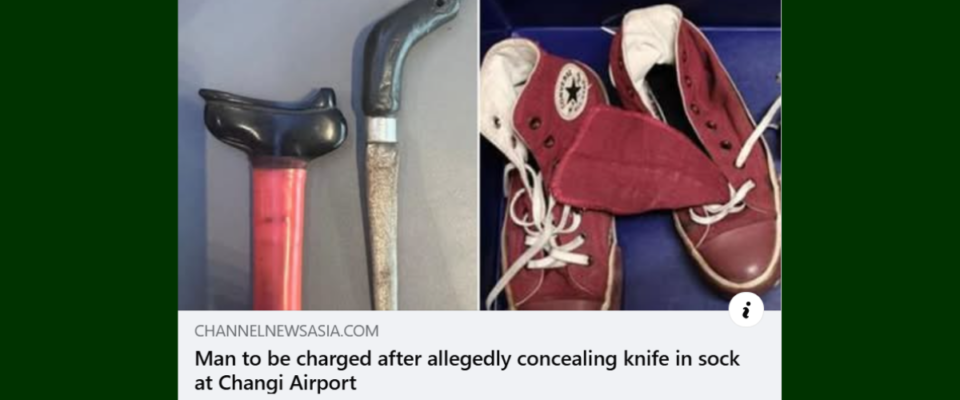
A 19.5 cm object.
A 12 cm blade.
Plastic bags.
Tape.
A sock.
A high-cut shoe.
And the departure security screening area at Changi Airport Terminal 4.
On 28 August 2026, Channel NewsAsia reported that a 32-year-old Indonesian man would be charged with carrying an offensive weapon in a public place after security officers detected what police described as a knife concealed inside his shoe. Police said the object had been wrapped in layers of plastic bags, sealed with tape and placed inside a sock. An X-ray operator detected a suspicious sharp object after the man was instructed to remove his shoes.
*Click here for Source News Article @ChannelNewsAsia
Those are allegations. A charge is not a conviction, and the publicly available report does not establish why the man had the object, whether he held any weapons licences, or whether he intended to commit any import or export offence.
But the circumstances raise an obvious question.
Why conceal a bladed object while passing through airport security?
For collectors, however, there is a more useful question than speculating about one man’s motive.
What does the law require before a weapon moves?
That question matters because one of the easiest mistakes a collector can make is to collapse several different legal activities into one.
I own it legally.
Therefore I can carry it.
I can carry it.
Therefore I can take it to the airport.
The airline accepts it in checked baggage.
Therefore I can export it.
The overseas seller is willing to ship it.
Therefore I can import it.
None of those conclusions necessarily follows.
Under Singapore’s current weapons regime, possession, carrying in public, transport, import and export can engage different legal rules.
A responsible collector therefore needs to ask more than:
Can I own this?
The better question is:
What am I about to do with it?
First, an important correction about the “12 cm rule”
The reported Changi object had a 12 cm blade. That number immediately looks significant.
It is also where collectors should be careful.
I went looking for the supposed rule that a sharp weapon becomes individually licensable once its blade reaches 12 cm.
I could not find such a general 12 cm threshold in the current Guns, Explosives and Weapons Control Act 2021, the 2025 weapons regulations, the Type 2 class-licence legislation, or the Singapore Police Force’s current GEWCA guidance.
So I would not tell collectors:
Every sharp object with a blade of 12 cm or more requires a possession licence.
That is an oversimplification I cannot support from the current primary sources.
The present framework works differently.
The GEWCA contains a statutory list of weapons. It expressly includes swords and certain sharp pointed stabbing instruments designed for hand-to-hand combat and ordinarily capable of concealment. Significantly for this audience, the Act expressly names the kris (keris), alongside items such as the karambit, kirpan and dirk.
Under the 2025 regulations, a Type 1 weapon is essentially a weapon that is neither Type 2 nor Type 3. Type 1 weapons require the individual licensing regime.
Type 2 is important because it includes, among other things, a blunted dagger and blunted sword. The legislation defines “blunted” by function: the cutting edges and points have been modified so they are blunt and not capable of causing serious injury or death.
SPF’s current guidance reinforces this distinction. It provides a “paper cut test” demonstration to distinguish sharp from blunt weapons and explains, for example, that a sharp sword requires individual possession and import/export licensing, while a sword properly blunted into Type 2 status is regulated through the class-licence framework.
So for a keris collector, sharpness and legal morphology matter far more than a simplistic 12 cm slogan.
A short object can still fall within a regulated weapon definition because of what it is and how it is constructed.
A long object is not automatically individually licensable merely because it crosses an invented universal blade-length threshold.
The Changi object’s reported 12 cm blade therefore tells us its size.
It does not, by itself, tell us its GEWCA category.
Knife, badik, keris, or something else?
CNA and the police report call the Changi object a knife.
That is the journalistic description.
Material culture asks a different question.
From the published police photographs, the object appears to be a compact sheathed Southeast Asian-style edged weapon. Its hilt and fittings invite comparison with regional dagger traditions, including badik-type forms and forms related to the wider keris world.
I would not go further than that from photographs.
A reliable identification would require better views of the blade, cross-section, construction, hilt, sheath and fittings. A photograph can suggest a family resemblance without establishing typology.
And then there is a third question.
What does Singapore law call it?
That answer does not depend on what a collector prefers to call the object.
A collector may describe something as a badik, keris, tumbuk lada, dagger, sword, heirloom or ceremonial object. The GEWCA applies its own statutory definitions.
That produces an important principle:
CULTURAL MEANING AND LEGAL CLASSIFICATION ANSWER DIFFERENT QUESTIONS.
A keris can simultaneously be an heirloom, artwork, antique, ceremonial object, family inheritance and weapon.
Its cultural meanings do not disappear because the law regulates it.
But those meanings do not automatically determine the legal category either.
The new GEWCA framework
Singapore’s Guns, Explosives and Weapons Control Act 2021 came fully into operation on 1 July 2025, replacing the old Arms and Explosives Act framework.
For edged-weapon collectors, one of the most useful things about the current system is the distinction between different categories and different regulated activities.
SPF describes Type 1 weapons as higher-risk weapons requiring individual licensing. Its examples include throwing knives, butterfly or gravity knives, flick knives, switchblades, karambits and, where sharp rather than properly blunted, weapons such as swords and daggers.
Type 2 weapons are regulated through class licences when the applicable conditions are satisfied. These include blunted daggers and blunted swords.
There are also specific class-licence regimes for ornamental, religious, theatrical and sporting uses.
For collectors, the Ornamental Use — Class Licence Order 2025 is especially interesting. It covers possession of certain blunted defined weapons as ornaments, curios or parts of collections because of their commemorative, historical, thematic or heirloom value.
Notice the word that keeps returning:
blunted.
“It’s an heirloom” is therefore not a magic exemption for a sharp keris.
Nor is:
“It’s antique.”
“It’s ceremonial.”
“It’s part of my collection.”
Those facts may be relevant to purpose or to a particular class-licence regime, but they do not erase the need to determine the object’s actual legal classification.
Possess ≠ carry ≠ transport ≠ import ≠ export
This is the part I want every collector to remember.
POSSESS ≠ CARRY IN PUBLIC ≠ TRANSPORT ≠ IMPORT ≠ EXPORT
A possession licence authorises possession of the weapons and at the places stated in the licence.
SPF separately describes a weapon transport licence as authorising movement of weapons between approved locations.
Its current GEWCA fee schedule likewise lists possession and transport as separate activities. For Type 1 weapons, SPF lists a possession licence and both renewable and non-renewable transport arrangements. Import/export is again treated separately, with a per-consignment licence.
That separation is not bureaucratic trivia.
Imagine a collector owns a sharp keris lawfully at home.
Now the collector wants to take it to:
a museum;
an exhibition;
another collector;
a conservator;
a restorer;
a cultural programme;
or Changi Airport.
The legal question has changed.
The collector is no longer merely possessing the object at its approved place.
The object is moving.
Transport: the moment the object leaves home
The 2025 Weapons and Noxious Substances Regulations define a weapon transport licence as authority to convey a weapon consignment on a Singapore journey using the vessel or vehicle stated in the licence.
The regulations also impose transport requirements on holders of transport licences. For transport by road or water, weapons must, where applicable, remain sheathed or covered and must not be visible to people other than those involved in packing, loading or unloading. The regulations also deal with approved routes and record-keeping.
This is worth contrasting with the Changi report.
Responsible transport is about lawful authority, controlled movement and compliance with licence conditions.
It is not about making an object secretly invisible to security screening.
That distinction lets us draw a line without deciding anything about the accused man’s eventual guilt:
Concealment is not compliance.
For Type 2 weapons, the position differs because their manufacture, trading, supply, carriage and disposal can operate under the Type 2 class-licence order when its conditions are met. That is another reason not to say that every keris movement requires the identical individual transport licence.
The object must be classified first.
Only then can you know which transport regime applies.
Carrying in public is another legal problem
GEWCA is not the only law a collector should know.
Singapore’s Corrosive and Explosive Substances and Offensive Weapons Act 1958 separately addresses carrying offensive weapons in public places.
Section 6 makes it an offence to carry or possess an offensive weapon in a public road or place otherwise than with lawful authority or for a lawful purpose. The Act defines an offensive weapon broadly as an instrument which, if used as a weapon of offence, is likely to cause hurt.
The legislation recognises lawful purposes that can include work, religious reasons, theatrical or film production, ornamental display and certain other uses.
But a collector should not read “lawful purpose” as permission to ignore GEWCA licensing.
These legal regimes answer different questions.
You may have a genuine reason for moving an object and still need whatever GEWCA authority applies to the weapon and activity.
Conversely, holding a GEWCA possession licence does not mean every manner of carrying the weapon in public is automatically lawful.
This is why compliance cannot be reduced to one piece of paper.
Import: buying it is not importing it
Collectors buy across borders.
That creates another dangerous assumption:
The seller is willing to ship it, so it must be legal.
No.
An overseas seller’s willingness to put a keris in a parcel tells you almost nothing about Singapore’s import requirements.
For regulated Type 1 weapons, SPF’s current framework requires the relevant GEWCA import/export licensing. Police guidance describes the import/export licence as a per-consignment authorisation.
Then there is the trade-control layer.
Singapore Customs operates TradeNet as the national system for import, export and transhipment permit applications. Where goods are controlled by a Competent Authority, the trader must meet that authority’s requirements as part of the TradeNet process.
SPF’s GEWCA import/export guidance requires the relevant GEW licence details in TradeNet declarations and lists supporting documents that can include invoices, packing lists, bills of lading or air waybills and end-user documentation, depending on the transaction.
This is the distinction collectors often miss:
A POLICE LICENCE AND A CUSTOMS PERMIT ARE NOT THE SAME THING.
Where both are required, one does not replace the other.
Buying the object is one event.
Owning it is another.
Importing it is another.
Export: leaving Singapore creates a new chain of questions
The same principle applies in reverse.
Suppose you want to send a sharp keris overseas for restoration.
Or sell it to an overseas collector.
Or take it to an exhibition.
Or travel with it as part of a cultural programme.
You need to establish the Singapore export position before it leaves.
For Type 1 weapons, SPF’s current guidance treats import/export licensing on a per-consignment basis. Its GEWCA FAQ also says that the relevant import/export licence is bundled with a non-renewable transport licence for that consignment, so a separate transport application is not needed for that particular licensed import/export movement.
TradeNet requirements may also apply.
And Singapore approval is only half the journey.
The destination country may regulate the same object differently.
A keris lawful to possess in Singapore may require an import permit elsewhere.
Another country may restrict double-edged daggers, blade dimensions, concealed weapons, antiques or particular weapon types under completely different definitions.
Singapore compliance does not equal destination-country compliance.
And the airline?
An airline may tell you that a bladed item is permitted in checked baggage subject to its conditions.
Useful information.
But that answers an airline question.
It does not automatically answer:
Is possession lawful?
Is carrying it to the airport lawful?
Is the Singapore transport authorised?
Does GEWCA require a licence?
Does Customs require a permit?
Is export authorised?
Will the destination country allow import?
Airport security, airline baggage rules, GEWCA, offensive-weapons law, Customs controls and foreign law can overlap.
Compliance with one does not make the others disappear.
This is why:
“The airline said I can check it in” is not a legal compliance strategy.
What the Changi case does not tell us
There is a temptation to connect all these rules directly to the accused man.
We should resist it.
The public reporting establishes that police describe the object as a knife, that it was allegedly concealed in a sock and high-cut shoe, that it was wrapped in plastic bags and tape, and that he is being charged with carrying an offensive weapon in a public place.
As of this writing, I have not found reliable public material establishing whether he held or lacked a GEWCA possession licence, transport licence or export licence.
Nor have I found a public charge alleging unlicensed export.
So I will not write:
“He was illegally exporting an unlicensed weapon.”
We do not know that.
The reported concealment reasonably raises the possibility that the object was being moved through security in a manner intended to avoid detection.
But motive remains for the court and the evidence.
The collector lesson does not depend on guessing it.
“But mine is an antique”
This deserves its own warning because keris collecting lives at the intersection of weapons and heritage.
Consider the usual statements:
“It’s an antique.”
“It’s ceremonial.”
“I inherited it.”
“It’s part of my collection.”
“I bought it legally.”
“It’s not for fighting.”
“I’m only taking it to an exhibition.”
“It’s inside my luggage.”
“I’m only bringing it to another collector.”
“I have a licence to possess it.”
Each statement may describe something true.
None, standing alone, answers all the legal questions.
The ornamental class licence is itself proof of why precision matters. It specifically recognises commemorative, historical, thematic and heirloom value, but for the defined weapons covered by that regime, it is built around blunted weapons and conditions governing their possession.
Heritage status and weapons regulation can coexist.
One does not cancel the other.
A responsible collector’s six questions
I would reduce the compliance habit to six verbs.
IDENTIFY → CLASSIFY → LICENSE → DECLARE → TRANSPORT → DOCUMENT
This is not official GEWCA terminology. It is a collector’s checklist.
IDENTIFY
What is the object actually?
Do not rely only on the seller’s label.
CLASSIFY
How does Singapore law classify this particular object?
Is it sharp or legally blunted? Does it meet a statutory weapon definition? Is it Type 1, Type 2 or otherwise treated?
LICENSE
What authority is required for the activity you intend?
Possession?
Transport?
Import?
Export?
DECLARE
Does the movement require a Customs or TradeNet permit or declaration in addition to Police licensing?
TRANSPORT
Are you legally authorised to move the object, and what conditions apply to that movement?
DOCUMENT
Keep the relevant licences, permits, invoices, provenance, correspondence and supporting records organised.
And when classification is genuinely uncertain, do not improvise.
Ask the Police Regulatory Department before acting.
The serious collector knows the law too
Collectors enjoy knowledge.
We can spend hours discussing dapur.
Pamor.
Tangguh.
Blade construction.
Fittings.
Regional typology.
Provenance.
Condition.
Restoration.
History.
Symbolism.
Those things matter.
But if we collect objects that are also legally weapons, there is another field of knowledge we do not get to ignore.
The law.
Knowing a keris intimately while having no idea whether you are authorised to move it is not complete collecting knowledge.
Responsible collecting includes legal literacy.
That does not mean being afraid of collecting.
It means taking collecting seriously.
Singapore’s weapons laws are not an obstacle that clever collectors should learn to work around.
They are part of the environment in which responsible collecting takes place.
The correct instinct is not:
How do I get this through?
It is:
What is this?
How is it classified?
What am I about to do with it?
What authority does that activity require?
Then act accordingly.
Because the most important legal question often begins only after you have established that you can own the object.
Know the object.
Know its history.
Know its legal classification.
And know what authorisation you need before the weapon moves.