
Most of the time, I am the one deciding which story to tell.
I choose the object. I choose the angle. I decide what to explain, what to leave out, and where the conversation should go.
This time, somebody else asked the questions.
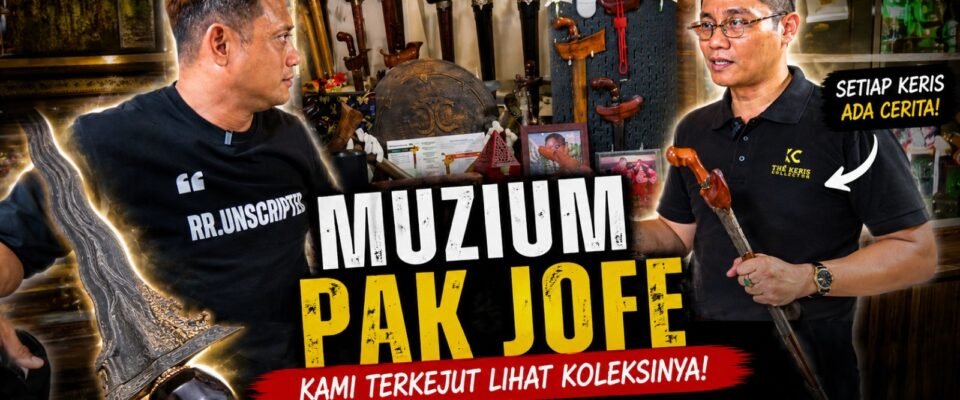
Recently, I had the pleasure of welcoming Raja Razie, host of RR.Unscripted, into my home gallery for a conversation about keris, collecting, belief, history, misconceptions and, really, whatever else came naturally once we started talking.
And I enjoyed it.
Not because everything had to be polished.
Quite the opposite.
There is something refreshing about sitting down in a familiar space, surrounded by objects I have lived with and studied for years, and simply responding to another person’s curiosity.
No formal presentation.
No carefully staged lecture.
No need to make every answer neat.
Just conversation.
That probably explains why I enjoyed the session as much as I did.
When I create my own content, I usually know where the story is going. In an interview, especially one like RR.Unscripted, you give up some of that control.
Someone else decides what to ask next.
A question can lead somewhere unexpected.
A small remark becomes another story.
And sometimes the more interesting parts of a conversation are the ones nobody planned.
The episode also gave me an opportunity to talk about keris in the environment where I normally study and live with them.
That matters to me.
A keris is easier to understand when it is not treated merely as an isolated weapon.
There is craftsmanship.
Material culture.
Trade.
Migration.
Belief.
Identity.
Status.
Memory.
Family histories.
And, naturally, plenty of misconceptions.
Some of those subjects came up during the conversation.
Others appeared almost by accident.
That is probably what I liked most about the session.
It felt less like an interview where somebody needed to extract a particular answer from me, and more like two people allowing a subject to unfold.
Raja has spent many years in Singapore media, so he knows how to keep a conversation moving without making it feel forced.
I appreciated that.
And I hope my sharing gives his audience another way of looking at the keris, beyond the usual questions about mysticism or whether every blade supposedly has a pendamping.
Those questions are interesting, of course.
But the world around the keris is much larger than that.
For anyone curious about the collection, my approach to collecting, and some of the stories behind these objects, the full conversation is now available on RR.Unscripted.
Watch the full episode here:
https://youtu.be/YwL7roDAe2E
I remain open to conversations like this with fellow content creators, researchers, media practitioners and people working seriously in culture and heritage, when the subject is meaningful and schedules permit.
Sometimes I tell the story.
Sometimes it is useful to sit down and let somebody else ask the questions.Most of the time, I am the one deciding which story to tell.
I choose the object. I choose the angle. I decide what to explain, what to leave out, and where the conversation should go.
This time, somebody else asked the questions.
Recently, I had the pleasure of welcoming Raja Razie, host of RR.Unscripted, into my home gallery for a conversation about keris, collecting, belief, history, misconceptions and, really, whatever else came naturally once we started talking.
And I enjoyed it.
Not because everything had to be polished.
Quite the opposite.
There is something refreshing about sitting down in a familiar space, surrounded by objects I have lived with and studied for years, and simply responding to another person’s curiosity.
No formal presentation.
No carefully staged lecture.
No need to make every answer neat.
Just conversation.
That probably explains why I enjoyed the session as much as I did.
When I create my own content, I usually know where the story is going. In an interview, especially one like RR.Unscripted, you give up some of that control.
Someone else decides what to ask next.
A question can lead somewhere unexpected.
A small remark becomes another story.
And sometimes the more interesting parts of a conversation are the ones nobody planned.
The episode also gave me an opportunity to talk about keris in the environment where I normally study and live with them.
That matters to me.
A keris is easier to understand when it is not treated merely as an isolated weapon.
There is craftsmanship.
Material culture.
Trade.
Migration.
Belief.
Identity.
Status.
Memory.
Family histories.
And, naturally, plenty of misconceptions.
Some of those subjects came up during the conversation.
Others appeared almost by accident.
That is probably what I liked most about the session.
It felt less like an interview where somebody needed to extract a particular answer from me, and more like two people allowing a subject to unfold.
Raja has spent many years in Singapore media, so he knows how to keep a conversation moving without making it feel forced.
I appreciated that.
And I hope my sharing gives his audience another way of looking at the keris, beyond the usual questions about mysticism or whether every blade supposedly has a pendamping.
Those questions are interesting, of course.
But the world around the keris is much larger than that.
For anyone curious about the collection, my approach to collecting, and some of the stories behind these objects, the full conversation is now available on RR.Unscripted.
Watch the full episode here:
https://youtu.be/YwL7roDAe2E
I remain open to conversations like this with fellow content creators, researchers, media practitioners and people working seriously in culture and heritage, when the subject is meaningful and schedules permit.
Sometimes I tell the story.
Sometimes it is useful to sit down and let somebody else ask the questions.
– JoFe.