
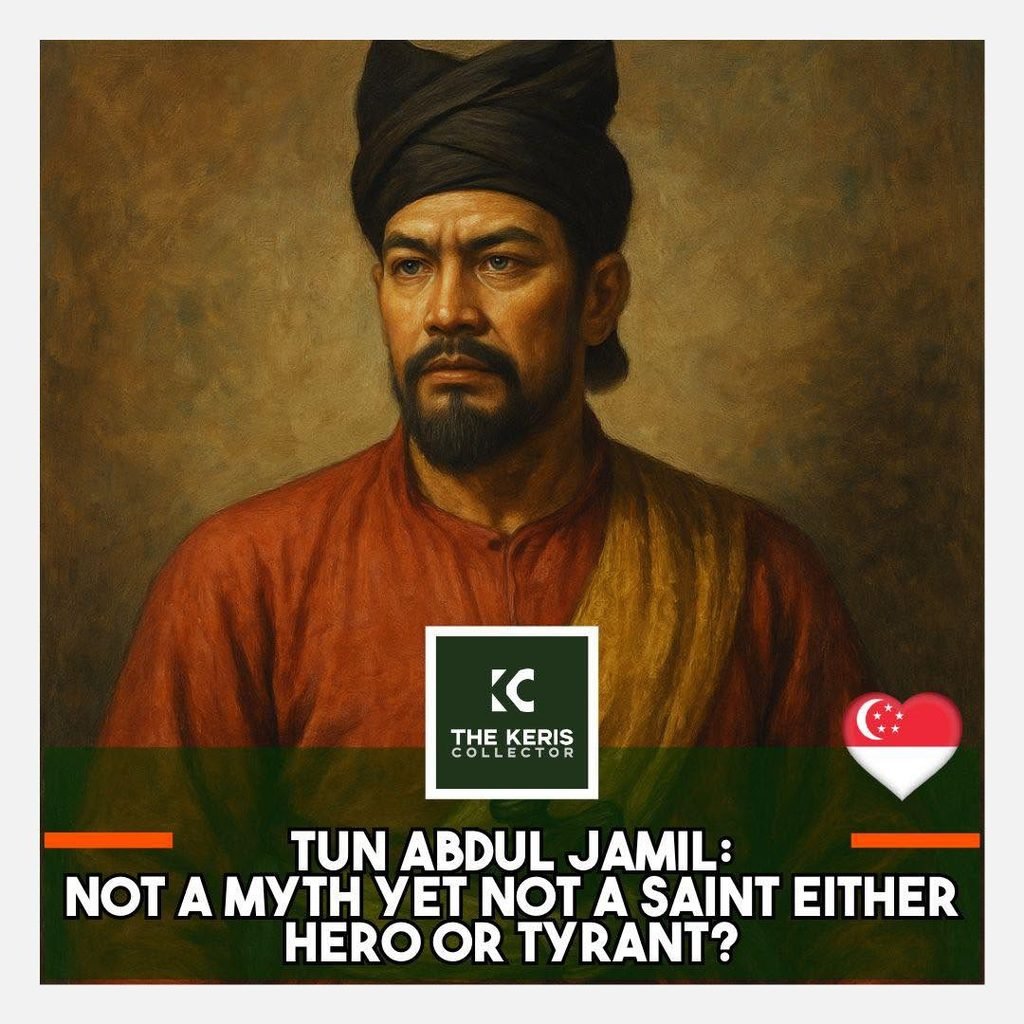
Author’s Note | Revisited, September 2026
I first published this essay on Facebook on 6 July 2025.
Its purpose was to challenge the tendency to turn complicated historical figures into uncomplicated heroes.
I still stand by that principle.
But there is an irony here.
In trying to correct an exaggerated version of Tun Abdul Jamil’s history, I understated his actual historical role.
My original essay argued that the 1640–41 attack on Portuguese Melaka was essentially a Dutch operation in which Johor played a secondary role, and that Tun Abdul Jamil should not be credited with leading the campaign.
That formulation was too sweeping.
The Dutch East India Company, or VOC, was indeed central to the siege and ultimately became the power occupying Melaka after the Portuguese surrender. But Johor was not merely an incidental participant. Historical accounts identify a substantial Johor force participating in the campaign, and Tun Abdul Jamil is identified as the commander of that Johor contingent.
That does not make him commander of the entire Dutch-Johor campaign.
But neither is it accurate to reduce him to a minor supporting character.
I also got another detail wrong. I originally wrote that Tun Abdul Jamil was killed in a palace coup in 1690. Sources instead place his fall from power and death in 1688.
So this Revisited essay requires more than polishing.
It requires correction.
The broader argument survives: historical people should not be transformed into flawless nationalist heroes.
But historical scepticism has obligations too.
If the evidence gives Tun Abdul Jamil more credit than I originally allowed him, then he should receive it.
That is the point of revisiting my own work.
Part I | The Original Essay
Originally published on Facebook, 6 July 2025
Tun Abdul Jamil and the Myth of Heroism: Reading Between the Lines of History
When we engage with history, especially stories from colonial times and Malay warriors, we have a responsibility. A duty to truth, not just nostalgia. To facts, not fiction. And especially to future generations who will inherit these narratives.
One figure often celebrated with emotional fervor is Laksamana Tun Abdul Jamil, particularly in relation to the 1640–41 attack on Melaka, then under Portuguese control. He is often portrayed as a fearless commander who rose to protect the dignity of the Malay world. But when we start unpacking the details, the story isn’t as straightforward, or as heroic, as many would like to believe.
Let’s go through and debunk some of the more problematic claims:
Claim 1: “He led the major assault on Melaka in 1640–41.”
Not supported by historical records.
The assault on Melaka in 1640–41 was indeed a major event, but it was led by the Dutch East India Company (VOC). Not by Tun Abdul Jamil.
While Johor supported the effort tactically, and Malay forces were involved, the main operation, planning, and execution were conducted by the Dutch. Most contemporary sources, Dutch, Portuguese, and even local, do not credit Tun Abdul Jamil as the main commander or strategist of the campaign.
Claim 2: “He joined forces with the Dutch to defeat the Portuguese who insulted the Malay-Islamic world.”
Overly romantic and historically misleading.
This claim frames the alliance in moralistic or religious terms, when in fact, it was a pragmatic political alliance. Johor had long been at odds with the Portuguese due to failed treaties, military conflict, and trade rivalries.
The Dutch, for their part, weren’t there to liberate or defend any civilisational honour. They were after Melaka’s strategic position on the trade route and the spice economy. The idea that this was a holy alliance to “defend the Malay-Islamic world” is a modern projection onto a very materialistic geopolitical reality.
Claim 3: “He orchestrated sophisticated land and sea strategies for the campaign.”
This was the Dutch’s show, not Johor’s.
The VOC had advanced naval and siege capabilities at the time, using blockades and artillery to cut off Portuguese supplies and reinforcements. Land forces included Asian mercenaries and local troops, but the entire campaign was led by Dutch commanders, with Johor’s troops playing a secondary, supporting role.
There’s no strong evidence to support that Tun Abdul Jamil masterminded or even co-led the broader military strategy.
Claim 4: “He was a selfless war leader who put his land above personal glory.”
This is selectively remembered.
Tun Abdul Jamil is remembered more clearly for his controversial role in Johor’s court politics than for military brilliance. He was heavily involved in power struggles and internal conflicts, including purging rivals and consolidating power.
In fact, his own downfall came through political infighting, and he was ultimately killed in a palace coup in 1690. If anything, his story is one of ambition, rivalry, and palace drama, not self-sacrificial patriotism.
So, Why Does This Matter?
Because when we simplify history into tales of “heroes vs villains”, we miss the actual lessons:
- How foreign powers used local alliances to their advantage
- How local leaders weren’t always united or noble in their intent
- And how the real story of our region is complex, messy, and much more educational when told truthfully
These exaggerated narratives may feel empowering, but they distort our understanding of the past. We end up inheriting illusions, not insights.
Final Thoughts: We Don’t Need Perfect Heroes
Figures like Tun Abdul Jamil deserve to be studied, but with context, not emotional nationalism.
He played a role. A complex one. Not always noble. Not always brave. But very human.
And that’s okay.
We don’t need our ancestors to be superheroes. We need them to be real, so we can learn from both their courage and their flaws.
TL;DR: The 1640–41 siege of Melaka was led by the Dutch, not Tun Abdul Jamil. Johor played a supporting role, and the alliance was political, not religious. Tun Abdul Jamil’s legacy is more complicated. He was a court power player, not just a wartime hero. History deserves to be respected with facts, not inflated myths. We owe ourselves, and the truth, better.
Part II | Revisiting the Argument
The Problem Was Not Scepticism. It Was Overcorrection.
The central instinct behind my original essay remains sound.
History should not be turned into patriotic mythology simply because the resulting story makes us feel good.
But there is another danger.
In trying to dismantle a heroic narrative, we can overcorrect.
That is what happened here.
The evidence does not require us to choose between two simplistic versions:
Tun Abdul Jamil conquered Melaka.
or
The Dutch conquered Melaka and Tun Abdul Jamil barely mattered.
Neither adequately describes the evidence.
The more interesting story is one of alliance, competing interests and shared military action.
Claim 1 Revisited: Did Tun Abdul Jamil Lead the Attack on Melaka?
My original answer was:
“Not supported by historical records.”
I would not write that today.
The Dutch VOC was unquestionably central to the siege that ended Portuguese rule in Melaka in January 1641.
But Johor also contributed military forces to the campaign.
Malaysian historical scholarship records that Johor sent a force to assist the Dutch and identifies that force as being under the command of Laksamana Tun Abdul Jamil.
This requires an important distinction.
Tun Abdul Jamil should not simply be described as commander of the entire siege.
But he can legitimately be described as a commander of the Johor forces participating in the campaign.
That is considerably more important than the role I gave him in my original essay.
Correction: Tun Abdul Jamil did hold a significant military command in the campaign. I understated that role.
Johor Was Not Merely an Extra in Someone Else’s War
My original language also described Johor too passively.
Johor and Portuguese Melaka had a long and complicated history of conflict, diplomacy and competition before 1640.
The Dutch-Johor relationship itself also predated the final siege by decades.
The fall of Portuguese Melaka therefore cannot be understood simply as Europeans fighting Europeans while Johor supplied some additional manpower.
Johor had its own political and strategic interests.
The VOC had its own.
For a period, those interests converged.
That is what alliances often are.
Claim 2 Revisited: Was This a War to Defend the “Malay-Islamic World”?
Here the core criticism of my original essay remains stronger.
I have found no good reason to reduce the Dutch-Johor alliance to a civilisational campaign in defence of a unified “Malay-Islamic world”.
That language risks imposing a modern ideological framework onto seventeenth-century politics.
Johor had political, dynastic, military and commercial reasons for opposing Portuguese power.
The VOC likewise did not enter the conflict as the liberator of the Malays or defender of Islam.
It was a chartered commercial company with military power pursuing Dutch strategic and commercial interests.
The alliance therefore makes more sense when understood through overlapping interests rather than romantic civilisational solidarity.
But I would also change something in my original language.
Calling the situation merely “materialistic geopolitical reality” was itself too reductive.
Seventeenth-century political actors could simultaneously have dynastic, commercial, religious, personal and strategic motivations.
Unless the sources allow us to reconstruct Tun Abdul Jamil’s own motivations, we should be careful about assigning them to him.
So the correction works both ways.
Do not invent heroic motives.
But do not invent cynical motives either.
Claim 3 Revisited: Did Tun Abdul Jamil Mastermind the Siege?
Here greater caution is still warranted.
Commanding Johor’s contingent does not establish that Tun Abdul Jamil designed the overall siege strategy.
The VOC brought considerable naval, artillery and siege experience to the campaign, and Dutch commanders directed Dutch operations.
Therefore:
Tun Abdul Jamil commanding Johor forces is historically significant.
But:
Tun Abdul Jamil masterminding the entire capture of Melaka requires additional evidence.
Those are different claims.
My original essay blurred them by treating rejection of the second as reason to minimise the first.
That was a mistake.
A commander does not have to be supreme commander of an entire coalition to have played an important military role.
What Happened After Melaka?
This is where Tun Abdul Jamil becomes considerably more interesting than the uncomplicated warrior figure.
The Portuguese surrender in January 1641 did not restore Melaka to Johor.
The Dutch occupied it.
That alone should make us cautious about turning the campaign into a simple story of Malay reconquest.
Johor benefited strategically from the removal of Portuguese power, but the resulting political arrangement was not equivalent to restoring the old Melakan Sultanate.
Tun Abdul Jamil’s career also did not end with the campaign.
He became increasingly important within Johor politics.
Leonard Y. Andaya’s major study of seventeenth-century Johor places the political struggles of this period within a much larger story involving the Johor court, Jambi, Riau, the Orang Laut, the Dutch and competing aristocratic factions.
Tun Abdul Jamil belonged to that world.
Reducing him to either “hero” or “villain” makes him less historically interesting.
Claim 4 Revisited: The Selfless Patriot
This remains the weakest kind of historical claim because it attempts to tell us what sort of person Tun Abdul Jamil fundamentally was.
History rarely gives us that luxury.
His later career certainly involved intense political competition.
He accumulated substantial influence within Johor.
His family became closely connected to the ruling dynasty.
He came into conflict with other powerful Johor elites, particularly the Bendahara faction.
During the minority of Sultan Mahmud Shah II, Tun Abdul Jamil became an extraordinarily powerful figure in Riau.
That does not automatically prove that he was selfish.
Neither does his military service prove that he was selfless.
These are moral categories imposed upon a political career.
A more useful historical question is:
What power did Tun Abdul Jamil possess, how did he acquire it, and how did he use it?
Those questions can actually be investigated.
Another Correction: His Death
My original essay stated:
“he was ultimately killed in a palace coup in 1690.”
That needs correction.
Dewan Bahasa dan Pustaka’s biographical entry dates Tun Abdul Jamil’s death to 1688.
Historical accounts of the Johor-Pahang succession struggle likewise place his fall from power in that year.
Opposition led by Bendahara Tun Habib Abdul Majid succeeded in driving Tun Abdul Jamil from Riau. He fled towards Terengganu and died there.
The exact circumstances surrounding his death deserve their own careful investigation, but 1690 should not have been presented as established fact.
I got that date wrong.
Was Tun Abdul Jamil a Hero?
I now think this is the wrong question.
“Hero” is a moral judgement.
History can tell us more useful things.
Tun Abdul Jamil was a significant Johor military and political figure.
He commanded Johor forces participating in the campaign against Portuguese Melaka.
He operated within a complicated relationship between Johor and the VOC.
He subsequently became deeply involved in Johor’s political and military struggles.
His influence grew enormously.
His family became connected to the royal house.
His accumulation of power contributed to conflict with other Johor elites.
Eventually, that political struggle contributed to his downfall.
That biography does not require us to turn him into either a nationalist superhero or a scheming villain.
It requires us to treat him as a seventeenth-century political actor operating within the conditions of his own time.
What I Got Wrong in 2025
This Revisited essay requires several corrections.
First, I understated Tun Abdul Jamil’s role in the 1640–41 campaign.
The Dutch were central to the siege, but Tun Abdul Jamil is identified as commanding the Johor forces participating in it.
Second, I treated Johor too much as a supporting actor in a Dutch story.
Johor had its own strategic interests and agency. The alliance worked because Dutch and Johor interests converged against Portuguese Melaka.
Third, I created too sharp a distinction between Dutch strategy and Johor participation.
Coalition warfare does not require every participating commander to control the entire operation before their contribution becomes historically significant.
Fourth, I was too confident about motivation.
Rejecting romantic claims about defending the “Malay-Islamic world” does not give us licence to replace them with equally speculative claims about purely material motivations.
Fifth, I gave the wrong year for Tun Abdul Jamil’s death.
The evidence points to 1688, not 1690.
These corrections change parts of my argument.
They do not destroy its underlying principle.
They make it better.
Final Thoughts: We Still Don’t Need Perfect Heroes
The line from my original essay that I would most readily preserve is this:
We don’t need our ancestors to be superheroes.
But I would add something now.
We don’t need to diminish them either.
If Tun Abdul Jamil commanded Johor forces against Portuguese Melaka, then he deserves to be credited for commanding those forces.
If the Dutch directed major elements of the siege, they should be credited accordingly.
If Johor entered the alliance because doing so served Johor’s interests, that agency should be recognised.
If later political struggles reveal Tun Abdul Jamil accumulating extraordinary power, those episodes belong in his biography too.
History becomes weaker when we inflate people.
It also becomes weaker when we minimise them merely because somebody else inflated them first.
That may be the most important correction to my original essay.
The internet encourages us to choose between heroes and villains.
History rarely does.
Tun Abdul Jamil’s life becomes more interesting when we stop asking whether he was heroic enough for modern nationalism and start asking what the evidence tells us about the world in which he actually lived.
The internet rewards attention. History rewards evidence.
And evidence occasionally requires us to correct ourselves.
Preserve Through Discovery.
References & Further Reading
Andaya, Leonard Y. The Kingdom of Johor, 1641–1728: Economic and Political Developments. Kuala Lumpur: Oxford University Press, 1975.
Abdullah Zakaria Ghazali. Paper presented for Majlis Polemik Sejarah Malaysia No. 44. Arkib Negara Malaysia. [The paper discusses the fall of Portuguese Melaka and identifies the Johor force assisting the Dutch as being led by Laksamana Tun Abdul Jamil.]
Dewan Bahasa dan Pustaka. “Tun Abdul Jamil.” Ensiklopedia Sejarah dan Kebudayaan Melayu / Pusat Rujukan Persuratan Melayu. [Biographical entry identifying Tun Abdul Jamil as a Johor official and giving his death year as 1688.]
Linehan, W. A History of Pahang. Originally published in the Journal of the Malayan Branch of the Royal Asiatic Society, Vol. 14, Part 2, 1936.
For further investigation, Dutch VOC records relating to Johor and Melaka should be consulted alongside the secondary literature, particularly when reconstructing the precise command structure and military operations of the 1640–41 siege.